The most common question in hair loss consultations is, “Do I need a female hair transplant?”
But in actual practice, there is a process that comes before that question.
It is the female hair loss examination.
Many people think of a “test” as simply looking at the scalp, but in reality, the process is quite systematic.
And this process determines the outcome of later treatment.
That is why how it is done, and what steps it includes, is important.

What Does a Female Hair Loss Examination Involve Before Hair Transplant Surgery? Summary
| A hair loss examination is not just a simple check, but a process that determines the treatment direction |
|---|
| The examination process proceeds in the order of 3D imaging → microscopic analysis → cause assessment → specialist diagnosis |
| For women, precision testing is especially important because thinning hair is the main concern |
| If female hair transplant surgery is performed without an examination, satisfaction with the results may decrease |
| Accurate examination data determines the treatment strategy |

This Is How a Female Hair Loss Examination Is Performed (Actual Process)
The examination is usually not a simple one-time process, but is divided into stages.
① Full scalp imaging (3D scan)
First, the entire scalp is photographed.
-
Simultaneous imaging from multiple angles
-
Consistent lighting and distance maintained
-
Scalp condition recorded in three dimensions
The key point of this process is “leaving the current condition as a baseline.”
This data later becomes the reference for comparing the speed of hair loss progression through follow-up imaging.
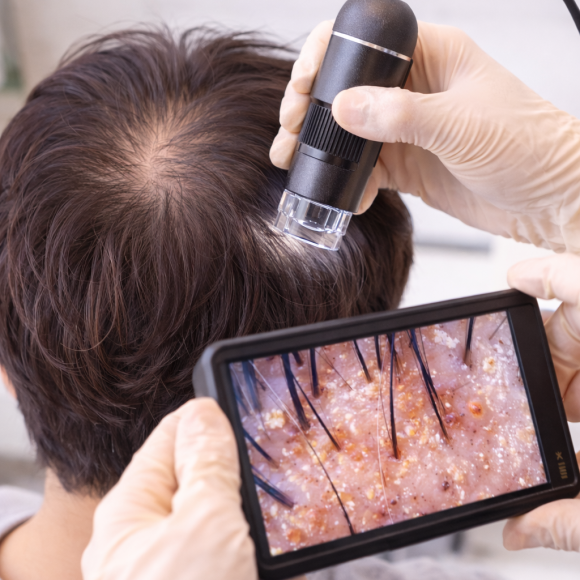
② Microscopic hair analysis (AI microscope)
In the next step,
the scalp is magnified and examined.
What is checked here is not simply “hair amount,” but
In particular, female hair loss is often first discovered at this stage.
That is because although things may look fine on the surface, the hair may already be thinning.
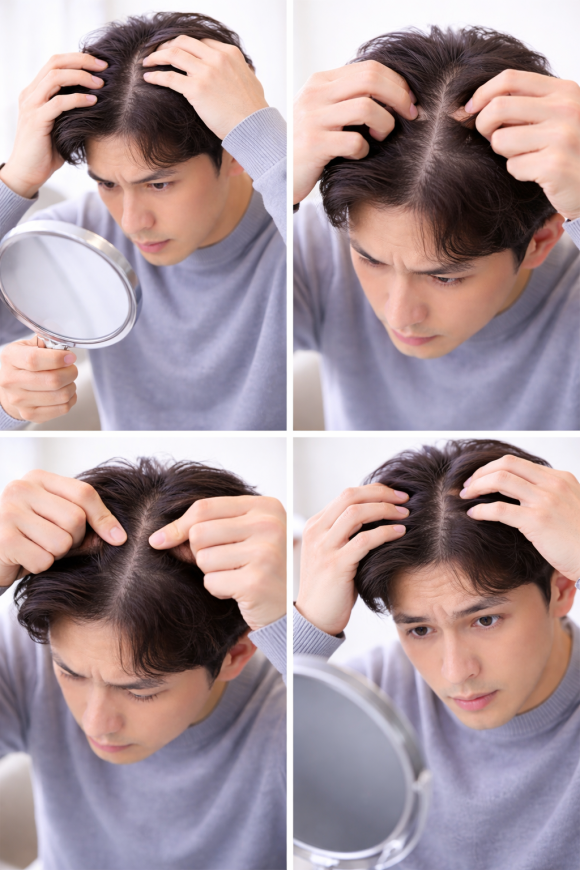
③ Cause assessment (stress and lifestyle factors)
Next is the stage of looking at “why the hair loss occurred.”
For female hair loss, this cause analysis is very important.
Even when it looks like the same kind of hair loss, the treatment can be completely different depending on the cause.
④ Final diagnosis by a specialist
In the final stage,
all the previous data is combined.
What is determined here is not a simple diagnosis, but
At this stage, it is decided whether a hair transplant is needed.

Why Is This Process Necessary?
If this process is not carried out, the following problems can occur.
In particular, women often have diffuse thinning hair loss, so simple transplantation may not be enough to solve the problem.
The Core of the Female Hair Loss Examination Is “Distinguishing”
The core of the examination is one thing.
“What kind of hair loss is this?”
-
Progressive hair loss
-
Temporary hair loss
-
Hormonal influence
-
Stress-related influence
This must be distinguished in order to determine the treatment direction.
| Stage | What is done | Meaning |
|---|
| Stage 1 | 3D scalp imaging | Record the current condition |
| Stage 2 | AI hair analysis | Check thickness and density |
| Stage 3 | Cause assessment | Stress and hormones |
| Stage 4 | Specialist diagnosis | Determine treatment direction |
The most important thing in hair loss is not “how quickly you start treatment,” but
“how accurately you begin.”
Female hair transplant surgery is a treatment that can change the result, but an examination is the process that determines the direction.
If you accurately understand your current condition through an examination and choose the right treatment, the results will naturally follow.
Now it is time for hairhair, Kim Jin-oh.
Pilsaengsinmo (必生新毛).
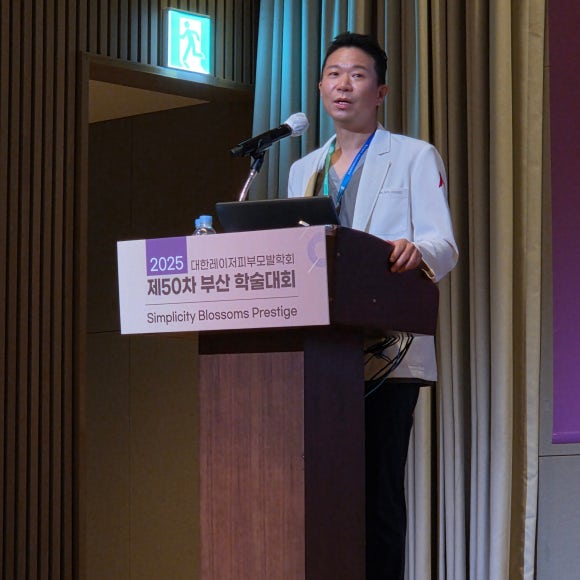
Written by: Kim Jin-oh of New Hair Plastic Surgery (Public Relations Director of the Korean Association of Plastic Surgeons / Academic Director of the Korean Society for Laser, Dermatology, and Hair)
Related posts you may find useful