Why does hair become thinner even when there is no family history?
This is a question I often hear from patients in their 20s and 30s in the clinic.
Many people think of hair loss as simply a genetic or stress-related problem, but in reality, there are not a few cases where the cause lies in a completely different direction.
Hair is one of the tissues in the body with the most active metabolism, so it acts like a “signal light” that reveals changes in overall health early.
In fact, a recent study analyzing more than 10,000 people found a significant association between early hair loss and the risk of diabetes¹.
The Relationship Between Diabetes and Hair Loss: A Summary
| Early hair loss before age 45 may be a sign of a metabolic disorder, not just simple genetics. |
|---|
| Hair loss patients have a 1.66-fold higher risk of diabetes and a 1.45-fold higher risk of impaired fasting glucose¹. |
| Insulin resistance worsens blood flow to hair follicles and promotes hair loss². |
| In particular, crown hair loss is more strongly associated with metabolic abnormalities². |
| If early hair loss has started, checking HbA1c is essential. |
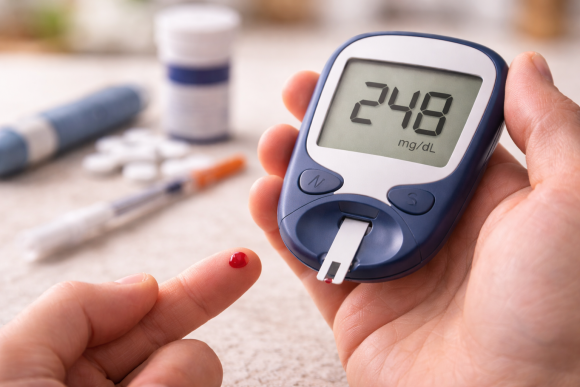
Why is hair loss connected to blood sugar?
When talking about hair loss, people often think only of male hormones, but behind it lies an important mechanism called “insulin resistance.”
When insulin resistance develops, the body’s ability to regulate blood sugar decreases, and blood insulin levels rise excessively.
If this state continues, microcirculation around the hair follicles decreases, and the environment needed for hair growth gradually worsens.
At the same time, excess insulin also stimulates androgen receptors and helps accelerate the progression of hair loss².
During this process, patients often ask:
If I take hair loss medication, could I develop diabetes?
To conclude, no.
So far, there is insufficient evidence that hair loss medications cause diabetes, and in fact, hair loss often progresses more quickly when blood sugar is not properly controlled.
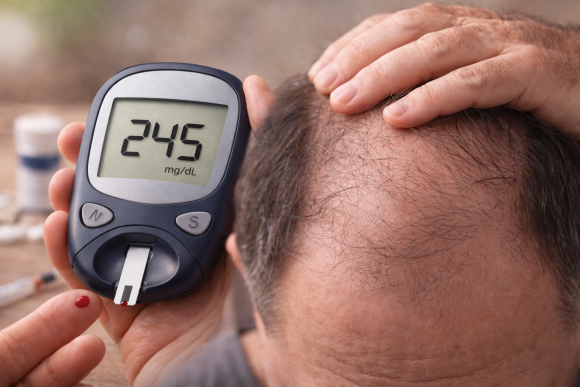
Risk increases confirmed in actual studies
The data make this relationship even clearer.
For hair loss patients under 45 years of age:
In addition:
These results mean that hair loss may not simply be an appearance-related issue, but rather an indicator reflecting metabolic abnormalities already in progress.
Similar questions also come up in the clinic.
If I control my blood sugar, can my hair become thicker again?
It is difficult to revive hair follicles that have already disappeared, but thinned hair still has enough potential to recover.
In fact, there are many cases in which hair thickness improves after dietary changes and blood sugar control.
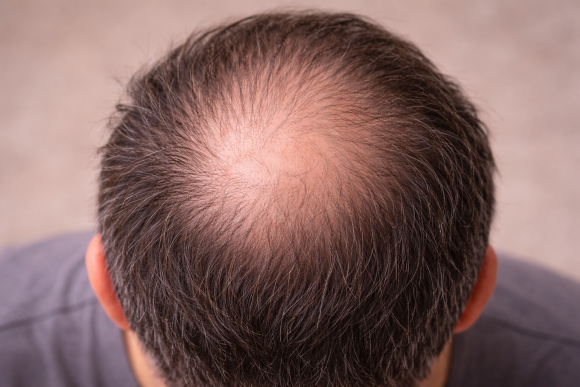
Why crown hair loss is more concerning
The location of hair loss is also an important clue.
In particular, studies have found that hair loss in the crown area is more closely related to insulin resistance and the risk of cardiovascular disease².
By contrast, M-shaped hair loss tends to be influenced more by hormonal factors.
Regarding this, there is something patients often wonder about.
Does the relationship between hair loss and diabetes also apply to Koreans?
Because the study subjects were based on an East Asian population, the results can be interpreted as sufficiently applicable to Koreans, who share similar dietary habits and genetic characteristics¹.
Why the treatment approach needs to change
Approaching hair loss only with medication or procedures has limitations.
In particular, for young hair loss patients, the overall physical condition must be checked as well.
At this point, another common question comes up.
Could metformin, a diabetes medication, also help with hair loss?
Metformin improves insulin sensitivity and reduces inflammation, so it has been suggested that it may have a positive effect on improving the scalp environment⁴.
However, it is not a first-line treatment for hair loss and must always be used under a specialist’s judgment.
Many people also worry about diet.
“Do I have to completely stop eating sugar for hair loss to stop?”
The key is not extreme restriction, but reducing refined carbohydrates that sharply raise blood sugar.
In other words, maintaining a low-glycemic-index diet is a more realistic and effective method.
| Question | Meaning | Recommended action |
|---|
| Crown hair loss before age 45 | Increased diabetes risk¹ | HbA1c test |
| Hair loss + abdominal obesity | Progressing insulin resistance | Improve diet |
| Fasting blood glucose 126 or higher | Entering the diabetic range | Active treatment |
| Hair loss after age 50 | Greater influence of aging | Focus on hair treatment |
Hair loss is no longer just an appearance issue.
Especially when it starts at a young age, it is highly likely to be an “early warning sign” sent by the body.
Rather than focusing only on protecting your hair, managing blood sugar and metabolic health together is a far more important long-term approach.
After all, hair is the first indicator that shows the health status of the entire body.
It is now time for hairhair, Kim Jino.
Pilsaengsinmo (必生新毛).

Written by: Kim Jino, New Hair Plastic Surgery (Public Relations Director, Korean Association of Plastic Surgeons / Academic Director, Korean Hair Research Society)
[References]
-
Zhu, L. et al. (2024). "Prevalence of Androgenetic Alopecia and Its Association with Cardiovascular Risk Factors in Southern China: A Population-Based Study." Journal of Dermatology. [cited: "Early-onset AGA may indicate DM risk in young and middle-aged adults."]
-
Ghouri, N. et al. (2020). "Androgenetic alopecia and risk of type 2 diabetes: a systematic review and meta-analysis." Diabetologia, 63(10), pp. 2092-2101. [cited: "Significant association between vertex baldness and DM risk in men."]
-
Vatankhah, N. et al. (2021). "Is androgenetic alopecia a marker for metabolic syndrome? A case-control study." International Journal of Trichology. [cited: "Metabolic syndrome parameters were significantly higher in AGA patients."]
-
Sharma, R. et al. (2022). "Metformin and its role in hair loss: A review of current evidence." Clinical and Experimental Dermatology. [cited: "Potential of insulin sensitizers in managing AGA."]