
Sneezing When You See Sunlight? It’s Not an Allergy, but the “photic sneeze reflex”
Some people experience sudden sneezing the moment they go outdoors and look at strong sunlight.
If there are no cold symptoms and no triggers such as dust or pollen, it is natural to suspect an allergy when it happens repeatedly.
However, this phenomenon occurs through a different mechanism from a typical allergic reaction.
In medical terms, it is called the “photic sneeze reflex,” and it is one of the neurological traits found in a relatively large number of people.
Why Do You Sneeze When You See Light?
There are complex networks of nerves in the human face that transmit various sensations.
Among them, the trigeminal nerve, which is responsible for sensation in both the eyes and the nose, plays a very important role.
When bright light enters the eyes, the optic nerve is stimulated, and as this signal is transmitted to the adjacent trigeminal nerve, it can also affect the nose.
During this process, even though there is no actual irritation inside the nose, the brain recognizes it as a stimulus and triggers a sneezing response.
Simply put, it can be seen as a kind of nerve misfiring in which stimulation of the eyes is incorrectly linked to a response in the nose.
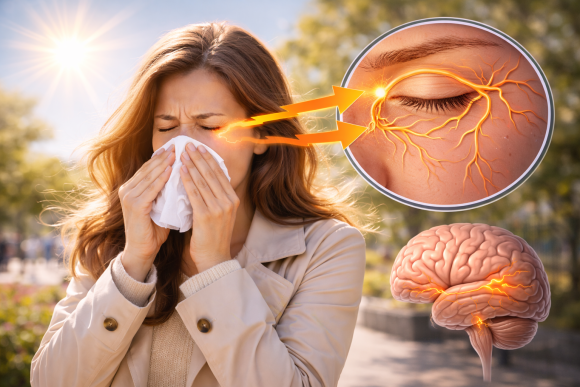
Difference from Allergies
The photic sneeze reflex is a completely different concept from allergies.
Allergies occur when the immune system overreacts to a specific substance, and symptoms such as a runny nose, nasal congestion, and itching often accompany sneezing.
By contrast, sneezing caused by sunlight happens independently of any external substance and appears only in certain situations.
In most cases, the symptom ends with sneezing alone, and there is no ongoing inflammatory or immune response involved.
How Common Is It?
This phenomenon is not as rare as you might think.
It is known to occur in about one in four people, and it is not uncommon for similar symptoms to appear among family members as well.
Because of this, a genetic influence has also been suggested.
In other words, it is more appropriate to understand it as a difference in a person’s nerve response pattern rather than as a specific disease.
Things to Keep in Mind in Daily Life
In most cases, it does not have a major impact on health, but caution may be needed depending on the situation.
In particular, when someone moves suddenly from a dark indoor space to a bright outdoor area, repeated sneezing can briefly obstruct their vision.
When driving or in situations that require concentration, even a small sneeze can become a risk factor, so it is important to be prepared in advance.
Wearing sunglasses or gradually adjusting to bright environments may help.

Is It a Symptom That Needs Treatment?
The photic sneeze reflex is not classified as a disease, so treatment is generally not necessary.
It does not cause any special complications, and in most cases it does not significantly interfere with daily life.
However, if the number of sneezes is excessively high or other symptoms appear along with them, it may be worth checking whether there is another cause, such as allergies or rhinitis.
The phenomenon of sneezing the moment you see sunlight is not due to an allergy, as is often misunderstood, but is a natural response that occurs during nerve transmission.
It happens when strong stimulation entering through the eyes also stimulates the nerves connected to the nose, and it is closer to a reaction based on an individual’s neurological structure.
For most people, it does not affect health, but because it can be uncomfortable in certain situations, it can help to understand your own pattern and adjust your environment accordingly.
Rather than something that needs treatment, it is more appropriate to accept this phenomenon as one of the ways the body responds to external stimuli.