A lot of people ask the same question about a month after getting a hair transplant.
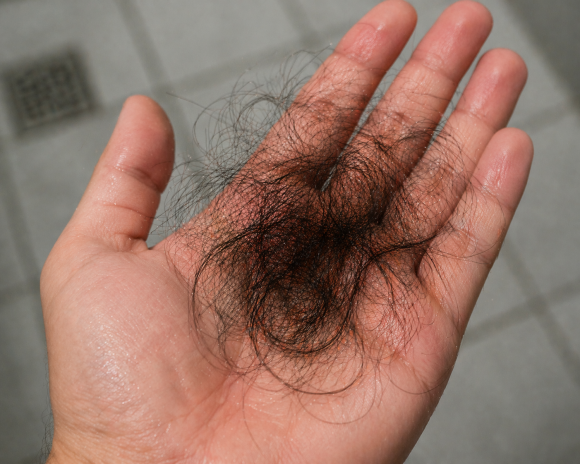
Doctor, the hair that wasn’t even transplanted is all falling out.
After making such a big decision to have surgery, it’s only natural to feel alarmed when it suddenly looks even thinner.
But this phenomenon is not a failure; in fact, it is highly likely to be a sign that recovery has begun.
After Hair Transplantation, Is Shock Loss a Failure? (Causes · Timing · How to Respond) Summary
| Shock loss, where existing hair falls out after a hair transplant, is a normal part of the recovery process. |
|---|
| It occurs because surgical stress temporarily puts hair follicles into the resting phase. |
| It usually begins between 2 and 6 weeks and most cases recover within 3 to 6 months. |
| The risk is about 30 times higher in women than in men¹. |
| If pain, inflammation, or pus is present, infection may be possible, so immediate medical attention is needed. |
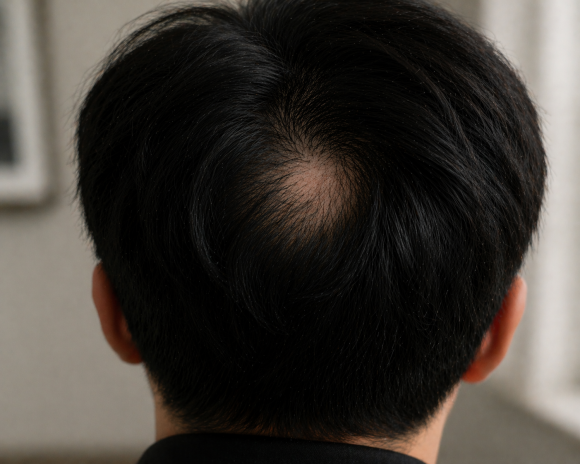
What Is Shock Loss?
Shock loss is medically called postoperative effluvium, a temporary telogen hair loss in the recipient area.
During surgery, tiny amounts of stress are applied to the scalp, causing nearby hair follicles to become stressed, stop the growth phase, and switch to the resting phase².
In simple terms, it means that “the follicles are resting for a while.”
Why Does Existing Hair Fall Out Too?
The transplant process is like a “construction project” for the scalp.
At this time, the existing hairs around the area respond to changes in the environment and shed.
Especially
Why It Is More Severe in Women
Recent research found that the risk of shock loss in female patients was about 30.18 times higher than in men³.
This is interpreted as being because women’s hair is relatively finer and more sensitive to hormonal changes.
-
2–6 weeks: shedding begins
-
4 weeks: the worst period (dark phase)
-
3 months: regrowth begins
-
6 months: most density recovers
-
1 year: final result is completed
At this stage, it is actually normal for it to “look even thinner than before surgery.”
How to Speed Up Recovery
Clinically, the three most important points are:
-
Continue taking hair loss medication → helps protect follicles
-
Use minoxidil → promotes the transition to the growth phase
-
Keep the scalp clean → helps prevent inflammation
In particular, medication treatment acts as a “shield” that protects the follicles.
| Condition | Assessment |
|---|
| Overall shedding 3–4 weeks after surgery | Normal shock loss |
| Redness of the scalp, pus, and pain | Suspected infection |
| Continued increase in shedding after 8 weeks | Possible progression of additional hair loss |
| Female + fine hair + crown | High-risk group |
| Widespread shedding extending to the occipital area | Possible stress-related hair loss |
Q1. After a hair transplant, can shock loss mean the hair may never grow back?
In most cases, it grows back.
If the follicles are alive, regrowth occurs within 3 to 6 months¹.
However, hair that had already been severely affected by hair loss may not recover.
Q2. Is it normal for a lot of hair to fall out when washing my hair after a hair transplant?
Yes, it is normal.
It simply means that hairs already in the shedding phase are falling out due to physical stimulation.
Shampooing itself does not cause hair loss.
Q3. How long does shock loss last?
It usually peaks around 4 weeks and recovery begins from about 3 months.
Most cases recover by 6 months.
Q4. Is there a way to prevent shock loss?
Complete prevention is difficult, but finasteride/dutasteride and oral minoxidil can greatly reduce the recovery time²
Q5. Why do women shed more hair?
Women’s hair is finer and more sensitive to hormonal changes, so they respond more strongly to surgical stress³
Q6. Is it okay to diet during the shock loss period?
It is not recommended.
Hair follicle recovery requires sufficient nutrition, and if energy intake is insufficient, shedding may become more severe.
Q7. What is the difference between transplanted hair shedding and shock loss?
Transplanted hair shedding → the transplanted hair falls out (normal process)
Shock loss → existing hair falls out
In both cases, most hair grows back.
Q8. Is it okay to wear a hat?
If it has been 2 weeks since surgery, there is no problem.
However, a loose hat with good ventilation is recommended.
Shock loss is the most anxious period for patients.
But medically speaking, it is one of the most normal recovery processes.
The follicles are alive; they are simply resting for a while.
If you get through this period well, you will face a completely different result 3 months later and 6 months later.
What matters most is “care and time,” not anxiety.
Now it’s time for hairhair to grow, this was Kim Jin-oh.
May new hair be born (必生新毛).

Written by: Kim Jin-oh of New Hair Plastic Surgery (Public Relations Director, Korean Association of Plastic Surgeons / Academic Director, Korean Association of Laser Dermatology and Hair)
References
-
Kerure, A.S. and Patwardhan, N., 2018. Complications in Hair Transplantation. Journal of Cutaneous and Aesthetic Surgery, 11(4), pp.182-189. cited: "Shock loss is a temporary phenomenon... reassurance and counseling of the patient is vital."
-
Garg, A.K. and Garg, S., 2021. Complications of Hair Transplant Procedures—Causes and Management. Indian Journal of Plastic Surgery, 54(04), pp.477-482. cited: "Pre-existing miniaturized hairs are especially vulnerable to surgical stress-induced effluvium."
-
Okochi, H. et al., 2024. An Analysis of Risk Factors of Recipient Site Temporary Effluvium After Follicular Unit Excision. Aesthetic Plastic Surgery. cited: "Female sex showed a remarkably higher risk for shock loss with an odds ratio of 30.18."
-
ISHRS, 2024. Telogen Effluvium: A Guide to Temporary Hair Loss. [Online] Available at: https://ishrs.org/telogen-effluvium/ [Accessed 19 Feb 2026].