
Cold That Won’t Go Away? Yellow Nasal Discharge and Postnasal Drip Symptoms: Sinusitis
In most cases, a cold naturally recovers within about a week.
�
However, if symptoms continue for more than 10 days or seem to get worse, the situation is different.
�
In particular, if nasal discharge becomes thick and darker in color, and you feel facial pain or pressure along with nasal congestion, it may have progressed beyond a simple cold.
�
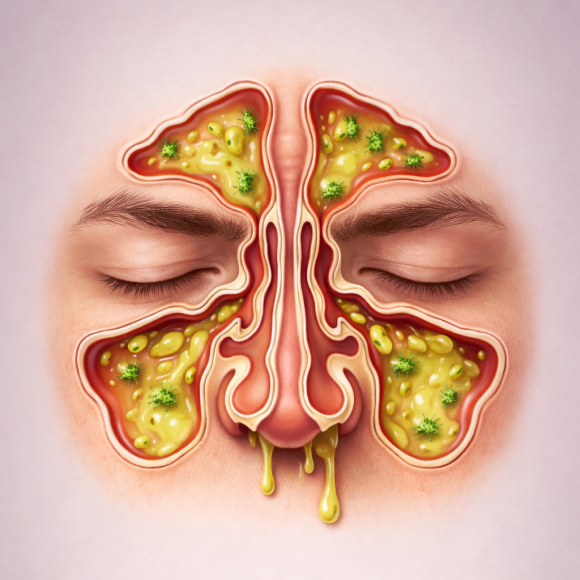
This is commonly called “sinusitis,” but more precisely, it refers to inflammation in the sinuses, the air-filled spaces around the nose.
Why Does Sinusitis Develop?
There are air-filled spaces around the nose called the “sinuses.”
�
When the nasal lining swells due to a cold or allergies, the openings that drain these spaces can become blocked, creating an environment where secretions collect and bacteria can multiply easily.
�
As a result, inflammation develops and pus-like nasal discharge forms.
�
In other words, the cold itself is not the direct cause; the blocked structure caused by the cold is the starting point of the problem.
If You Have These Symptoms, Suspect It
Sinusitis can be identified by the following characteristic symptoms.
�
-
Nasal discharge turns yellow or green
-
An unpleasant smell comes from the nose
-
Nasal discharge runs down the back of the throat and causes coughing
-
Severe nasal congestion, sometimes on just one side
-
A dull, heavy pain in the forehead, around the eyes, or in the cheeks
-
Symptoms are especially worse in the morning
�
In particular, “postnasal drip,” where nasal discharge runs down the back of the throat, is one of the main symptoms many people find uncomfortable.
�
This is also why you may feel like there is something stuck in your throat or keep clearing your throat.
How Are a Cold and Sinusitis Different?
The biggest difference between a cold and sinusitis is the duration and the nature of the nasal discharge.
�
-
Cold: Clear nasal discharge �> gradually decreases �> improves within 7 days
-
Sinusitis: Thick, darker-colored nasal discharge �> gradually worsens �> lasts more than 10 days
�
Also, while a cold is centered on systemic symptoms such as fever and body aches, sinusitis is more notable for localized symptoms around the nose and face.

How Is It Treated?
If it is mild, it may improve with enough rest, fluid intake, and warm steam inhalation alone.
�
However, if symptoms last a long time or the pain is severe, medical treatment is needed.
�
In general, the following treatments may be used.
�
-
Antibiotics: When a bacterial infection is suspected
-
Nasal spray: To reduce swelling of the lining
-
Mucolytics: To help discharge nasal mucus
�
The important point is not to hold in the nasal discharge but to help it drain properly.
�
Rather than simply putting up with a cold that lasts a long time, it is important to watch for changes in symptoms.
�
If the color of the nasal discharge changes, it smells bad, or the feeling of it going down the back of the throat continues, it may be more than a simple cold.
�
Sinusitis can improve relatively easily if managed early, but if left untreated, it can become chronic.
�
Therefore, if cold symptoms do not improve for more than 10 days, it is a safe choice to get professional medical care at least once.