People diagnosed with polycystic ovary syndrome are often most confused by one thing: ‘hair.’
This is because unwanted body hair increases, while at the same time scalp hair becomes thinner and falls out, creating a contradictory situation.
Until now, the rate of hair loss had been known to be around 30–50%, but recent studies have reported much higher figures, changing the way it is viewed¹.
Now, it needs to be seen not as a simple hormonal disorder, but as an issue connected to overall metabolic health.
Is Hair Loss in Polycystic Ovary Syndrome Really 83%? Summary
| In a study of patients with polycystic ovary syndrome (PCOS), the rate of hair loss was reported to be as high as 83%¹. |
|---|
| Metabolic status such as LDL cholesterol may be a stronger factor than simple hormone levels¹. |
| At age 30 or older, and with hirsutism, the risk of hair loss increases by more than twofold². |
| Lack of sleep and smoking are factors that each increase the risk of hair loss by about 1.9 times⁴. |
| Hair loss should be approached not as an appearance issue, but as a signal of an overall metabolic imbalance in the body. |
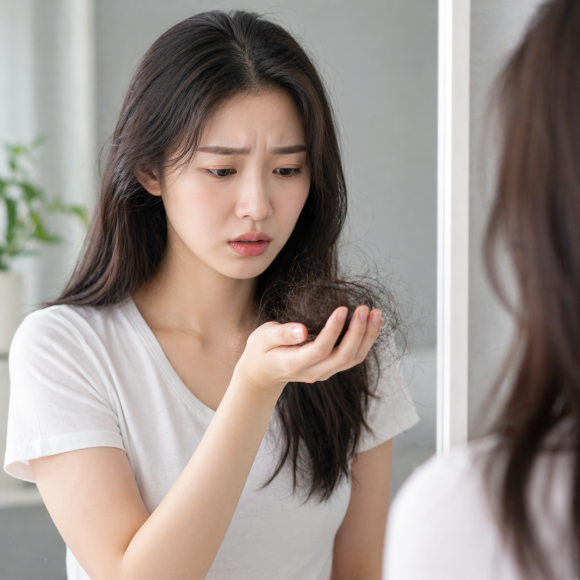
Is hair loss in polycystic ovary syndrome really as high as 83%?
In a recent study, 83% of patients with polycystic ovary syndrome were reported to have androgenetic alopecia¹.
This may be a result that appears high depending on the specific environment or patient group, but the important message is clear.
“Far more patients than expected are experiencing hair loss.”
In clinical practice as well, the proportion of patients complaining of reduced hair volume is quite high, and female pattern hair loss that spreads around the crown is commonly observed.
Key cause: follicular miniaturization + metabolic issues
The essence of hair loss is ‘follicular miniaturization.’ Over time, hair follicles gradually become smaller, thick hairs become thinner, and eventually disappear³.
What is especially noteworthy is that the main cause of hair loss may not simply be “male hormone levels.”
Recent studies have found that
-
The direct correlation between blood androgen levels and hair loss is limited
-
Instead, LDL cholesterol acts as an independent risk factor¹
In other words,
Normal hormone levels → no hair loss ❌
Poor metabolic status → hair loss progresses ⭘
That is the key structure.
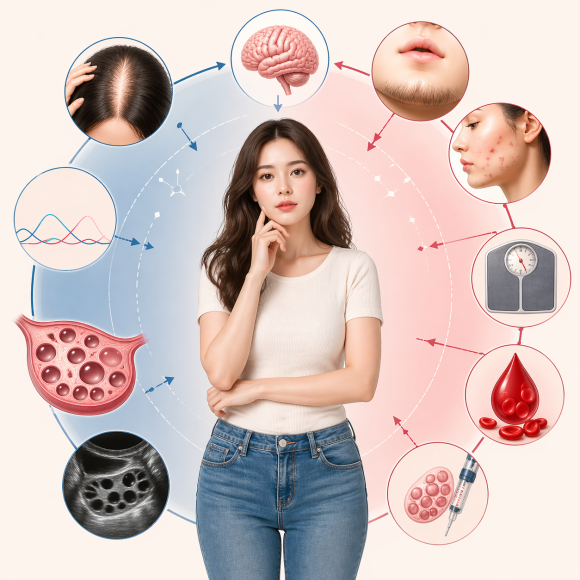
Four variables that increase the risk of hair loss
The high-risk factors commonly confirmed in research and clinical practice are as follows.
Risk factor Impact
-
Age 30 or older: hair loss risk increases by about 2.3 times²
-
With hirsutism: hair loss risk increases by about 2 times
-
LDL ≥130 mg/dL: a strong independent risk factor¹
-
Lack of sleep / smoking: risk increases by about 1.9 times each⁴
In particular, sleep and smoking are important because they are variables that also reduce treatment effectiveness.
Why does cholesterol affect hair?
LDL cholesterol goes beyond a simple blood vessel problem and
-
causes inflammation in small blood vessels
-
reduces the supply of oxygen and nutrients around hair follicles
-
impairs cellular metabolic function
As a result, hair follicles enter an environment where it is difficult to grow, and hair loss progresses.
In other words, hair loss is not a scalp problem, but the result of a “systemic metabolic problem.”
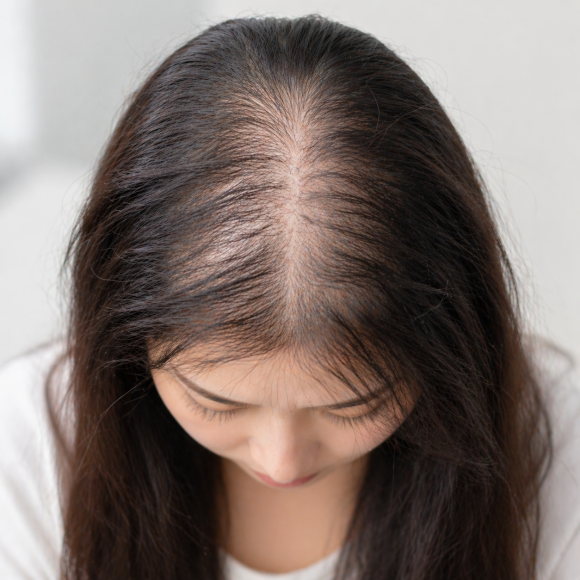
Q1. If you have polycystic ovary syndrome, is hair loss almost inevitable?
A. It is not inevitable, but studies have reported rates as high as 83%, so the frequency is very high¹.
If early symptoms are present, early intervention is important.
Q2. Why does hair loss occur even when hormone levels are normal?
A. The follicle’s ‘hormone sensitivity’ and metabolic factors such as LDL may have a greater effect¹.
Q3. If you have hirsutism, does hair loss become worse too?
A. Yes. It means androgen responsiveness is high, and the risk of hair loss increases by about 2 times.
Q4. If LDL cholesterol is lowered, does hair loss improve too?
A. It is not a direct treatment, but it can help by improving the follicular environment and slowing the progression of hair loss.
Q5. Does lack of sleep really affect hair loss?
A. Sleep is recovery time for hair follicles. If sleep is insufficient, the risk of hair loss increases by about 1.9 times⁴.
Q6. How much does smoking affect hair loss?
A. It is an important worsening factor that reduces scalp blood flow and even lowers treatment response.
Q7. Can weight loss help improve hair loss?
A. More important than BMI itself is improving LDL through weight loss.
Q8. Where is the best place to start treatment?
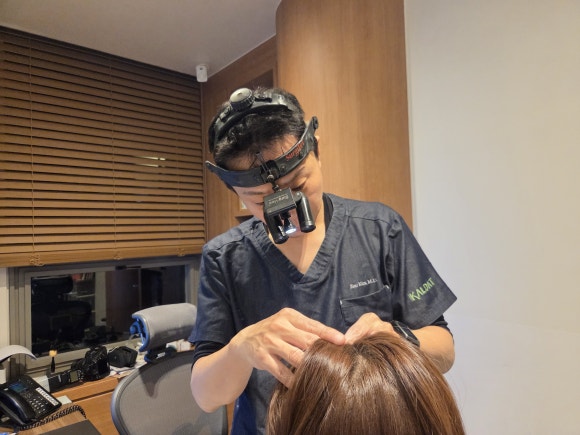
A. The most effective approach is to combine obstetrics and gynecology, internal medicine (metabolism), and hair-loss specialist care.
Hair loss in polycystic ovary syndrome is not simply a matter of hair falling out.
It is the result of a complex interplay of hormones, metabolism, and lifestyle.
The especially important points are as follows.
-
If you judge hair loss based only on hormone levels, you may miss the real cause
-
Lifestyle factors such as LDL, sleep, and smoking may be more important
-
Hair loss is already a ‘warning sign’ the body is sending
Therefore, the direction of treatment must also change.
Rather than an approach that only says “take medicine,” a strategy that addresses “metabolism + lifestyle habits + hair treatment” at the same time is needed.
Now it’s time for hairhair, Kim Jin-oh.
May new hair grow for life (必生新毛).
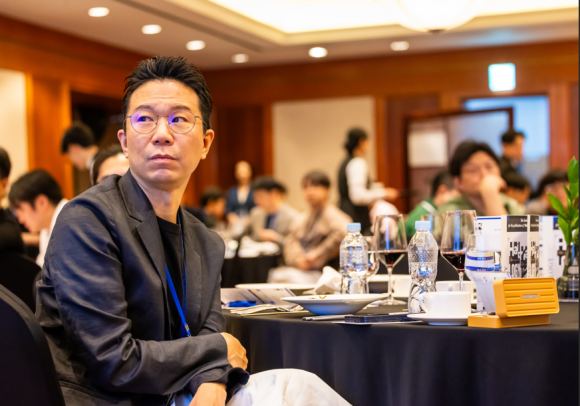
Written by: Kim Jin-oh of New Hair Plastic Surgery (Public Relations Director, Korean Society of Plastic and Reconstructive Surgeons / Academic Director, Korean Society of Laser Dermatology and Hair)
References
-
Hasan, F., Ahmed, N., Malik, T., ul Bari, A., Memon, U. and Ashraf, U. (2026). Frequency of androgenic alopecia in patients presenting with polycystic ovarian syndrome at tertiary care hospital Karachi. Journal of Pakistan Association of Dermatologists, 36(1), pp.10-15. cited: "Among 135 participants, 112 (83%) had androgenic alopecia... Elevated LDL was an independent predictor"
-
Starace, M., Orlando, G., Alessandrini, A. and Piraccini, B.M. (2020). Female androgenetic alopecia: an update. American Journal of Clinical Dermatology, 21(1), pp.69-84. cited: "Starace et al. also emphasized age as a key determinant of female pattern hair loss severity."
-
Bienenfeld, A., Azarchi, S., Lo Sicco, K., Marchbein, S., Shapiro, J. and Nagler, A.R. (2019). Androgens in women. Journal of the American Academy of Dermatology, 80(6), pp.1497-1506. cited: "noted that progressive follicular miniaturization increases with age"
-
Qiu, Y., Yin, C., Huang, Y., Zhang, X., Li, J., Wang, H. et al. (2022). Association of androgenetic alopecia with metabolic syndrome: a systematic review and meta-analysis. Acta Dermato-Venereologica, 102(4), pp.adv1012. cited: "highlighted that lifestyle-related stressors contribute to the worsening of androgenetic alopecia"
Related posts you may also like