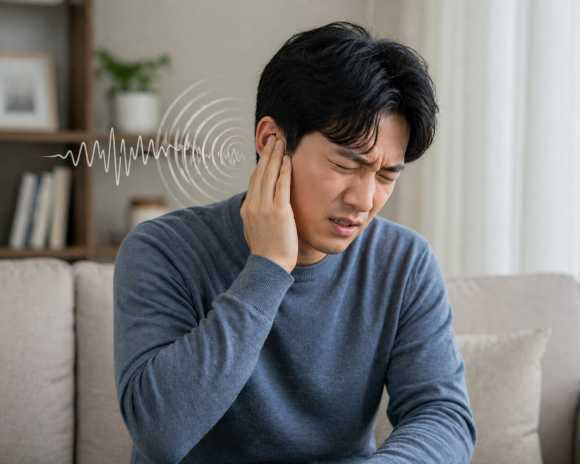
Buzzing or Beeping in the Ear? Tinnitus Symptoms and Causes?
Have you ever heard a sound like a “beep” or “static” in your ear when you were in a quiet place?
This sound may feel like an insect is chirping, or it may continue like an electronic noise. Many people experience this symptom at least once.
Medically, this is called “tinnitus,” and it refers to a state in which sound is perceived inside the ear or head even though there is no actual sound coming from outside.
It can appear temporarily due to simple fatigue, but if it recurs or lasts for a long time, it is important to understand and manage the cause accurately.
Why does tinnitus happen?
Tinnitus does not occur for just one reason.
The most common cause is an abnormality in the auditory system.
The ear is not just an organ for hearing sound; it is a complex sensory system connected to the brain.
If a problem occurs anywhere in this process, the brain may create sound even when there is no actual sound.
In particular, damage to the inner ear (cochlea) is considered a major cause.
When the tiny hair cells that detect sound are damaged, the brain recognizes this as a “lack of signal” and creates a phantom sound as compensation.
Because of this, tinnitus is often felt more strongly when it is quiet.
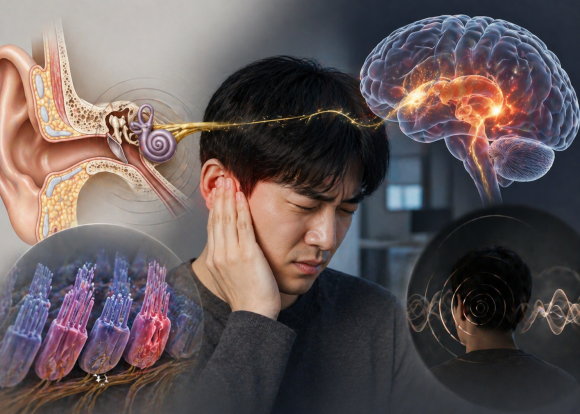
The most common causes of tinnitus
Noise exposure
Listening to earphones at high volume or being exposed to loud environments for a long time can damage hair cells and cause tinnitus.
Stress and fatigue
This is a very common cause in modern life. Stress destabilizes the autonomic nervous system and worsens tinnitus symptoms.
Blood circulation problems
If blood flow around the ear is not smooth, a pulsatile tinnitus that sounds like a “hum” may appear.
Ear diseases (otitis media, eustachian tube dysfunction, etc.)
If there is a problem with the structure inside the ear, sound may occur due to changes in pressure.
Aging (presbycusis)
As people get older, auditory cells naturally decrease, and tinnitus often appears along with this.
When you should be especially careful with tinnitus
If the following apply, it is best not to dismiss it as a simple symptom.
-
If it is heard continuously in only one ear
-
If the sound gradually becomes louder or happens more often
-
If dizziness or hearing loss occurs together
-
If a “thumping” sound matches the pulse
These symptoms may not be simple tinnitus, but rather a sign of another disease.

Can tinnitus be treated?
For tinnitus, managing and controlling it is more important than treatment that completely makes it “go away.”
Typical methods include the following.
-
Sound therapy (white noise)
-
Instead of a quiet environment, provide a steady background sound to reduce awareness of tinnitus.
-
Stress management
-
Stabilizing the autonomic nervous system through meditation, improved sleep, and similar measures
-
Medication
-
Aimed at symptom relief, such as circulation-improving agents and tranquilizers
-
Using hearing aids
-
Effective when hearing loss is also present
Tinnitus, such as a “beeping” or “buzzing” sound heard in the ear, may be more than a simple inconvenience; it can be a signal that your body is sending.
Especially if it recurs or affects daily life, it is important to check the cause rather than just endure it.
Most tinnitus is not a life-threatening condition, but if left untreated, it can lead to stress and sleep disturbances.
Therefore, identifying the cause early and improving lifestyle habits is the most practical solution.
Remember that “not hearing sound is normal,” and not missing even small changes coming from your ears is the first step in protecting your health.