Many people suffer from sneezing, runny nose, and nasal congestion every spring.
Rhinitis is often thought of as only a condition that makes the nose uncomfortable, but recent studies suggest that it can also affect scalp and hair health through systemic immunity and inflammatory responses.
In actual consultations, it is quite common to see chronic rhinitis patients who also complain that their hair has become thinner or that the volume at the crown has decreased.
What was once considered a simple coincidence has now been supported by a large cohort study showing that patients with allergic rhinitis have a significantly increased risk of androgenetic alopecia¹.
So how are rhinitis and hair loss connected?
And can commonly used antihistamines really help protect hair?
Does Having Rhinitis Increase Hair Loss Risk by 1.8 Times? Summary of the Relationship Between Allergies and Hair Loss
| A study reported that patients with allergic rhinitis have about 1.81 times higher risk of androgenetic alopecia.¹ |
|---|
| Inflammatory substances increased by rhinitis and prostaglandin D2 (PGD2) may interfere with the hair follicle growth cycle.² |
| The group that took antihistamines consistently had up to a 77% reduction in hair loss risk.¹ |
| The hair-loss-preventive effect of rhinitis treatment was especially greater in younger people under 30.¹ |
| Rhinitis, which is often thought of as only a simple nasal condition, can actually affect the systemic immune environment and scalp health. |
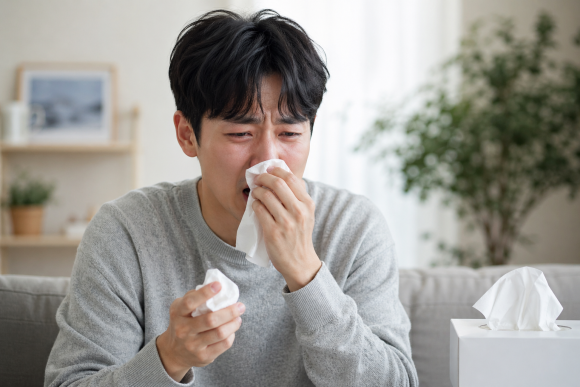
Why does rhinitis increase the risk of hair loss?
Allergic rhinitis is not simply a condition in which the nasal mucosa swells.
It can be viewed as a state in which the body's immune system reacts excessively and various inflammatory substances are released.
A substance that plays an important role here is prostaglandin D2 (PGD2).
This substance increases when an allergic reaction occurs, and the problem is that it also acts to inhibit hair growth on the scalp.²
In scalps where hair loss was progressing, PGD2 levels were measured to be much higher than in normal scalps, and this substance shortens the hair follicle growth phase and brings on the resting phase earlier.²
In other words, if inflammatory reactions in the body are repeated because of rhinitis:
-
the immune balance is disrupted
-
inflammatory mediators increase
-
microinflammation of the scalp worsens
-
and the environment for hair follicle growth is more likely to deteriorate.
In a study involving about 540,000 people published in 2026, the risk of androgenetic alopecia in patients with allergic rhinitis was 1.81 times higher than in the general population.¹
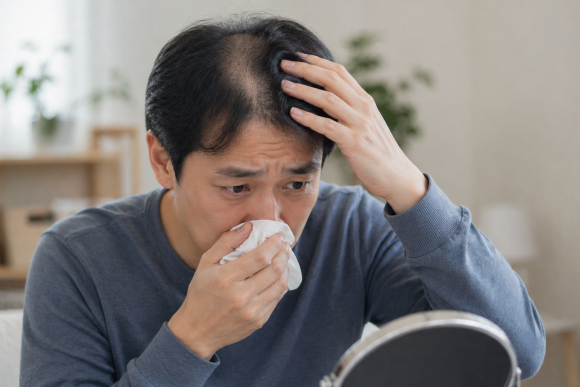
Can rhinitis medication really help prevent hair loss?
This is where things get interesting.
In the study, the risk of hair loss was significantly reduced in rhinitis patients who took antihistamines consistently.¹
In particular, in the group taking second-generation antihistamines, the hair loss risk index dropped to as low as 0.23.¹
Simply put, this means that the group that received consistent rhinitis treatment had a significantly lower likelihood of developing hair loss.
For cetirizine and levocetirizine in particular, a mechanism has been reported in which they not only suppress allergy symptoms but may also reduce PGD2, which is associated with hair loss, and increase PGE2, which may help hair growth.³
In other words, rhinitis treatment may not only control nasal symptoms but also stabilize the inflammatory environment around the hair follicles.
The more consistently the medication was taken, the greater the effect
One especially notable part of this study was the dose-dependent effect.¹
In other words, the protective effect was stronger in patients who managed their condition consistently than in those who took medication only occasionally.
In the study, the hair loss risk index dropped to 0.12 in the group with higher cumulative medication use.¹
This is something that also feels familiar in actual practice. People with severe rhinitis who keep putting off treatment often also complain of:
-
scalp itchiness
-
increased sebum
-
scalp sensitivity
-
thinning hair
On the other hand, many patients also say that when their rhinitis is well controlled, their scalp condition improves as well.
It was especially effective in younger people
It is also important that the protective effect of antihistamines was strongest in those under 30.¹
Hair follicles at a younger age still have relatively strong recovery ability, so they are more sensitive to changes in the immune environment.
So:
-
do not leave rhinitis untreated
-
detect early signs of hair loss quickly
-
control scalp inflammation
These can become far more important management points than many people expect.
Many people think, “Rhinitis is just how I am,” but repeated chronic inflammation can affect the body in surprisingly diverse ways.
| Situation | Research finding | Management direction |
|---|
| Chronic rhinitis, but no hair loss yet | Hair loss risk increases 1.81 times¹ | Reduce the inflammatory environment by consistently managing rhinitis itself |
| Under 30 + early hair loss | Strong risk-reduction effect when using antihistamines¹ | Combine rhinitis treatment with early hair loss management |
| Taking rhinitis medicine only when needed | Protective effect may decrease | Consult a specialist about a long-term management plan |
| Taking cetirizine-class medication | Possible reduction in PGD2 and increase in PGE2³ | Expect stabilization of the scalp environment |


Q1. If rhinitis is severe, can hair really fall out?
A. Yes, it is possible.
Recent studies have shown that the risk of androgenetic alopecia is significantly higher in patients with allergic rhinitis.¹
In particular, if chronic inflammatory responses continue, microinflammation of the scalp and stress on hair follicles can increase.
Q2. Does taking rhinitis medication for a long time help prevent hair loss?
A. The study confirmed a hair-loss-reducing effect in the group that took antihistamines consistently.¹
However, taking it on your own for the purpose of treating hair loss is not recommended, and specialist consultation is definitely needed.
Q3. Which rhinitis medicines are related to hair loss?
A. Cetirizine and levocetirizine are representative examples.
These ingredients have been reported to reduce PGD2, which is associated with hair loss, and may increase PGE2, which is related to hair growth.³
Q4. If rhinitis improves, will hair loss be completely restored too?
A. Not necessarily.
Genetics and hormones have a very large influence on hair loss.
However, there is certainly a possibility that managing rhinitis can help reduce worsening of the follicular environment.
Q5. Does this also apply to women with rhinitis?
A. Yes. The study showed a similar trend regardless of sex.¹
Female pattern hair loss can also be affected by scalp inflammation and the immune environment.

Rhinitis and hair loss may seem like completely different conditions, but in reality they may influence each other through a common link: immunity and inflammation.
In particular, chronic allergic rhinitis is not just a matter of nasal symptoms; it can disrupt the body's overall immune balance, and that effect can extend to the scalp and hair follicles.
Of course, rhinitis treatment alone will not completely solve hair loss.
But if you are undergoing hair-loss treatment while leaving rhinitis untreated, the follicular environment may continue to be exposed to inflammatory stress.
If:
- rhinitis has lasted a long time
- hair has recently become thinner, or
- you have noticed reduced volume at the crown
it would be better not to dismiss it as a simple seasonal issue and to check the scalp and immune environment together.
Now it's time for hairhair, Kim Jin-oh.
Pilsaengsinmo (必生新毛).
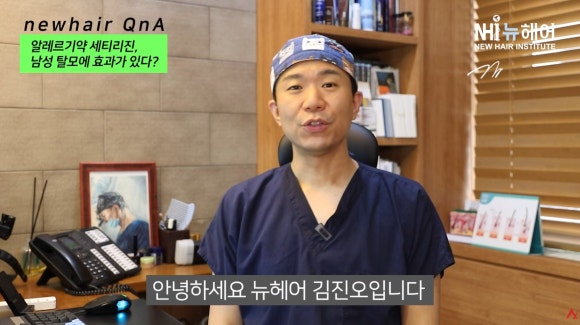
Written by: Kim Jin-oh, New Hair Plastic Surgery (Public Relations Director, Korean Society of Plastic and Reconstructive Surgeons / Academic Director, Korean Society for Laser Dermatology and Hair Restoration)
[References]
-
Zhang, H.W. et al. (2026) 'Androgenetic alopecia risk in allergic rhinitis: A cohort study of immune and antihistamine effects', World Allergy Organization Journal, 19(5), 101373. cited: "AR patients had a higher risk of AGA (adjusted hazard ratio [aHR]: 1.81, 95% confidence interval [CI]: 1.69-1.93, $p<0.001$). Among AR patients, sgSHs users had a lower risk of AGA than nonusers (aHR: 0.23, 95% CI: 0.20-0.26)."
-
Garza, L.A. et al. (2012) 'Prostaglandin D2 inhibits hair growth and is elevated in bald scalp of men with androgenetic alopecia', Science Translational Medicine, 4(126), pp. 126-134. cited: "Prostaglandin D2 inhibits hair growth and is elevated in bald scalp of men with androgenetic alopecia."
-
Bassiouny, E.A. et al. (2023) 'Comparison between topical cetirizine with minoxidil versus topical placebo with minoxidil in female androgenetic alopecia', Archives of Dermatological Research, 315, pp. 1293-1304. cited: "Preclinical investigations indicate that cetirizine may diminish $PGD_{2}$ expression while elevating $PGE_{2}$ levels."
Related posts you may also like