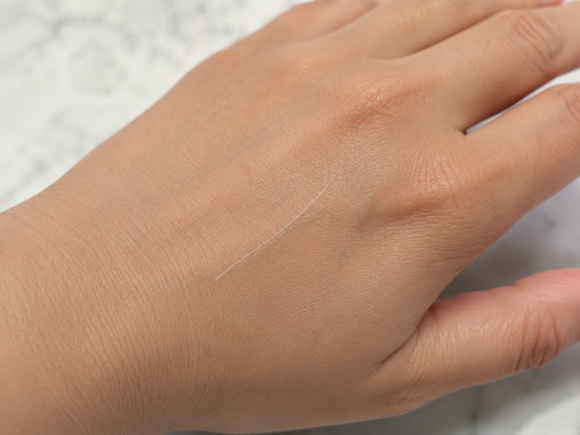
Why You Suddenly Grow a Long White Hair on Your Body
Sometimes one or two especially long, white hairs grow in areas we usually do not pay much attention to, such as the arms, shoulders, chest, abdomen, or around the neck.
If a white hair appears mixed in with black body hair, or a long white hair suddenly grows in a place that mostly had fine downy hair, you may wonder, “Could something be wrong with my body?”
However, in most cases, a long white hair or two on the body is closer to a natural phenomenon related to changes in hair follicle pigment, differences in the hair growth cycle, hormonal effects, aging, or genetic traits rather than a serious disease.
Hair is not just a thread-like structure visible outside the skin; it is made and grown in the hair follicle under the skin and goes through a process of taking on color.
If any part of this process changes, the color, thickness, and length of the hair can also change.
Why do white hairs appear? The key is “melanin pigment.”
Hair color is mainly determined by a pigment called melanin.
Black scalp hair or body hair appears dark because melanin is produced sufficiently inside the hair follicle and the pigment is delivered well to the hair.
Conversely, when melanin production decreases or is not delivered well, the hair becomes closer to gray, silver, or white.
In other words, when white body hair appears, it means the function of producing pigment in that hair follicle has weakened temporarily or permanently.
It is similar to the way scalp hair turns gray with age.
However, because body hair is usually observed less often than scalp hair, it can feel as if it appeared out of nowhere one day.
White hair is especially easy to notice compared with the surrounding black hair.
In many cases, it was already there before, but it is only discovered later because the color is lighter and the hair has grown longer.
Studies related to gray hair also explain that white or gray hair is associated with a decrease in melanin, and that some white hairs can feel thicker and stiffer than black hairs.
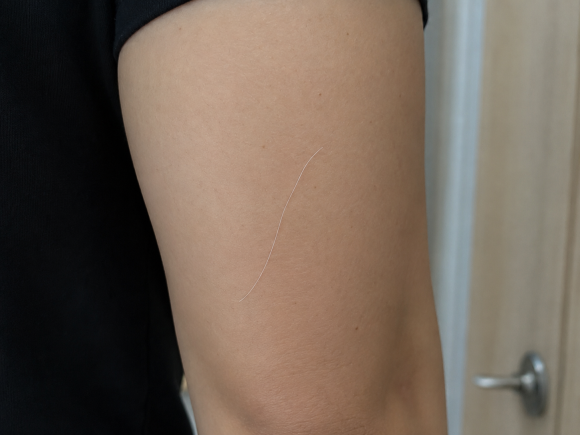
Why does it grow “long” in particular? Because each hair has a different growth period
Not all body hair grows at the same speed or to the same length.
Hair goes through cycles called the growth phase, regression phase, and resting phase. The longer the growth phase, the longer the hair can grow and, as a result, the longer it may become.
For example, scalp hair can grow long because its growth phase is long, while eyebrows and eyelashes do not grow beyond a certain length because their growth phase is short.
Body hair also has different growth periods depending on the area. Some follicles produce only short downy hair, while others can produce thicker and longer hair.
So when one or two long white hairs grow on the body, it may be because the hair follicle in question has a slightly longer growth phase than the surrounding follicles, or because it tends to produce thicker hair.
In simple terms, even within the same area of skin, each follicle has a slightly different nature. Some follicles produce short hairs, while others can produce hairs that grow longer.
Among body hair, thick and long hairs are medically closer to terminal hair, while short and fine hairs are closer to vellus hair.
After puberty, hormonal changes can cause some vellus hairs to change into thicker and longer hairs, and this is also why hair length and thickness differ by area.
Is it common for only one strand to turn white?
Yes, it is common. When one or two hairs grow long in a specific area rather than white hair spreading widely across the whole body, it is usually considered a localized change in the hair follicle.
Each hair follicle functions independently.
In some follicles, the function of pigment cells may decline first, while other follicles may still produce black hair.
So within the same arm, some hairs can be black, some white, and some especially long.
These changes do not necessarily mean there is a problem with the health of the whole body.
Just as a few white scalp hairs may appear first, hair without pigment may also appear first in certain follicles on the body.
In particular, if there are family members who developed gray hair or white body hair early, genetic influence may also be considered.
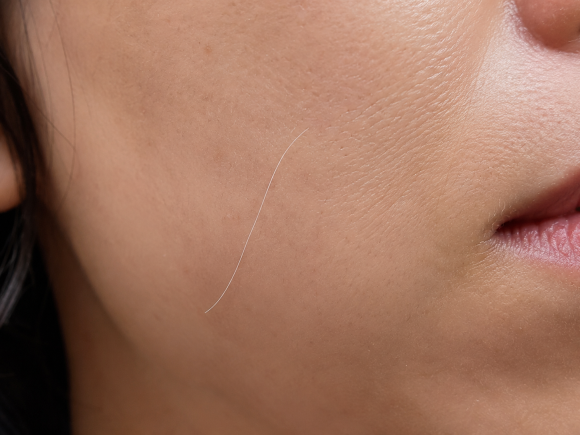
Can I pluck it? Will more grow if I do?
Plucking one or two white hairs does not cause more white hairs to grow around them.
The saying that “if you pluck one white hair, two or three more will grow” is not medically correct.
Usually, one hair grows from one follicle, so plucking it does not turn nearby follicles white.
However, repeated plucking can irritate that follicle.
If the area is sensitive, folliculitis, redness, or hyperpigmentation can occur, so trimming the hair short is safer than plucking it often.
In particular, if the area around the hair is swollen, painful, or has pus, it is best to avoid plucking.
The reason a long white hair grows on the body is usually that melanin has decreased in that follicle and the hair’s growth phase is longer than the surrounding hairs.
If only one or two strands are visible, it can be considered a common localized change and does not necessarily mean there is a health problem.
However, if white hair suddenly increases a lot, or if symptoms such as white patches on the skin, hair loss, inflammation, or general fatigue appear together, it is better to get checked by a doctor rather than dismissing it as a simple body hair change.
In short, one or two long white hairs are usually not something to worry about, but if the change becomes significant over a short period or other symptoms accompany it, it should be evaluated.
Body hair may look like a small change, but because it is the result of the combined action of follicles, pigment, hormones, and growth cycles, the most practical approach is to observe the pattern of change rather than assuming something is wrong.