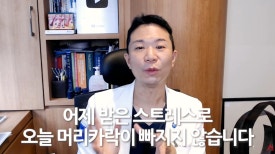
When consulting with patients about hair loss in the clinic, I often hear, “I’ve been under a lot of stress lately, and my hair is falling out so much.”
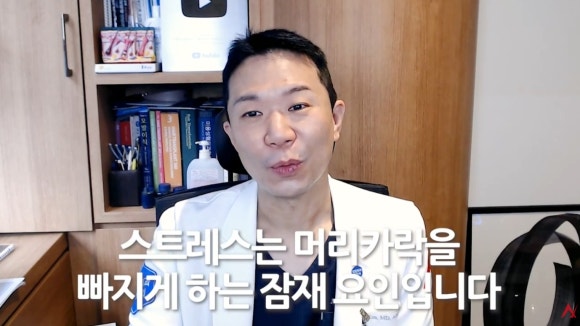
Stress is indeed known as one of the important factors that can worsen hair loss.
However, not everyone who experiences stress will immediately develop hair loss.
The problem is when stress continues for a long time, or when it appears together with lifestyle changes such as lack of sleep, an unbalanced diet, smoking, or weight changes.
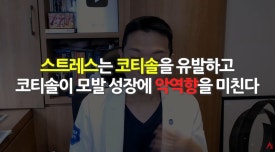
When our body is under stress, it recognizes the situation as a crisis and secretes stress hormones such as cortisol.
This response is necessary in the short term to protect the body, but over a long period it can weaken the growth signals of hair follicles¹,².
Simply put, it means that hair may not grow enough during the period when it should be growing, and may move into the resting phase too quickly.
So, can hair lost due to stress grow back?
The answer is: “It depends on the cause and the state of the hair follicles, but many cases have the potential to recover.”
In particular, hair loss caused by temporary factors such as telogen effluvium can improve again once stress factors decrease and the body’s balance is restored.
On the other hand, if androgenetic hair loss or alopecia areata is also present, an accurate diagnosis and treatment are needed.
Stress-Related Hair Loss: Can It Grow Back? Summary
| Stress can interfere with the hair follicle growth cycle through cortisol, neurogenic inflammation, oxidative stress, and more. |
|---|
| Telogen effluvium may appear as sudden, heavy shedding a few months after childbirth, surgery, high fever, or severe emotional shock. |
| Alopecia areata may also be related to stress and immune responses, and the hair loss itself can create a vicious cycle that increases stress again. |
| Mindfulness meditation, cognitive behavioral therapy, enough sleep, and a balanced diet may help create an environment for hair recovery. |
| Stress-related hair loss should not be viewed simply as a “mental issue”; hair follicles, hormones, immunity, and lifestyle should all be evaluated together. |

Q1. Why does stress-related hair loss happen?
Stress-related hair loss is not simply “hair falling out because you feel mentally overwhelmed.”
It happens because stress changes hormones, immunity, and inflammatory responses in the body.
A representative pathway is cortisol.
When chronic stress continues, cortisol rises, and this can interfere with the activation process of hair follicle stem cells².
Hair goes through repeated cycles of growth, regression, and rest, and stress can disrupt this cycle, causing hairs in the growth phase to move into the resting phase more quickly⁶.
Another important factor is neurogenic inflammation.
When under stress, neuropeptides such as substance P can increase in nerves, and these substances can stimulate inflammation and immune responses around the hair follicle³,⁴.
If oxidative stress also increases, hair follicle cells can be damaged and recovery may slow down³.
In other words, stress-related hair loss can be understood as a process in which mental strain leads to physical physiological responses, and as a result the hair follicle environment worsens.
Q2. What kinds of hair loss are commonly seen with stress?
The types of hair loss commonly associated with stress are telogen effluvium and alopecia areata.
Telogen effluvium often appears as sudden, heavy hair shedding 2–3 months after major surgery, childbirth, high fever, rapid weight loss, or severe psychological shock.
At this time, patients often say things like, “A handful comes out when I wash my hair,” or “I see way too much hair on my pillow or on the floor.”
This is explained as the result of stress causing hair to move from the growth phase to the resting phase too quickly⁶.
Alopecia areata is a condition in which the immune system attacks its own hair follicles.
Stress is not the sole cause of alopecia areata, but it can destabilize immune responses and promote inflammatory reactions, affecting onset or worsening¹,⁴.
In actual clinical practice, there are quite a few patients who report severe stress, sleep deprivation, or overwork before alopecia areata developed.
However, not all hair loss should be blamed on stress alone.
Androgenetic alopecia, female pattern hair loss, thyroid disease, anemia, nutritional deficiency, and medication effects should also be checked.
Q3. Can hair lost from stress grow back?
Yes, it can.
In particular, telogen effluvium often improves over time once the cause is resolved.
This is because the hair follicle has not completely disappeared, but has temporarily entered a resting state.
However, recovery takes time.
Hair does not become full again overnight.
It may take weeks to months for shedding to decrease, and it takes even longer for newly grown hair to become visibly longer.
That is why the most difficult part for patients is the “waiting time.”
Clinically, we reduce stress factors, stabilize sleep and meals, and if necessary combine medication treatment or scalp treatment.
If hair loss continues for more than 6 months, or if the part line, crown, or M-shaped hairline gradually widens, we should check whether androgenetic hair loss may also be present rather than assuming it is only telogen effluvium.
Q4. Can meditation or cognitive behavioral therapy help with hair loss?
Yes, they may help.
Psychological approaches such as mindfulness meditation, MBSR, and cognitive behavioral therapy have been shown in studies to positively affect anxiety and depression in hair loss patients and improve quality of life⁴.
Hair loss is not just a problem of hair.
The experience of losing hair itself can become a major source of stress, and this stress can create a vicious cycle that worsens hair loss.
That is why reducing psychological burden during treatment is more important than it may seem.
Meditation may help lower cortisol and tension responses, and cognitive behavioral therapy may help control anxious thoughts such as “I’m going to keep losing hair” or “I’ll never recover.”
Of course, meditation alone does not treat all hair loss. But in stress-related hair loss, it can be an important supportive strategy that helps create an environment in which hair follicles can recover.
Q5. Does lack of sleep also worsen hair loss?
Yes.
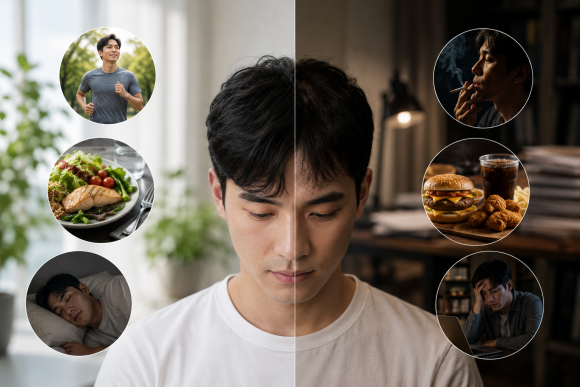
Sleep is a very important factor for hair recovery.
During deep sleep, the body carries out several physiological processes needed for recovery and regeneration.
However, if sleep is insufficient or the day-night rhythm is disrupted, the balance of cortisol and inflammatory substances can be disturbed⁸.
In particular, people under stress often sleep lightly, wake up frequently before dawn, or go to bed late.
When this continues, hair follicles also have difficulty recovering properly.
This is why checking sleep patterns is just as important as medication or procedures when treating hair loss.
If possible, it is best to maintain a consistent sleep and wake schedule, reduce smartphone use before bedtime, and adjust caffeine intake time.
These may seem like very basic habits, but in stress-related hair loss, these small changes form the basis of recovery.
Q6. How important is diet for stress-related hair loss?
It is very important.
When people are stressed, they often skip meals, crave sweets or stimulating foods, or go on extreme diets.
These changes can lead to insufficient intake of protein, iron, zinc, and vitamin D, which are needed for hair growth.
Because hair is made of protein, insufficient protein intake can make hair thinner and weaker.
Iron and zinc are also closely related to hair growth.
In female hair loss patients in particular, we often see low iron stores or nutritional imbalance after childbirth or dieting.
For diet, balance is more important than special health foods.
It is best to include protein in every meal and to consume vegetables, whole grains, and healthy fats in appropriate amounts.
If stress-related hair loss is suspected, maintaining a diet that allows the body to recover should come before extreme restriction.

Q7. Do smoking and lifestyle habits also affect hair follicles?
Yes. Smoking can constrict scalp blood vessels and increase oxidative stress, which may worsen the hair follicle environment⁹.
Hair follicles are small organs, but they are very sensitive to blood flow and nutrient supply. If circulation decreases and free radicals increase, it becomes difficult for hair to grow healthily.
Also, the more severe the stress, the more smoking, drinking, late-night snacking, and lack of sleep tend to increase together.
In the end, not only stress itself but also the lifestyle changes caused by stress can further worsen hair loss.
Therefore, when managing stress-related hair loss, it is more practical to check the lifestyle factors you can control first rather than setting the vague goal of “eliminating stress.”
It is a good idea to look at sleep, diet, smoking, alcohol, dieting intensity, and exercise together.
Q8. How should stress-related hair loss be treated?
The first step is an accurate diagnosis.
Even if the patient has been under a lot of stress, the actual condition may involve a mix of androgenetic alopecia, female pattern hair loss, alopecia areata, and telogen effluvium.
Hair loss pattern should be distinguished through scalp magnified examination, hair thickness assessment, and confirmation of the hair loss distribution pattern, and if necessary, blood tests.
The second step is to create a recovery-friendly environment.
Sleep should be stabilized, diet should be organized, and stress-reducing meditation or exercise can be combined.
If needed, minoxidil, anti-inflammatory treatment, injection therapy, or medication treatment may be considered according to the patient’s condition.
The third step is follow-up over time.
Hair is a tissue that changes slowly.
Because it does not become full immediately after treatment starts, it is important to compare photos and hair condition at regular intervals to check the direction of recovery.

| Category | Effect on Hair Loss | Management Direction |
|---|
| Chronic stress | Increased cortisol, weakened growth signals in hair follicles | Meditation, rest, counseling, stress factor management |
| Neurogenic inflammation | Increased inflammation around hair follicles via substance P and related factors | Check for inflammatory scalp condition, treat if needed |
| Oxidative stress | Damage to hair follicle cells, delayed recovery | Antioxidant-rich diet, reduce smoking, improve sleep |
| Lack of sleep | Worsened balance of cortisol and inflammatory responses | Consistent sleep rhythm, reduce smartphone use at night |
| Unbalanced diet | Protein, iron, and zinc deficiency | Balanced diet centered on protein, testing if needed |
| Anxiety caused by hair loss | Stress-hair loss vicious cycle | Cognitive behavioral therapy, psychological support, explanation of the course |
Stress-related hair loss is not something that can be solved simply by saying, “Don’t be stressed.”
Stress affects hair follicles through multiple pathways such as cortisol, neurogenic inflammation, oxidative stress, lack of sleep, and changes in eating habits.
Therefore, treatment should not rely on just one method; it should consider accurate diagnosis, lifestyle management, psychological stability, and, if necessary, medical treatment together.
Fortunately, in many cases of hair loss caused by stress, the hair follicles may not have disappeared completely but may simply be temporarily resting.
In such cases, if the cause is reduced and the body’s balance is restored, there is a possibility that hair will grow back.
What matters is not just looking at how much hair is falling out and becoming anxious, but checking why it is falling out and creating an environment in which recovery is possible.
Hair is also a signal that shows the condition of the body.
If stress-related hair loss is suspected, it is a good idea to check not only the scalp but also sleep, diet, mental state, and daily rhythm together.'
Now it is time for hairhair, this was Kim Jin-oh.
Beomhaksinmo (必生新毛).
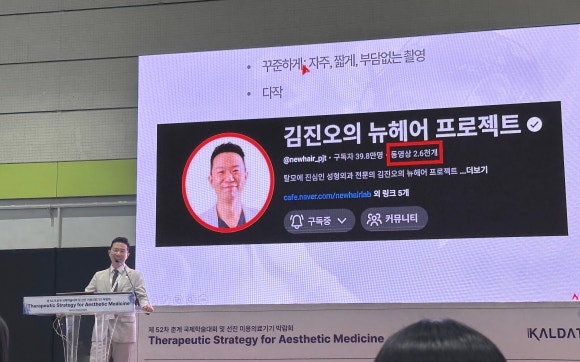
Written by: Kim Jin-oh of New Hair Plastic Surgery Clinic (Public Relations Director, Korean Society of Plastic Surgeons / Academic Director, Korean Hair Research Society)
[References]
- Bai JQA et al. The Role of Psychological Stress in Hair Loss: A Review. JAAD Reviews. 2025. DOI: [10.1016/j.jdrv.2025.10.002].
quoted in the article: “Psychological stress has long been implicated in the pathogenesis and exacerbation of a multitude of hair loss disorders including telogen effluvium, androgenetic alopecia, and alopecia areata.”
- Choi S et al. Corticosterone inhibits GAS6 to govern hair follicle stem-cell quiescence. Nature. 2021;592(7854):428–432.
quoted in the article: “Chronic stress prolongs hair follicle quiescence by elevating corticosterone levels, which suppresses growth arrest-specific 6 (Gas6) expression in dermal papillae, thereby inhibiting activation of follicular stem cells and delaying regeneration.”
- Ma YQ et al. Oxidative stress and alopecia areata. Front Med. 2023;10:1181572.
quoted in the article: “In parallel, stress-induced neuropeptides including substance P and calcitonin gene-related peptide can promote neurogenic inflammation, a process characterized by peripheral nervous system activation and mast cell degranulation, leading to a pro-inflammatory milieu around the hair follicle.”
- Maloh J et al. Systematic Review of Psychological Interventions for Quality of Life, Mental Health, and Hair Growth in Alopecia Areata and Scarring Alopecia. J Clin Med. 2023;12(3):964.
quoted in the article: “Stress-induced neuropeptides including substance P and CRH contribute to alopecia areata pathogenesis by inducing apoptosis in follicular keratinocytes, stimulating mast cell degranulation, and disrupting hair follicle immune privilege.”
- Lee EY et al. The local hypothalamic–pituitary–adrenal axis in cultured human dermal papilla cells. BMC Mol Cell Biol. 2020;21(1).
quoted in the article: “Central to this process is the hypothalamic–pituitary–adrenal (HPA) axis, which when activated by stress, triggers the release of corticotropin releasing hormone (CRH), adrenocorticotropic hormone (ACTH), and ultimately glucocorticoids such as cortisol.”
- Manolache L & Benea V. Stress in patients with alopecia areata and vitiligo. J Eur Acad Dermatol Venereol. 2007;21(7):921–928.
quoted in the article: “Psychological stress may precipitate a premature shift of hair follicles from the anagen phase to the telogen phase of the hair cycle, mediated by increased cortisol secretion and downstream inflammatory signaling.”
-
Cipriani R et al. Paroxetine in alopecia areata. Int J Dermatol. 2001;40(9):600-601.
-
Wright KP et al. Influence of sleep deprivation and circadian misalignment on cortisol, inflammatory markers, and cytokine balance. Brain Behav Immun. 2015;47:24-34.
-
Kavadya Y & Mysore V. Role of Smoking in Androgenetic Alopecia: A Systematic Review. Int J Trichology. 2022;14(2):41-48.
-
Nam YJ et al. CRH receptor antagonists from Pulsatilla chinensis prevent CRH-induced premature catagen transition in human hair follicles. J Cosmet Dermatol. 2020;19(11):3058-3066.
-
Wikramanayake TC et al. Prevention and treatment of alopecia areata with quercetin in the C3H/HeJ mouse model. Cell Stress Chaperones. 2012;17(2):267-274.
Related posts you may find helpful