When consulting about hair transplantation, there is one point that patients misunderstand the most often.
If it is taken out by FUE, doesn’t hair grow back in that spot?
If you keep taking hair from the back and putting it in the front, won’t it eventually become fuller?
If I don’t have enough hair, can’t I transplant hair from a family member or someone else?
These questions are all natural curiosities.
However, medically speaking, hair transplantation is not a treatment that creates new hair.
To be precise, it is a surgical procedure that moves hair follicles from the back and sides of the head, which are relatively less affected by hair loss, to the areas that need them. In other words, it changes the location of hair resources that already exist in the body.
So the most important thing in hair transplantation is not simply “how many grafts can be implanted?”
A more important question is, “How safely can I use the donor hair resources at the back of my head?”
This is because excessive harvesting can fill the front, but leave the back looking sparse.
Below, let’s easily organize the limits of hair transplantation and the principles of donor area management, focusing on the questions patients most often ask in actual consultations.
Summary of the Limits of Hair Transplantation and Why It Cannot Be Done Unlimitedly
| Hair transplantation is not a treatment that creates new hair, but a redistribution surgery that moves follicles from the back of the head to the needed area. |
|---|
| Follicles do not regenerate in the area where they were taken during FUE, so the occipital donor resources must be used carefully. |
| Part of the back and sides of the head are considered a safe zone that is less affected by DHT, and follicles from this area tend to remain relatively stable even after transplantation.¹ |
| If the donor area is overharvested, the back of the head can look thin, so planning is generally needed with the 50% rule in mind.³⁴ |
| Transplanting another person’s hair or artificial hair is difficult to consider a practical alternative because of the greater risk of immune rejection, chronic inflammation, and scalp damage.⁵ |
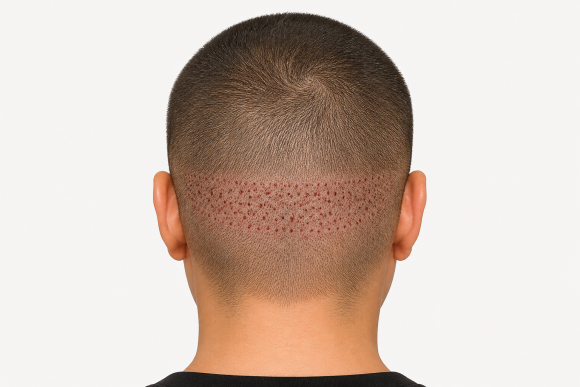
Q1. Does hair grow back in the area where it was taken out with FUE?
Unfortunately, once a follicle has been completely harvested, the same follicle does not grow back in that spot.
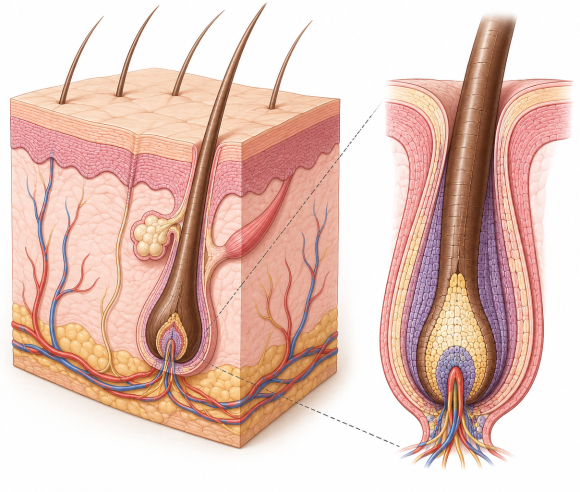
Hair is not simply a thread-like structure that comes out above the skin.
It can continue to grow only if there is root tissue that produces hair, namely the hair follicle.
Inside the follicle are the dermal papilla and surrounding cells, which are key structures that regulate hair growth.²
FUE hair transplantation removes these follicular units one by one and moves them to the needed area.
Because the entire follicle is moved, a new follicle is not created again in the original location.
Instead, that follicle begins growing again in the transplanted area, such as the front of the hairline or the crown.
So hair transplantation is not “cloning,” but “moving.”
Simply put, it is closer to moving assets from a bank in the back of the head to the front.
Q2. Then if hair keeps being taken from the back, won’t the back look thin?
That is possible. That is why overharvesting the donor area must absolutely be avoided in hair transplantation.³
No matter how strong the hair at the back is, it is not unlimited.
If too many follicles are harvested without planning, the density in the occipital area decreases, and when the hair is cut short, the scalp may show through or the area may look sparse.
One clinically important guideline used to prevent this is the 50% rule.
In general, people’s eyes tend not to easily notice reduced hair density until the density in a given area falls to less than half of the original amount.⁴
In other words, it is important to maintain visual density by harvesting evenly and carefully across the entire occipital area.
However, this standard does not apply equally to everyone.
People with thick hair and high density may be able to harvest a relatively large number of grafts with less visible change, but people whose hair is naturally fine and whose occipital density is low may look thin even with a smaller number of grafts harvested.
In the end, what matters is not “someone else had 4,000 grafts,” but the amount that my own occipital area can safely handle.
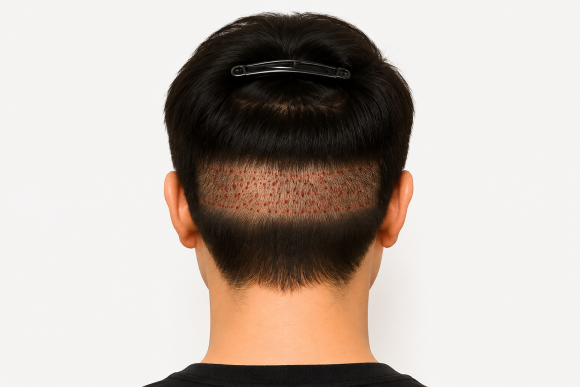
Q3. Why does back-of-the-head hair remain for so long after transplantation?
The back and some of the sides of the head commonly used in hair transplantation are medically called the safe zone.
Follicles in this area are known to be relatively less affected by DHT, the main hormone that causes male pattern hair loss.¹
When looking at people with male pattern hair loss, it is common to see that the front and crown have thinned significantly while the back and sides remain relatively preserved.
Because of this characteristic, even when occipital follicles are moved to an area affected by hair loss, they retain much of their original nature.
This can be understood as the concept of “donor dominance.”
Even after being moved, a follicle largely retains the genetic characteristics it originally had.
So follicles taken from the back of the head are likely to remain relatively long-lasting even when implanted in the front or crown.
However, this does not mean they are “100% guaranteed never to fall out for life.”
The results can vary depending on the individual’s degree of hair loss, age, whether they are receiving medication, and the stability of the safe donor zone. That is why a precise preoperative evaluation is important.
Q4. How is the number of grafts for hair transplantation determined?
The number of grafts that can be transplanted is not determined simply by how much the patient wants.
The following factors must be considered together.
First, the density of the occipital hair. You need to check how densely the hair is distributed within the same area.
Second, hair thickness. With the same 3,000 grafts, thick hair will look fuller, while fine hair may provide less coverage.
Third, scalp laxity and the possibility of scarring. This affects whether an excision method or an FUE method is more suitable.
Fourth, the extent of hair loss. You must consider not only the currently empty areas, but also the likelihood that hair loss will progress in the future.
Hair transplantation is not a surgery that fills only today’s empty spaces.
You also need to calculate the resources that should be left behind so that the result does not look unnatural 5 or 10 years from now.
That is why experienced medical teams explain the graft number that is safe for the patient before the number the patient wants.
Q5. Can’t hair from another person be transplanted?
In general, another person’s hair cannot be transplanted.
Our body has an immune system that distinguishes our own tissue from someone else’s tissue.
If another person’s follicles are placed into the scalp, immune cells recognize them as foreign material and attack them.
In this process, the transplanted follicles may fail to take root and a rejection reaction can occur.⁵
In theory, it may be possible if immunosuppressants are used, as in organ transplantation.
However, taking immunosuppressants for life just for a cosmetic hair transplant is not realistic.
This is because immunosuppressants can come with infection risk, organ toxicity, and overall health problems.
Cases involving genetically almost identical individuals, such as identical twins, are very exceptional, but for ordinary family members or between parents and children, transplanted hair from another person is not a realistic option.
Q6. What about transplanting artificial hair?
At first glance, artificial hair may seem like a way to supplement insufficient hair resources.
However, medically speaking, it is an area that requires great caution.
Artificial hair is not a living follicle, so it does not grow on its own.
Also, the body may recognize artificial fibers as foreign material.
If this foreign-body reaction repeats, chronic inflammation, pus, fibrosis, and scalp damage can occur.
In particular, the scalp is an area that is continuously exposed to sebum, sweat, bacteria, and external irritation.
If artificial material remains embedded in this area for a long time, inflammation may become difficult to manage.
So in cases of extensive hair loss with insufficient donor resources at the back of the head, it may be safer to consider scalp micropigmentation, wigs, medication, and strategies to preserve existing hair together rather than forcing artificial hair transplantation.

Q7. If you take hair-loss medication, does the donor supply at the back increase?
Taking hair-loss medication does not create new follicles in the occipital area.
That is because follicles that do not already exist cannot appear newly.
However, hair-loss medication may help keep existing hair thicker and slow the progression of hair loss.
In particular, if miniaturized hair around the crown or frontal area recovers to some extent, the area that needs to be filled by transplantation may become smaller.
Also, if hair has become weaker up to the boundary of the occipital area, it may be more beneficial to stabilize the hair condition with medication first and then make the surgical plan.
In other words, hair-loss medication should be understood not as a treatment that “increases” donor resources, but as a supportive strategy that stabilizes the overall hair environment and improves transplant efficiency.
| Patient condition | Surgical planning direction | Points to watch |
|---|
| High occipital density and thick hair | FUE harvesting can be done over a relatively wide area | Even so, excessively dense transplantation should be planned with long-term considerations |
| Fine hair and low occipital density | Reevaluate after medication rather than forcing large-volume harvesting | Even a small number of grafts can make the back look thin |
| Extensive hair loss | Set priorities and take a stepwise approach to the hairline, crown, and so on | Trying to fill every area at once increases the burden on the donor area |
| Insufficient donor resources at the back | Consider non-surgical options such as scalp micropigmentation, wigs, and medication | Transplanting another person’s hair or artificial hair carries significant risk |
| Young age with a high chance of future hair loss progression | Conservative planning that takes future hair loss into account | If all grafts are used based only on current satisfaction, there will be less room for revision surgery |
The key to hair transplantation is not simply filling the front hairline densely.
What matters more is how strategically the limited donor resources at the back of the head are used.
Once follicles from the back are harvested, they are not recreated in that same spot.
So hair transplantation is not a treatment that can be repeated indefinitely, and the number of grafts possible and the proper design differ from patient to patient.
A good hair transplant should consider not only today’s empty areas, but also future hair loss progression.
It is completely understandable to want a slightly lower hairline or a denser crown.
However, the medical team must always determine whether that desire is safe in the long term.
In the end, the success of hair transplantation depends less on “how many grafts were implanted” and more on “how long, how naturally, and how safely the hair resources I have were designed to be used.”
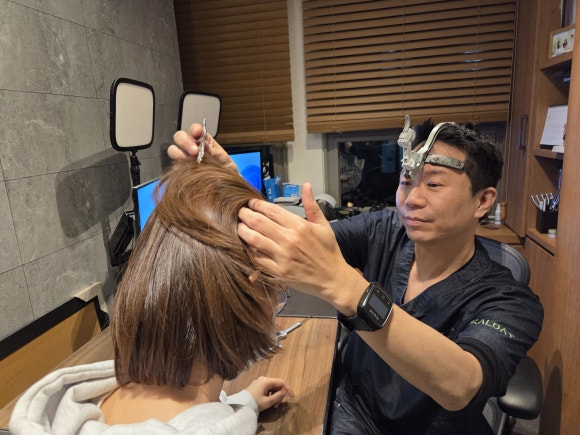
Before surgery, it is best to evaluate the density of the occipital area, hair thickness, the extent of hair loss, and the possibility of medication treatment together before making a plan.
It’s time for hairhair, Kim Jin-o.
Filsaengsinmo (必生新毛).
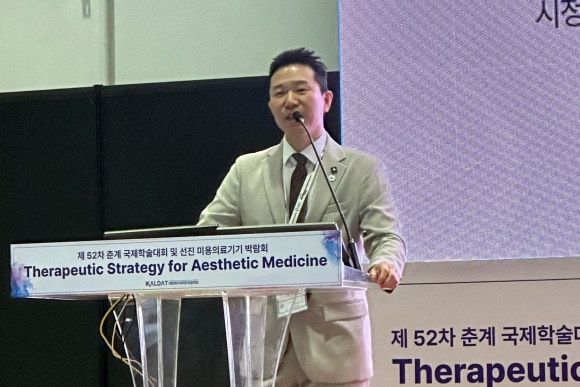
Written by: Kim Jin-o of New Hair Plastic Surgery (Public Relations Director, Korean Association of Plastic Surgeons / Academic Director, Korean Hair Research Society)
[References]
-
Unger, W.P. and Shapiro, R. (2011) Hair Transplantation. 5th edn. New York: Marcel Dekker. cited: "The safe donor zone remains stable over a lifetime because its follicles lack the critical density of androgen receptors that mediate miniaturization."
-
Jimenez, F. and Izeta, A. (2012) 'Reflections on How Nature Engineers the Human Hair Follicle', Journal of Investigative Dermatology, 132(5), pp. 1244-1248. cited: "Complete removal of the dermal papilla during follicular unit extraction permanently abrogates the regenerative capacity of that specific follicular site."
-
Cole, J.P. (2016) 'Donor Area Depletion: The Risks of Overharvesting in FUE', Hair Transplant Forum International, 26(3), pp. 87-91. cited: "Overharvesting occurs when the extraction density reduces the hair count beyond the physiological threshold required for optical coverage."
-
Avram, M.R. and Watkins, R. (2019) 'Donor Area Management in FUE Hair Transplantation', Dermatologic Surgery, 45(3), pp. 438-445. cited: "The 50% rule functions as a clinical guideline ensuring that conversational distance visualization does not detect regional alopecia post-harvesting."
-
True, R.H. and Dorin, R. (2021) 'Immunological Barriers in Allogeneic Hair Transplantation and Alternative Hair Restoration Pathways', International Journal of Cosmetic Medicine, 23(1), pp. 112-119. cited: "Allogeneic hair transplantation triggers a robust MHC class I and II mediated T-cell response, necessitating systemic immunosuppression equivalent to solid organ transplantation."
Related post