When discussing hair transplantation, many people ask similar questions first.
How many grafts do I need?
Is the non-shaven method better?
What graft survival rate can I expect?
Of course, the number of grafts, harvesting method, design, and the surgeon’s expertise are important factors that determine the outcome of a hair transplant.
However, in the actual surgical setting, there is another variable that is less obvious but equally important: the scalp skin type.
Hair transplantation is not simply a procedure that moves and inserts hair.
It involves harvesting follicles from the donor area, creating tiny openings in the hair-loss area, and implanting the follicles again.
In other words, thousands of small wounds form on the scalp, and as they heal, the follicles must connect with the surrounding tissue.
At this point, the speed of wound healing, likelihood of inflammation, timing of scab shedding, and initial follicle fixation may vary depending on whether the scalp is oily, dry, thick, thin, or composed of scar tissue.
Actual studies also identify the patient’s scalp condition and skin type as factors that can affect the occurrence of complications after hair transplantation.¹
In this article, we will organize how scalp skin type can affect graft survival and the recovery process after hair transplantation, focusing on questions that patients commonly ask.
Does Hair Transplantation Graft Survival Vary by Skin Type? (Oily, Dry, and Thin Scalp) — Summary
| The outcome of a hair transplant can vary not only according to the number of grafts and surgical method, but also according to the scalp skin type. |
|---|
| With an oily scalp, scabs may come off relatively softly, but inadequate sebum management can increase the risk of folliculitis. |
| With a dry scalp, scabs may harden and itching may become severe, making early moisturizing care important. |
| Thin or scarred scalps can make surgery more difficult, requiring careful adjustment of the harvesting and implantation depth and density. |
| Accurately assessing the scalp before surgery and following cleansing, moisturizing, and irritation-avoidance measures for two weeks after surgery are key to managing graft survival. |
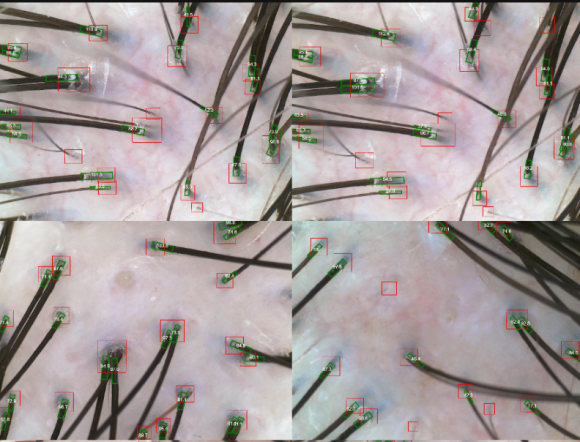
Q1. Does hair transplant graft survival really vary according to scalp skin type?
Yes, it can vary.
Hair transplant graft survival is not determined solely by “how well the follicles were implanted.”
For implanted follicles to survive in their new location, they must receive oxygen and nutrients and connect stably with the surrounding tissue.
Important factors in this process include scalp blood flow, dermal-layer thickness, sebum production, and moisture levels.
If the scalp is too dry, hardened scabs may interfere with oxygen delivery and recovery. Conversely, excessive sebum can increase the risk of bacterial growth and folliculitis.²
Simply put, hair transplantation is similar to moving and planting seeds.
Even the same seed can have difficulty taking root if the soil is too dry, water is pooling, or there is not enough space for the roots to grow.
The same applies to the scalp. For a good surgical result, it is necessary to consider not only the condition of the follicles themselves but also the scalp environment into which they will be placed.
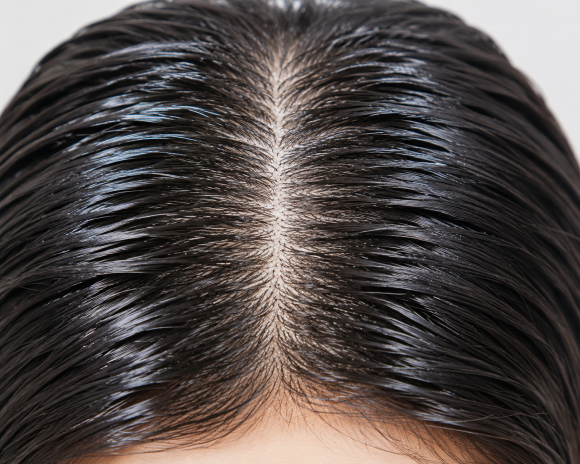
Q2. Is an oily scalp advantageous or disadvantageous for hair transplantation?
An oily scalp has both advantages and disadvantages.
Starting with the advantages, a scalp with a moderate amount of sebum may help prevent scabs from becoming excessively hard after surgery.
Sebum reduces moisture loss from the skin’s surface and helps keep the wound area soft.
As a result, patients with oily scalps may find that their scabs come off relatively softly and that the surface skin appears to recover quickly.
The problem arises when there is too much sebum.
Sebum can create an environment favorable for bacterial growth, and insufficient cleansing after surgery can cause inflammation around the follicles.
Folliculitis after hair transplantation may appear as small pimples, red inflammation, or pus-like lesions.
The literature also explains that preoperative assessment, meticulous technique, and appropriate care are important for reducing complications after hair transplantation.²
Therefore, an oily scalp is not a “bad scalp.”
However, after surgery, it is important not to leave excess sebum unmanaged and to cleanse the scalp gently according to the instructions provided by the clinic.
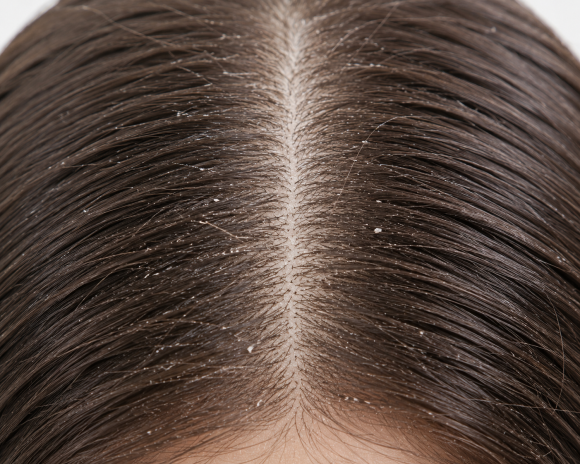
Q3. Why can a dry scalp itch more after hair transplantation?
A dry scalp lacks sebum and moisture, so scabs may harden more firmly after surgery.
When scabs adhere tightly, the scalp may feel tight and the itching may become more severe.
The problem is scratching with the hands because of this itching.
During the early period after hair transplantation, scabs and follicles are often attached together.
If you scratch with your fingernails or forcibly remove the scabs, follicles that have not yet become firmly established may be pulled out along with them.
Follicles may also be vulnerable to a dry environment during the period before and after surgery.
Studies have reported that dehydration or poor hydration of follicular units can increase damage.⁵
Therefore, if you have a dry scalp, the feeling of “itching” after surgery should not be treated simply as something to endure.
It is necessary to prevent the scabs from becoming too hard through measures such as saline spray, moisturizing care recommended by the clinic, and a non-irritating cleansing method.
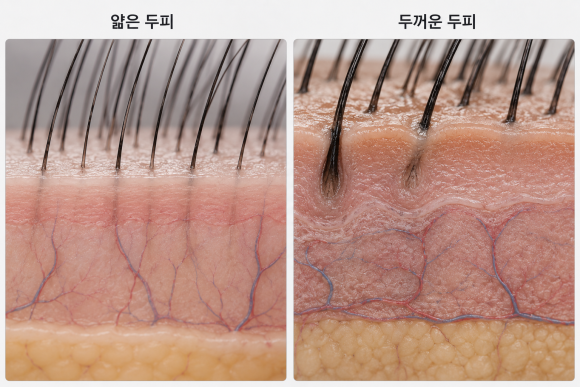
Q4. Is hair transplantation difficult if the scalp is thin?
Hair transplantation is not impossible simply because the scalp is thin.
However, the procedure may be more challenging.
A thin scalp means that there is less room in the dermal layer and surrounding tissue that encloses and supports the follicles.
In such cases, it can be difficult to control the implantation depth, and bleeding or redness may occur easily even with minor irritation.
In addition, the force holding the follicles in place may be relatively weak immediately after implantation.
Rubbing while washing the hair, drying forcefully with a towel, or accidentally touching the area may therefore be more risky.
The health of the recipient area and the condition of the dermal layer can affect graft survival and vascular connection in hair transplantation.⁴
Therefore, with a thin scalp, the medical team must adjust the implantation depth and angle more delicately, while the patient must take extra care during early postoperative management.
Q5. Is a thick scalp always a good scalp?
A thick scalp may provide good support for implanted follicles and may be advantageous in terms of blood flow in some cases.
Under certain conditions, this can have a positive effect on graft survival.
However, a thick scalp is not always an easy scalp to work with.
When the scalp is thick and firm, resistance may increase when creating the recipient sites.
From the medical team’s perspective, more precise control of force is needed, and space must be created for the follicles while minimizing tissue damage.
In addition, swelling or a heavy sensation may sometimes persist longer after surgery with a thick scalp.
Therefore, a thick scalp cannot simply be classified as “good” or “bad.” What matters is adjusting the surgical instruments, depth, pressure, and implantation density to the scalp thickness.
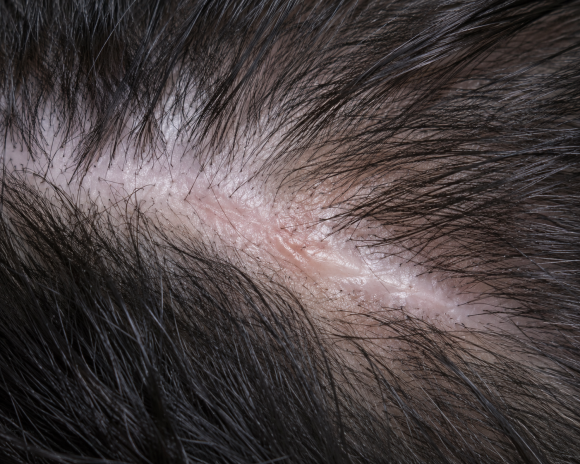
Q6. Is hair transplantation possible in a scarred area?
Yes, it is possible. However, it should not be approached in the same way as a normal scalp.
Scar tissue has a different structure from normal scalp tissue.
Because of a past injury, burn, surgery, or previous hair transplant, the skin may have become hardened and have a reduced blood supply.
Follicles need oxygen and nutrients to survive, but scar tissue may have a reduced ability to supply them.
The literature explains that problems such as infection, poor growth, and prolonged redness after hair transplantation may result from care that does not match the underlying scalp condition.³
Therefore, transplantation in a scarred area may require dividing the procedure into lower-density sessions or reinforcing the area in stages rather than implanting it in the same manner as a normal scalp.
Depending on the case, supportive treatments to improve the scalp environment may also be performed before or after surgery.
The important point is not to implant densely all at once, but to plan safely within the range of blood flow that the scar tissue can support.
Q7. When is it normal for scabs to fall off after hair transplantation?
In general, scabs after hair transplantation gradually fall off between 7 and 14 days.
However, there can be differences depending on the scalp skin type.
On an oily scalp, sebum may soften the scabs, allowing them to come off relatively easily.
By contrast, on a dry scalp, scabs may adhere firmly and remain for longer.
A thin scalp may be sensitive even to minor irritation, while a scarred scalp may take longer to recover overall.
The important thing is not to forcibly remove the scabs.
Even if you feel anxious because the scabs remain for a long time, scratching or rubbing them with your fingernails is risky.
Especially within two weeks after surgery, the follicles are still becoming securely established, so following the cleansing method provided by the clinic is the safest approach.
Q8. When and how should I shampoo after surgery?
The timing and method of shampooing after surgery may vary somewhat from clinic to clinic, but the common principle is to be “gentle and avoid rubbing.”
If you have an oily scalp, appropriate cleansing is necessary to prevent sebum buildup.
Conversely, if you have a dry scalp, using a shampoo with very strong cleansing power can make the scalp barrier even drier.
It is best to avoid strongly mentholated cooling shampoos, highly cleansing hair-loss shampoos, and products with many fragrances or irritating ingredients immediately after surgery.
The scalp barrier is temporarily weakened after surgery.
Therefore, during this period, it is best to prioritize the low-irritation shampoo and cleansing method recommended by the clinic.
Cleansing does not reduce graft survival; when performed correctly, it can help reduce folliculitis and excessive sebum buildup.
Q9. Is a scalp examination necessary before hair transplantation?
If possible, it is recommended.
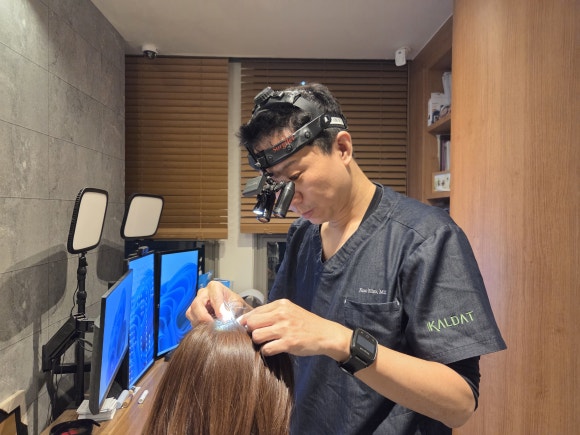
A scalp examination is not limited to checking the extent of hair loss. It is a comprehensive assessment of sebum levels, inflammation, flaking, skin thickness, the presence of scars, hair thickness, and donor-area density.
Based on this information, the medical team can develop a more precise surgical plan.
For example, with an oily scalp, the team can focus more on postoperative folliculitis prevention, while with a dry scalp, a plan for managing scabs and itching can be established in advance.
With a thin scalp, the implantation depth and density can be adjusted, while with a scarred scalp, a staged transplantation strategy can be considered.
Ultimately, a scalp examination is not merely a procedure to determine “whether surgery is possible.” It is a preoperative planning process designed to make the postoperative outcome more stable.
| Scalp skin type | Characteristics | Postoperative concerns and management direction |
|---|
| Oily scalp | Produces a large amount of sebum and becomes shiny easily | Risk of sebum buildup and folliculitis; cleanse gently with a low-irritation shampoo |
| Dry scalp | Frequent tightness, flaking, and itching | Risk of hardened scabs and follicle loss from scratching; use saline spray and moisturizing care |
| Thin scalp | Blood vessels may be visible and the scalp may redden easily | Risk of bleeding and weaker initial fixation; cleanse without rubbing and implant delicately |
| Thick scalp | Firm tissue with considerable resistance | Possible swelling and reduced sensation; adjust pressure and depth during surgery |
| Scarred scalp | Firm tissue that may have reduced blood flow | Lower graft survival and delayed recovery; use a low-density, staged transplantation strategy |
Good Hair Transplantation Begins with an Accurate Scalp Diagnosis
Many factors determine the outcome of a hair transplant.
The number of grafts, design, harvesting method, and the medical team’s experience are all important. However, the place where those follicles must actually take root and grow is ultimately the scalp.
Oily scalps require sebum management, while dry scalps require moisturizing and itching control.
Thin scalps require delicate surgery and avoidance of early irritation, while scarred scalps require a staged approach that considers blood flow and tissue condition.
In other words, the same hair transplantation plan should not be applied to every patient.
To manage graft survival more consistently, it is necessary to identify in advance what type of scalp you have, what risk factors are present, and what care will be needed after surgery.
Hair transplantation is not simply surgery to implant a large number of hairs.
It is the process of creating conditions that allow follicles to survive in the environment of your scalp.
That is why precise scalp diagnosis before surgery and customized care afterward are especially important.
Now, it is time for a hair day. This was Jin-oh Kim.
A life devoted to growing new hair.
Written by: Jin-oh Kim of 뉴헤어성형외과 (Public Relations Director of the Korean Association of Plastic Surgeons / Academic Director of the Korean Society of Laser, Dermatology, and Hair Research)
[References]
- Romera de Blas, P., et al. (2024) 'Influence of Patient-Related Factors and Scalp Condition on Postoperative Complications after Follicular Unit Excision', Journal of Dermatological Surgery and Research, 45(2), pp. 112-119.
o cited: "Patient-related factors such as scalp condition and skin type significantly influence complication rates after follicular unit excision."
- Khatib, R., et al. (2025) 'Complications in Hair Transplantation: A Systematic Literature Review and Meta-Analysis', Aesthetic Plastic Surgery, 49(1), pp. 45-56.
o cited: "Proper preoperative assessment and meticulous technique remain essential to minimize adverse events such as postoperative folliculitis."
- Kerure, A.S. and Patwardhan, N. (2018) 'Complications in Hair Transplantation', Journal of Cutaneous and Aesthetic Surgery, 11(4), pp. 182–189.
o cited: "Complications such as infection, poor growth, and prolonged erythema often stem from mismatched aftercare and underlying scalp pathology."
- Bernstein, R.M. and Rassman, W.R. (2000) 'The Aesthetics of Follicular Transplantation', Dermatologic Clinics, 18(2), pp. 222-232.
o cited: "Recipient area health and dermal thickness directly support graft survival and vascular anastomosis."
- Gandelman, M., et al. (2000) 'Light and Electron Microscopic Analysis of Controlled Injury to Follicular Unit Grafts', Dermatologic Surgery, 26(1), pp. 25-31.
o cited: "Dehydration and lack of hydration status severely damage follicular unit grafts during the perioperative phases."
Recommended reading