The White Spot That Appears on the End When You Pull Out a Hair
Hair may look like a simple thread, but it is actually a structure connected to various tissues, including hair follicles, sebaceous glands, and blood vessels.
That is why various forms may appear at the end when hair falls out.
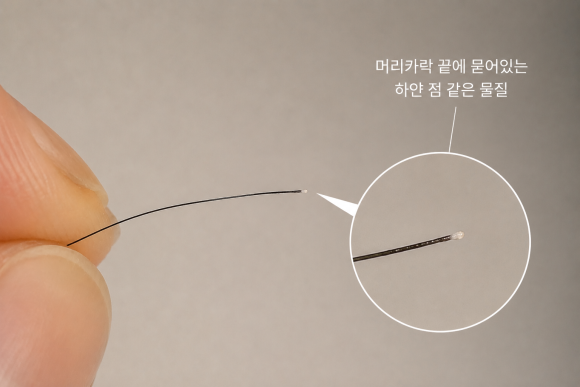
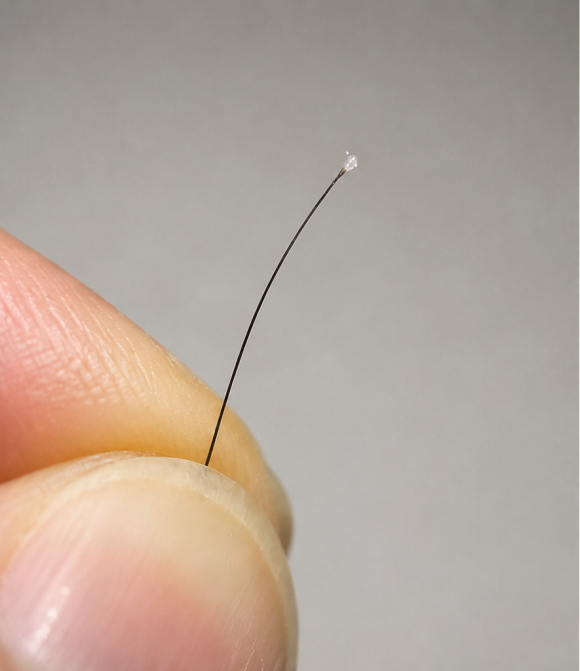
The most commonly seen features are white spots or transparent, jelly-like substances. Many people see these and mistakenly think that “the entire hair follicle has come out.”
However, in most cases, the white substance is the hair bulb, which is the root of the hair, or a substance made up of sebum and dead skin cells.
In other words, it is highly likely to be a part that naturally comes out along with the hair when it falls out. Therefore, there is no need to automatically interpret it as hair loss.
What Is the White Substance at the End of the Hair?
The white spot attached to the end of a hair can generally be divided into two types.
The first is the hair bulb.
The bulb is a structure in which the end of the hair root is rounded and enlarged. It may be visible when hair that has completed its growth cycle falls out.
It is especially commonly observed in naturally shed hair. In this case, it is generally considered part of the normal hair replacement process.
The second is sebum and dead skin cells.
The scalp continuously secretes sebum. When this sebum mixes with dead skin cells, it may appear as a white substance attached to the end of the hair.
If it feels soft or sticky when touched, it is likely to be sebum.
It may be more noticeable in people with oily scalps or when the scalp has not been cleansed sufficiently even after shampooing.
Does Seeing White Mean Hair Loss?
To get straight to the point, seeing a white substance does not immediately mean hair loss.
People naturally lose an average of about 50–100 hairs per day.
It is common for a white bulb to be visible during this process.
On the other hand, if many hairs are breaking in the middle without any root structure, damage or inflammation may be suspected.
However, if you also experience symptoms such as those below, a hair-loss examination may be necessary.
-
A sudden increase in the amount of hair falling out when washing your hair
-
Hair gradually becoming thinner
-
Decreased density at the crown or hairline
-
Recurrent scalp itching or inflammation
-
An increase in short, fine hairs
In other words, what matters is not the white substance itself, but overall changes in the condition of the hair.
Why Are White Spots Particularly Noticeable?
If something resembling white clumps of sebum appears more often than usual, it may be related to the scalp environment.
Common causes include the following:
-
Excessive sebum production
-
Residue buildup after shampooing
-
Lack of sleep and stress
-
Seborrheic dermatitis
-
Frequent use of hair products
Stress and lack of sleep, in particular, can increase sebum production and worsen the scalp’s inflammatory environment.
In this case, you may feel that white substances are sticking to the ends of your hair more frequently.
Also, repeatedly pulling out hair with your hands can irritate the scalp, so caution is needed.
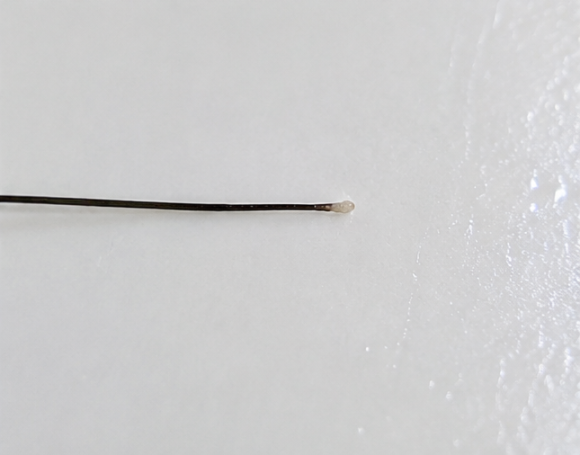
The white spot visible at the end when you pull out a hair is often a normal hair-root structure or sebum and dead skin cells.
Therefore, there is no need to conclude that you have hair loss simply because you see a white substance.
However, if your hair becomes thinner, the amount of hair falling out suddenly increases, and your scalp condition also worsens, it may be an early sign of hair loss rather than simple natural shedding.
In such cases, instead of judging the situation on your own, it may be helpful to undergo an examination that evaluates the condition of both your scalp and hair.
Ultimately, what matters is not “whether there is a white substance,” but “whether your hair density and thickness are being maintained.”
Observing your scalp condition and shedding pattern together in everyday life can be considered the most practical guideline.