When consulting with patients, there is one question I hear surprisingly often.
Doctor, is it better to wash my hair in the morning?
Does washing it in the evening help prevent hair loss?
In fact, many people think that the timing of shampooing itself determines whether hair loss occurs.
However, from the perspective of hair loss and scalp health, the important issue is not simply whether you shampoo in the morning or evening.
What matters more is what changes occur on the scalp throughout the day and how long that condition is left unattended.
In this article, I will summarize the relationship between shampooing time and scalp health, focusing on questions patients frequently ask.
When Is It Better to Shampoo—In the Evening or in the Morning? Summary
| Sebum and pollutants continuously accumulate on the scalp during the day² |
|---|
| If you have an oily scalp, dandruff, or seborrheic dermatitis, evening shampooing is often advantageous³⁴ |
| More important than the time of shampooing is the habit of thoroughly cleansing and completely drying the scalp |
| There is insufficient evidence that washing your hair frequently worsens hair loss¹ |
| To prevent hair loss, an accurate diagnosis and treatment are more important than shampooing alone |
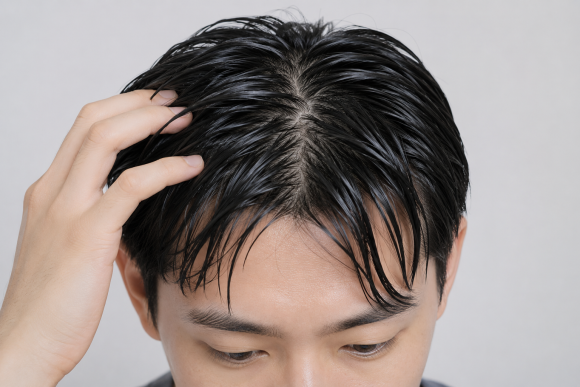
Q1. What changes does the scalp undergo during the day?
The scalp does not remain in the same condition all day.
According to research, as the day progresses into the afternoon, scalp sebum production, moisture levels, and pH tend to increase, while barrier function tends to decrease somewhat.²
Put simply, sebum, sweat, dust, and pollutants continuously accumulate on the scalp throughout the day.
These changes are especially noticeable during the summer, after exercise, or on days with a lot of outdoor activity.
In clinical practice, many patients complain of scalp itching or oiliness as the afternoon progresses.
Q2. Can excess sebum affect hair loss as well?
It is not possible to definitively say that “sebum causes hair loss.”
However, excessive sebum can be one factor that worsens the scalp environment.
Sebum serves as a primary nutrient source for scalp microorganisms such as Malassezia and plays an important role in the development of dandruff and seborrheic dermatitis.³⁴
Recent studies have also suggested that changes in sebum composition and the scalp microbiome may be associated with the progression of male-pattern hair loss.⁵
Therefore, keeping the scalp clean may help create a healthy scalp environment.
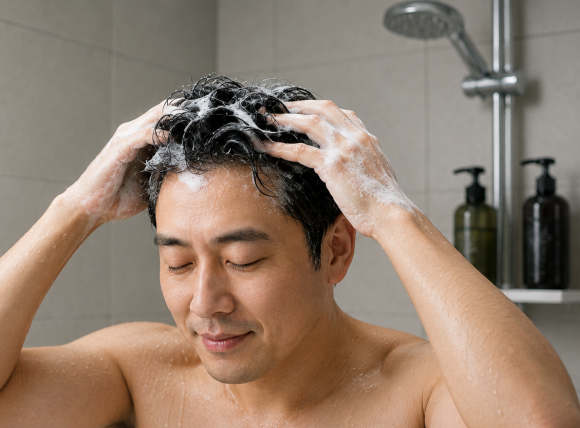
Q3. Is evening shampooing better for preventing hair loss?
In many cases, it is.
Washing your hair in the evening allows you to go to bed after removing the sebum, sweat, fine dust, and pollutants that accumulated throughout the day.
Evening shampooing is particularly recommended in the following situations.
| Type | Recommendation |
|---|
| Oily scalp | Evening shampooing recommended |
| Dandruff or seborrheic dermatitis | Evening shampooing recommended |
| Frequent exposure to fine dust | Evening shampooing recommended |
| Frequent helmet or hat use | Evening shampooing recommended |
| Frequent exercise | Evening shampooing recommended |
In patients with scalp inflammation, I often see itching or excessive oiliness improve simply by adopting the habit of cleansing the scalp in the evening.
Q4. Are there cases in which washing your hair in the evening can actually be harmful?
Yes.
This happens when the hair is not dried properly.
If the scalp remains wet for a long time, the higher temperature and humidity may create an environment favorable for the growth of microorganisms.
Therefore, if you choose evening shampooing, it is important to dry the scalp thoroughly before going to bed.
Personally, I often explain that “whether you dry it properly” is more important than “when you wash it.”
Q5. Is morning shampooing bad for hair loss?
No.
If you have a dry scalp, spend a lot of time indoors, and have little exposure to pollutants, morning shampooing is also perfectly acceptable.
For some people, washing their hair in the morning fits more naturally into their routine, especially when styling their hair.
However, if you have an oily scalp or severe dandruff, pollutants accumulated during the day may remain until the following day, so evening shampooing may be somewhat more advantageous.
Q6. Does washing your hair frequently worsen hair loss?
This is one of the most enduring common misconceptions.
Research has found that even daily shampooing does not have any particular adverse effects on scalp or hair condition.¹
Many people feel that their hair loss has worsened because they see hair falling out while shampooing, but in most cases, these are hairs that had already entered the resting phase and were going to fall out naturally.
In other words, shampoo does not cause hair loss; it simply washes away hair that was already going to fall out.


Many people wonder whether they should wash their hair in the morning or in the evening.
However, from the perspective of scalp health and hair loss, what matters more than the timing itself is how thoroughly you keep your scalp clean.
For most adults, evening shampooing is often somewhat more advantageous because it removes the sebum and pollutants accumulated throughout the day.
However, regardless of the time of day, thorough cleansing followed by careful drying can help maintain a healthy scalp environment.
Hair loss prevention is also not determined by shampooing time alone.
If you suspect hair loss, the most important step is to confirm whether an accurate diagnosis and treatment are needed, together with managing your lifestyle habits.
This was Kim Jin-oh from Hair Hairnal Time.
Must Grow New Hair (必生新毛).

Written by: Kim Jin-oh of 뉴헤어성형외과 (Public Relations Director of the Korean Association of Plastic Surgeons / Academic Director of the Korean Society of Laser, Dermatology, and Hair Research)
[References]
-
Punyani S., Tosti A., Hordinsky M., Yeomans D., Schwartz J. (2021). The Impact of Shampoo Wash Frequency on Scalp and Hair Conditions. Skin Appendage Disorders, 7(3), 183–193. cited: “A daily shampoo regimen was found NOT to affect hair and scalp conditions adversely.”
-
Piérard-Franchimont C., Henry F., Loussouarn G., Saint-Léger D., Piérard G-E. (2007). Circadian chronophysiology of the scalp. Pathologie Biologie (Paris), 55(6), 283–287. cited: “The early afternoon was the time of maximum increase in redness, hydration, pH and sebum output,
combined with decreased skin barrier function.”
-
Ro B.I., Dawson T.L. (2005). The role of sebaceous gland activity and scalp microfloral metabolism in the etiology of seborrheic dermatitis and dandruff. Journal of Investigative Dermatology Symposium Proceedings, 10(3), 194–197. cited: “Most common scalp flaking disorders show a strong correlation with sebaceous gland (SG) activity.”
-
Salamanca-Córdoba M.A. et al. (2021). Seborrheic dermatitis and its relationship with Malassezia spp. Infectio, 25(2), 120–129. cited: “Seborrheic dermatitis (SD) is a chronic inflammatory disease that typically occurs as an inflammatory response to Malassezia species.”
-
Suzuki K. et al. (2021). Scalp Microbiome and Sebum Composition in Japanese Male Individuals with and without Androgenetic Alopecia. Microorganisms, 9(10), 2132. cited: “Changes in sebum composition and/or the scalp microbiome may be involved in AGA development and progression.”
-
Samra T., Lin R.R., Maderal A.D. (2024). The Effects of Environmental Pollutants and Exposures on Hair Follicle Pathophysiology. Skin Appendage Disorders, 10(4), 262–272. cited: “Some pollutants, such as particulate matter, trigger inflammatory responses and have been associated with alopecia areata.”
Recommended related reading