This is one of the questions I hear most often in the clinic.
“I'm losing a lot of hair when I wash it. Should I get tested for hair loss?”
More people than you might expect judge hair loss simply by the number of hairs they shed.
However, in an actual hair loss diagnosis, there are more important factors than the amount of hair loss.
That means changes in hair thickness, changes in density, and the pattern of progression in specific areas.
Even healthy people can naturally lose around 50–100 hairs a day.
Therefore, it is best to understand hair loss testing as a process of checking how the current condition of your hair has changed compared with the past, rather than simply looking at the amount of hair being shed.
This article summarizes when hair loss testing is necessary and the criteria for testing, focusing on the questions patients are most curious about.
When Is Hair Loss Testing Necessary? Summary of Warning Signs and Timing
| Hair loss testing is not necessarily required simply because you are losing a lot of hair. |
|---|
| Along with an increase in hair loss, it is important to determine whether hair is becoming thinner and whether changes are appearing at the crown or in the M-shaped hairline. |
| If losing more than 100 hairs a day continues or reduced density is visible in a specific area, testing may be considered. |
| Postpartum hair loss, hair loss after dieting, and stress-related hair loss may sometimes be monitored over time. |
| Hair loss testing is not only a way to check your current condition; it also creates a baseline for comparing future changes. |

Q1. Does losing a lot of hair always mean hair loss?
Not necessarily.
Temporary increases in hair shedding are more common than you might think.
Typical situations include the following:
-
Postpartum hair loss
-
Rapid weight loss
-
Severe stress
-
Lack of sleep
-
Seasonal changes
In these situations, the number of hairs shed may temporarily increase as more hairs enter the resting phase.
In fact, among the many people who visit the clinic saying, “I’ve been losing a tremendous amount of hair over the past month,” quite a few have temporary telogen hair loss rather than progressive hair loss.
Therefore, rather than concluding that you have hair loss based only on an increase in shedding, it is important to check whether changes in hair thickness and reduced density in specific areas are also present.
Q2. What are the warning signs of hair loss?
The following are representative warning signs of hair loss.
-
Losing more than 100 hairs a day on an ongoing basis.
-
The crown appears thinner than before.
-
The part has become wider.
-
The hairline feels as though it is receding.
-
Changes are visible in the M-shaped hairline.
-
The hair has become thinner and weaker.
-
The hair overall feels less full.
In particular, the change from thick hairs to finer hairs is often a more important sign than the amount of hair being shed.
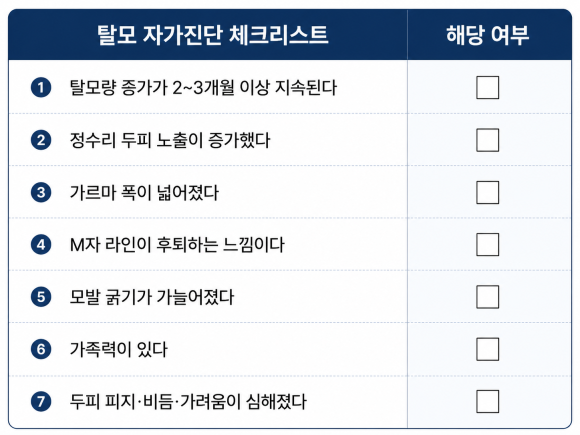
Q3. How reliable is self-assessment for hair loss?
Self-assessment can be useful as a reference, but it cannot replace a diagnosis.
However, the checklist below may help you decide whether to visit a clinic.
If two or more of these signs continue to apply, you may want to consider hair loss testing.
In clinical practice, regularly taking photos of the crown and comparing them can often help determine whether hair loss is progressing.
Q4. When is hair loss testing especially necessary?
Hair loss testing is recommended in the following situations.
First, when changes in a specific area persist.
If reduced density is repeatedly observed at the crown or along the M-shaped hairline, it is necessary to check for the possibility of progressive hair loss.
Second, when increased hair shedding continues for several months or longer.
Temporary telogen hair loss often improves over time, whereas progressive hair loss tends to continue worsening.
Third, when there is a family history.
If you have a genetic predisposition, tracking your condition from the time early changes appear may be helpful.
Fourth, when you are considering medication or a hair transplant in the future.
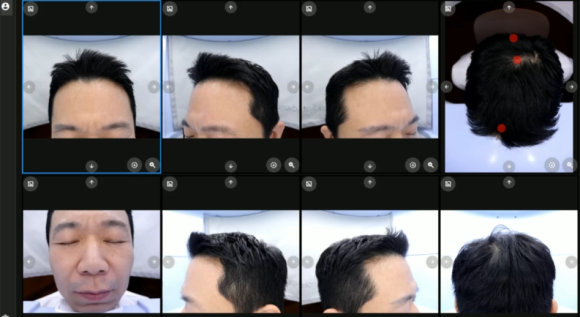
Recording your current condition numerically allows treatment effects to be evaluated objectively later.
Q5. How is hair loss testing performed?
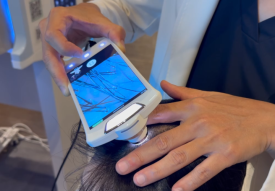
Recent hair loss testing goes beyond simply examining the hair with the naked eye and uses a variety of equipment.
The following procedures are commonly performed:
| Type of test | What it checks |
|---|
| 3D scalp scan | Analysis of the overall scalp condition |
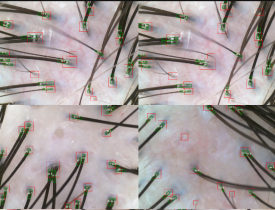
| Digital microscopy | Measurement of hair thickness and density |
| Follicle analysis | Number of hairs per follicle |
| Stress assessment | Evaluation of environmental factors |
| Specialist consultation | Assessment of the type and progression of hair loss |
Digital microscopy is particularly useful in diagnosing early hair loss because it can identify miniaturization—the thinning of individual hairs—which is difficult to distinguish with the naked eye.
Q6. Why is testing important in the early stages of hair loss?
The earlier hair loss is detected, the better.
Most patients visit a clinic after their hair has visibly thinned, but actual changes in the hair often begin much earlier.
Testing in the early stages allows your current condition to be recorded objectively and makes it possible to accurately track subsequent changes.
In other words, hair loss testing is not simply a way to determine “Do I have hair loss right now?” It is a process of creating baseline data to assess whether the condition will progress in the future.
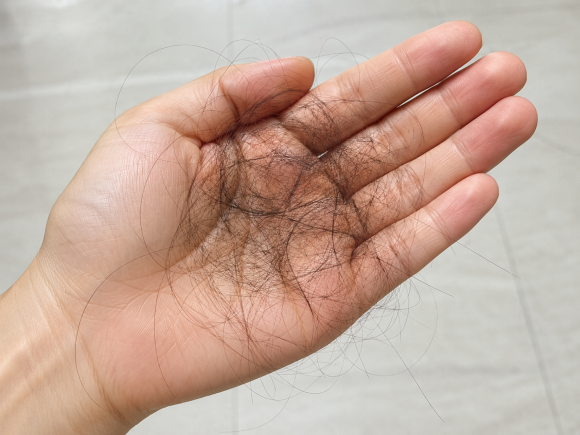
Hair loss testing is not a test that everyone must undergo simply because they are losing a lot of hair.
However, if increased hair shedding is accompanied by thinning hair, changes at the crown, or progression of an M-shaped hairline, it may be helpful to have your current condition assessed objectively.
Because the rate of hair loss progression varies from person to person, it is important to establish a baseline rather than simply assuming, “It’s probably fine for now.”
If it is difficult to determine whether the changes you are experiencing are temporary or reflect actual progressive hair loss, getting a hair loss assessment can be a useful way to find out more accurately.
This was Jin-oh Kim, reminding you that it is time to care for your hair.
A lifelong commitment to new hair.
Written by: Jin-oh Kim of 뉴헤어성형외과 (Public Relations Director of the Korean Association of Plastic Surgeons / Academic Director of the Korean Society of Laser, Dermatology and Hair)
Recommended reading