Is my alopecia areata too severe to qualify for insurance coverage?
This is one of the questions most frequently asked by patients with alopecia areata in the consultation room.
Especially for those who have lost not only scalp hair but also their eyebrows or eyelashes, the cost of treatment has often been a greater concern than its effectiveness.
In fact, JAK inhibitors, which have emerged over the past several years, have brought significant changes to the treatment of severe alopecia areata. However, medication costs of several hundred thousand won per month have placed a considerable burden on patients.
Fortunately, with health insurance coverage scheduled to begin in July 2026, access to treatment is expected to improve significantly.
Today, I will organize the information around the questions patients are most curious about.
Health Insurance Coverage for Severe Alopecia Areata Treatment: Who Is Eligible? Summary
| Health insurance coverage for severe alopecia areata treatments (JAK inhibitors) will begin in July 2026. |
|---|
| With coverage, patients’ out-of-pocket costs will decrease to approximately 30% of the previous medication cost. |
| Eligible patients are adults aged 18 or older with severe scalp hair loss affecting 50% or more of the scalp. |
| Coverage applies only when standard treatments, such as steroids, have been administered for at least three months without effect. |
| Coverage is limited to a maximum of two years, and adolescent patients are currently excluded. |
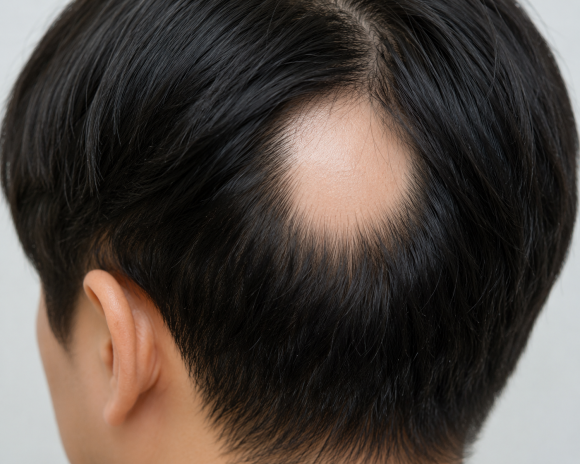
Q1. How is alopecia areata different from common hair loss?
When many people think of hair loss, they first think of an M-shaped receding hairline or crown hair loss.
However, alopecia areata has an entirely different underlying cause.
Male- and female-pattern hair loss are conditions in which the hair follicles gradually shrink under the influence of genetic factors and hormones.
Alopecia areata, on the other hand, is an autoimmune disease in which the body’s immune cells attack its own hair follicles.
In particular, severe alopecia areata can cause loss of not only scalp hair but also eyebrows, eyelashes, and body hair, and it can have a significant impact on daily life and mental health.
Q2. What kind of treatment are JAK inhibitors?
Conventional treatments have primarily worked by suppressing the overall immune response using steroids or immunomodulators.
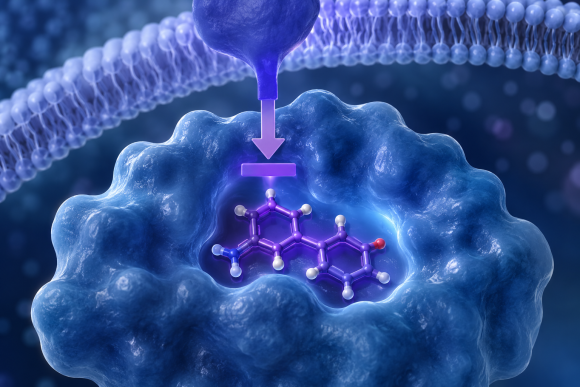
JAK inhibitors, by contrast, selectively block specific signals that instruct immune cells to attack the hair follicles¹².
Put simply, rather than turning off the power to the entire body, they work more like switching off only the specific switch causing the problem.
A representative study by King et al. confirmed meaningful hair regrowth in patients with severe alopecia areata¹.
Q3. How much will treatment costs decrease with health insurance coverage?
Previously, monthly medication costs were approximately 500,000–700,000 won.
After coverage begins, however, patients’ co-payment rate is expected to decrease to around 30%, making treatment available for approximately 150,000 won per month.
This can be considered a significant change for patients who require long-term treatment.
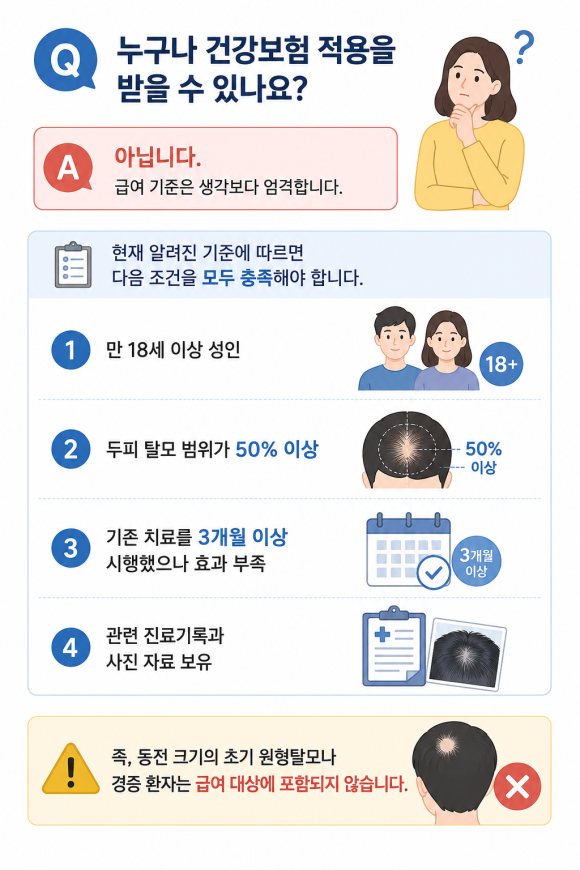
Q4. Can anyone receive health insurance coverage?
No.
The coverage criteria are stricter than many people might expect.
According to the criteria currently available, all of the following conditions must be met.
-
Adult aged 18 or older
-
Scalp hair loss affecting 50% or more of the scalp
-
Insufficient response despite at least three months of conventional treatment
-
Relevant medical records and photographic documentation
In other words, patients with early-stage, coin-sized patches of alopecia areata or mild disease are not included among those eligible for coverage.
Q5. Why is the treatment period limited to a maximum of two years?
The government must consider the long-term sustainability of health insurance finances.
However, there is considerable disappointment within the medical community as well.
Alopecia areata is a chronic, relapsing disease that is closer to a condition requiring management than one that can simply be cured.
In fact, relapses have been reported in a substantial number of patients after discontinuing JAK inhibitors³.
For this reason, medical professionals have consistently expressed the view that the system should be improved so that coverage can be extended in the future according to each patient’s condition.
Q6. Are adolescent patients with alopecia areata not covered by insurance?
That is correct under the current criteria.
This coverage policy was designed primarily for adult patients.
However, some JAK inhibitors have been approved for use in adolescents aged 12 and older.
The issue is that health insurance negotiations for these medications have not yet taken place.
Since alopecia areata frequently begins during adolescence, this is considered an area where discussions on expanding coverage are needed⁴.
| Category | Health insurance coverage | Patient cost |
|---|
| Adults with severe alopecia areata (50% or more scalp involvement) | Available | Approximately 150,000 won per month |
| Adults with mild to moderate alopecia areata | Not available | 500,000–700,000 won per month |
| Adolescents aged 12–17 with severe alopecia areata | Not available | 500,000–700,000 won per month |
| Patients without records of conventional treatment | Review required | May be available after meeting the criteria |
This health insurance coverage for severe alopecia areata treatments represents a meaningful change that will significantly improve patients’ access to treatment.
JAK inhibitors, in particular, are considered an important medical development because they have provided a new treatment option for patients who did not respond to conventional treatments¹².
However, the two-year maximum coverage period and the exclusion of adolescent patients remain issues that require improvement in the future.
If you are considering treatment for severe alopecia areata, it is advisable to check the current extent of your hair loss and your history of previous treatment, then consult with a specialist.
This has been Kim Jin-oh from New Hair. It is time to grow new hair.
New hair for life (必生新毛).
Written by: Kim Jin-oh of 뉴헤어성형외과 (대한성형외과의사회 공보이사/대한레이저피부모발학회 학술이사)
[References]
- King, B., et al. (2022). "Efficacy and Safety of Baricitinib for Alopecia Areata." New England Journal of Medicine, 386(19), 1799-1811.
cited: "Baricitinib was effective in promoting hair regrowth in patients with severe alopecia areata, with significant improvements noted over 36 weeks of continuous therapy."
- Kwon, O., et al. (2023). "A Randomized, Double-Blind, Phase 3 Study of JAK Inhibitors in Severe Alopecia Areata: Focus on Asian Cohort." International Journal of Dermatology, 62(4), 512-520.
cited: "Selective Janus kinase inhibition provides a targeted therapeutic pathway, minimizing systemic corticosteroid toxicity while achieving acceptable hair density response."
- Advanced Therapeutics Initiative. (2025). "Long-term Maintenance and Relapse Rates Post-Discontinuation of Selective JAK Inhibitors in Autoimmune Alopecia." Journal of Dermatological Science, 108(2), 89-96.
cited: "Relapse of hair loss was observed in up to 70% of patients within 24 weeks following the cessation or high reduction of dosage, highlighting the chronic relapsing nature of the pathology."
- National Health Insurance Service Review Board. (2026). "Statistical Analysis of Early-Onset Autoimmune Diseases and Policy Barriers in Pediatric Populations." Korean Journal of Health Policy, 34(1), 45-58.
cited: "The clinical onset of severe alopecia areata peaks during adolescence, making the adult-only restriction on novel biologics a significant public health blind spot."
Related Posts