These days, does it feel as though your forehead has become wider? Could this be early-stage M-shaped hair loss?
This is one of the questions I hear most often in the clinic.
Many people think that “hair loss” means losing a significant amount of hair. In reality, however, early-stage M-shaped hair loss is much more likely to appear first as changes in the hairline rather than as noticeable shedding.
The bigger problem is that most patients do not recognize the changes until the condition has progressed considerably.
According to research, people tend to notice a reduction in hair density only after approximately 30–50% of their original hair volume has decreased.
So, what changes should make you suspect M-shaped hair loss?
Summary: How Is Early M-Shaped Hair Loss Different from Simply Having a Broad Forehead? Hair Loss FAQ
| M-shaped hair loss often appears first as changes in the hairline and miniaturization rather than as significant hair shedding. |
|---|
| Most people tend to become aware of their hair loss only after their hair volume has decreased by approximately 30–50%. |
| The biggest difference between a naturally M-shaped forehead and an M-shaped forehead caused by hair loss is whether it changes over time. |
| Medication does not create hair that has already disappeared; it is intended to protect the remaining hair follicles. |
| The earlier M-shaped hair loss is detected, the more treatment options are available and the better the prognosis tends to be. |

FAQ 1. What symptoms appear first in early-stage M-shaped hair loss?
The most important early sign of M-shaped hair loss is “miniaturization.”
Miniaturization refers to the process in which hair that was originally thick gradually becomes thinner and weaker, resembling fine vellus hair.
This is often first observed around the temples, along the hairline.
Early M-Shaped Hair Loss Checklist
-
The hair around the temples has become noticeably thinner ▲
-
The volume of the bangs has decreased compared with before ▲
-
The bangs separate, making the forehead more visible ▲
-
The bangs become greasy and clump together easily by the afternoon ▲
-
The scalp has become tender or more sensitive ▲
In clinical practice, patients often describe the problem not as “my hair is falling out,” but as “my hair has lost its strength.”
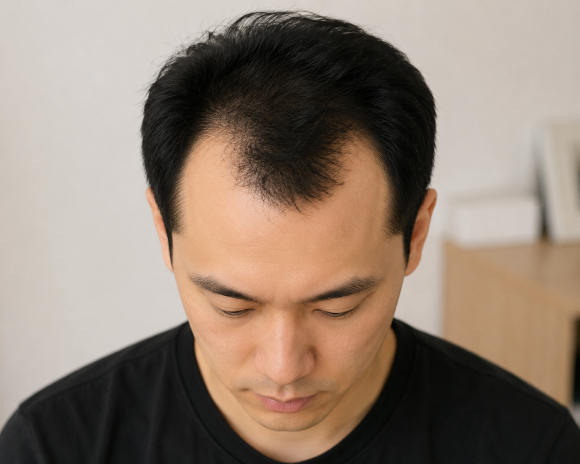
FAQ 2. How can I distinguish a naturally M-shaped forehead from hair loss?
The key is not how it looks now, but whether it has changed.
A naturally M-shaped forehead tends to have a similar shape even in childhood photographs and does not change significantly over time.
By contrast, an M-shaped forehead caused by hair loss tends to gradually recede over several years.
Comparison of a Naturally M-Shaped Hairline and an M-Shaped Hairline Caused by Hair Loss
| Category | Naturally M-shaped | M-shaped caused by hair loss |
|---|
| Childhood | Looks the same in photographs | Shows differences |
| Hairline | Position remains stable | Gradually recedes |
| Hair thickness | Remains consistent | Miniaturization progresses |
| Progression | None | Continues to progress |
I always recommend that patients bring old photographs with them.
This is because comparing the current appearance with the past is much more accurate than assessing the current appearance alone.
FAQ 3. Is hairline maturation different from hair loss?
Yes, it is.
After puberty, the hairline may rise slightly as a normal physiological change.
This is called hairline maturation.
Typically, the change stops within approximately 1 cm.
However, if the hairline continues to recede afterward or the temples become deeply recessed on both sides, progressive hair loss should be considered.
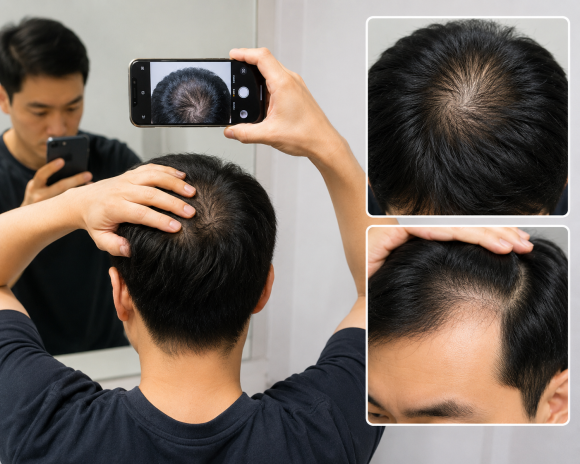
FAQ 4. Can early-stage M-shaped hair loss be diagnosed from a photograph alone?
Unfortunately, an accurate diagnosis is difficult to make from a single photograph.
This is because the hairline can look considerably different depending on the lighting, angle, and hairstyle.
However, taking repeated photographs under the same conditions can be very useful.
-
How to properly document the hairline
-
Use the same indoor lighting
-
Maintain the same distance
-
Keep the same hairstyle
-
Take photographs at 1–2-month intervals
-
Include the entire face in the photograph
Clinics also use this method to compare the condition before and after treatment.
FAQ 5. If I have early-stage M-shaped hair loss, do I need to take medication?
To date, medication is the treatment supported by the strongest scientific evidence.¹⁻³
In particular, finasteride and dutasteride suppress the production of DHT and help slow the progression of hair loss itself.
However, contrary to a common misconception, these medications do not create new hair in areas where the scalp has become completely bare.
Rather, the primary purpose of medication is to preserve living hair follicles for as long as possible.
Minoxidil is used as an adjunctive treatment to thicken hair in a miniaturized state.⁴
FAQ 6. Conversely, are there cases in which a hair transplant is not yet necessary?
Yes.
In fact, hair transplantation is often not rushed in the early stages of M-shaped hair loss.
In the following cases, it is generally advisable to begin with medication and monitor the progress:
-
The hairline recession is mild
-
Miniaturization is the main concern
-
Hair loss is progressing rapidly
-
The patient is relatively young
-
There is a high likelihood that the existing hair can be preserved
In particular, among patients in their 20s and 30s with early-stage hair loss, I often see cases in which medication alone maintains a stable condition for a considerable period of time.

FAQ 7. If I take hair-loss medication, will the empty M-shaped areas fill in again?
Unfortunately, hair follicles that have completely disappeared are difficult to restore with medication alone.
In areas where the follicles have been lost due to scarring, hair transplantation is currently the most reliable treatment option in medicine.
Therefore, the key to treating hair loss is best understood not as “creating new hair,” but as “protecting it while it is still there.”
FAQ 8. Can M-shaped hair loss improve simply by changing my lifestyle?
Improving your lifestyle is important, but it is not a standalone treatment.
However, the following factors may affect the rate at which hair loss progresses:
In particular, smoking constricts the scalp’s microvasculature, so reducing it is recommended.
With M-shaped hair loss, “when it is detected” matters more than “how much has been lost”
In the early stages of M-shaped hair loss, it may simply look as though the forehead has become wider.
However, follicular miniaturization may already have begun beneath the surface.
In particular, if miniaturization, hairline recession, and reduced bang volume are repeatedly observed, it is important to distinguish these changes from a naturally broad forehead shape.
The success of hair-loss treatment depends greatly on how quickly the condition is detected.
If it is difficult to make this judgment on your own, the most important step is to objectively assess your current condition through a professional scalp examination and hair-loss evaluation.
This has been Kim Jin-oh—now it is time for your hair to grow.
必生新毛.

Written by: Kim Jin-oh of New Hair Plastic Surgery (Public Relations Director of the Korean Association of Plastic Surgeons / Academic Director of the Korean Association of Laser, Dermatology and Hair Research)
-
Adjunct Professor, Department of Plastic Surgery, Yonsei University College of Medicine
-
American Board of Hair Restoration Surgery (ABHRS) diplomate
-
Executive Director, Korean Association of Plastic Surgeons
-
Executive Director, Korean Association of Laser, Dermatology and Hair Research (KALDAT)
-
Executive Director, Korean Society for Laser Medicine
-
Full member, International Society of Hair Restoration Surgery (ISHRS)
Recommended Reading