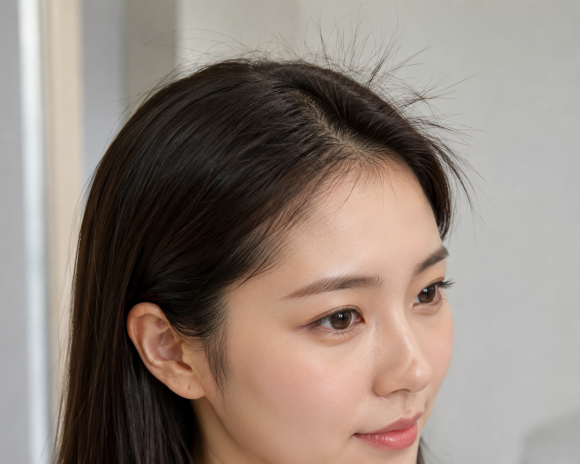
Are New Baby Hairs a Good Sign or a Sign of Hair Loss?
When you look in the mirror and notice a lot of short baby hairs around your forehead or crown, you may find yourself wondering:
"Is new hair growing?"
Or,
"Could this actually be a sign that hair loss is beginning?"
This is, in fact, one of the questions most frequently asked in hair-loss clinics.
However, to give you the conclusion first, it is not possible to determine whether baby hairs are a good or bad sign based solely on their appearance.
Even when they look like the same kind of baby hairs, in some cases they may indicate that the hair is growing healthily, while in others they may mean that the hair is gradually becoming thinner as hair loss progresses.
So, let us take a closer look at the differences.
Baby hairs are often a good sign
Our hair continuously renews itself throughout our lives by repeating the cycles of growth, regression, and rest.
Losing about 50–100 hairs a day is also normal.
New hair grows back where hair has fallen out, and the hair that first emerges is usually short and fine, appearing as baby hair.
Therefore, if your stress has recently decreased, you are in a period of recovery from postpartum hair loss, or you have started hair-loss treatment, seeing baby hairs is more likely to be a positive change.
In particular, if the baby hairs gradually become longer and thicker over time, this can be interpreted as a sign that healthy hair is growing normally.
However, not all baby hairs are a good sign
Conversely, hair that looks like baby hair can also appear as hair loss progresses.
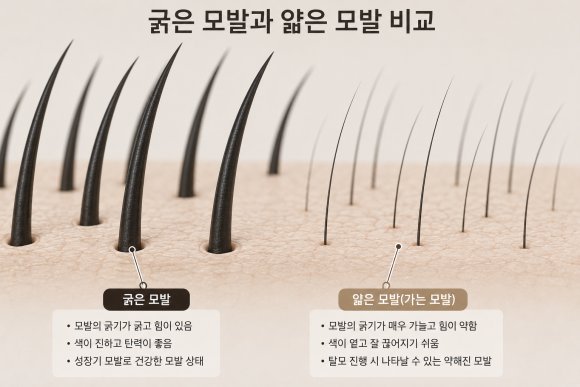
A typical example is the phenomenon of hair miniaturization observed in male-pattern and female-pattern hair loss.
Hair miniaturization refers to the process in which hair that was originally thick gradually becomes thinner and shorter.
In simple terms, the hair grows thin and weak without reaching full growth.
In this case, the hair does not become thicker no matter how much time passes. Instead, it gradually becomes even thinner and shorter.
If the following symptoms appear together, it may be necessary to consider the possibility of hair loss.
-
Your forehead seems wider than before.
-
Your part is gradually widening.
-
The volume at your crown has decreased.
-
Your hair is thinner than it used to be.
-
Someone in your family has hair loss.
-
The baby hairs remain unchanged for a long time.
How can you distinguish healthy baby hairs from hair-loss-related baby hairs?
Baby hairs that are a positive sign gradually become longer and thicker over time.
They also tend to retain a relatively dark color and a healthy appearance.
By contrast, baby hairs caused by hair loss are often extremely thin and weak and fail to grow long.
They tend to remain soft and short for a long time, much like a baby's fine down.
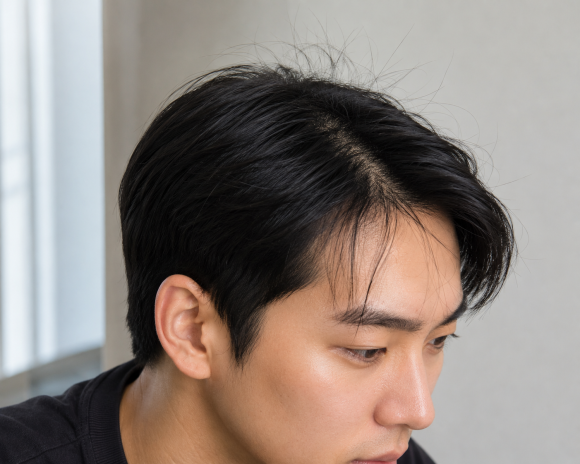
There is also an easy way to check at home.
Take photos of the same area at one-month intervals.
If the baby hairs are gradually getting longer, they are more likely to be a sign of recovery.
On the other hand, if there is no change in their length or thickness even though they appear more numerous, a hair-loss evaluation may be necessary.
Seeing baby hairs does not automatically mean that it is a good sign, nor does it automatically mean that you have hair loss.
What matters is not whether baby hairs are 'appearing,' but 'how they are changing.'
If they are becoming thicker and longer over time, they are more likely to be a positive sign.
However, if they remain thin and short or if the density at both the forehead and crown is decreasing, they may be an early sign of hair loss.
If you are concerned because you are seeing more baby hairs, rather than checking in the mirror every day, the most accurate approach is to take photos periodically under the same conditions and observe how they change.
If you suspect a change, the safest approach is to receive an accurate diagnosis through a consultation with a hair-loss specialist.