Would lowering the forehead by just 2 cm make you look more attractive?
This is one of the questions I hear most often during hairline correction consultations.
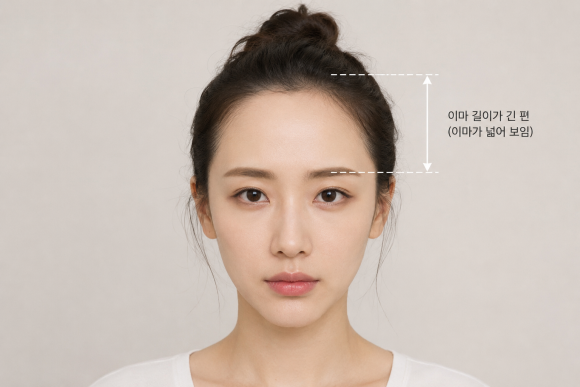
However, in actual consultations, the forehead often looks wider because of the shape of the hairline rather than its height.
Even with the same forehead height, deep M-shaped recessions on both sides or hollow temples can make the upper part of the face look wider and more imposing.
Conversely, in many cases, simply refining the curve of the hairline naturally—without lowering the center very much—can create a much softer and more feminine appearance.
In this post, we will look at hairline correction hair transplantation, focusing on the questions patients ask most often.
Summary: Design Points More Important Than Lowering the Forehead in Women’s Hairline Correction
| A feminine appearance is influenced more by the curve of the hairline and the facial frame than by forehead height.¹² |
|---|
| Satisfaction may be higher when the M-shaped areas and temples are designed together rather than lowering only the central hairline.¹ |
| Hairline correction hair transplantation is not surgery that changes the shape of the bone; it is a treatment that naturally adjusts the outer contours of the face.²³ |
| Good results are determined not by how many centimeters the hairline is lowered, but by the harmony of facial proportions and the direction, thickness, and density of the hair.¹⁵ |
| Forehead reduction surgery and hair transplantation have different advantages and disadvantages, so it is important to choose according to your facial shape and goals.⁴ |
Q1. Isn’t women’s hairline correction simply surgery to lower the forehead?
Many people think of hairline correction as “forehead reduction surgery.”
However, during the actual design process, we first examine the overall frame of the face rather than the forehead height.
This is because the hairline serves a role similar to a frame surrounding the face.
If the M-shaped areas on both sides are deep or the temples recede backward, the forehead can look much wider even when its actual height is not particularly high.
A recent study of East Asian women also reported very high satisfaction with the appearance of the upper face when not only the central height but also the temple width was reduced.¹
In clinical practice, I often see cases in which the face looks much softer simply by making a minor adjustment to the center and naturally connecting the curves on both sides.
Q2. Can it still be effective to fill in only the M-shaped areas while leaving the center of the forehead unchanged?
Yes, it can.
In fact, this is one of the most commonly performed designs for women’s hairline correction.
Naturally filling in only the two corners can make a forehead that previously looked square appear closer to an oval shape.
The change is especially noticeable when the bangs are brushed up or the hair is tied back.
This is why considering facial proportions and harmony is more important than automatically lowering the center substantially.¹
Q3. Is it always best to make a women’s hairline completely round?
Not necessarily.
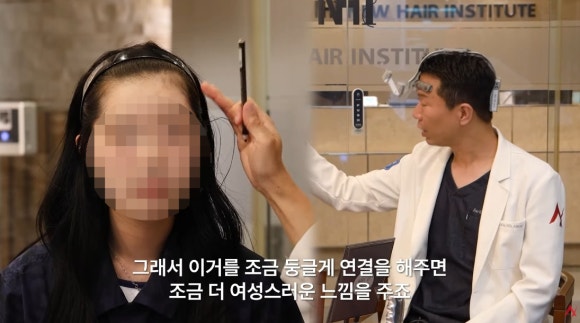
A perfect semicircular shape can actually look artificial, like a wig.
A more ideal women’s hairline is generally considered to have slight variation in the height of the center, with a gentle curve that connects naturally toward both sides.²
In addition, fine single-hair grafts should be used along the very front, while thicker hair and greater density are gradually added farther back to create a natural-looking hairline.¹⁵
Q4. Can the protruding bone above the eyebrows also be improved through hairline correction?
No.
This is a common misunderstanding.
Hair transplantation is surgery that changes the hairline, not surgery that changes the forehead bones.
However, when the hairline is softened, attention is diverted, which may make the underlying bone structure appear less prominent.
In reality, a feminine appearance in the upper face is influenced by multiple factors, including the prominence of the frontal bone, eyebrow position, orbital contours, the angle connecting the forehead and nose, and the hairline.²³
In other words, if the skeletal issue is substantial, hair transplantation alone may have limitations.
Q5. Isn’t the result better the more the forehead is lowered?
Not necessarily.
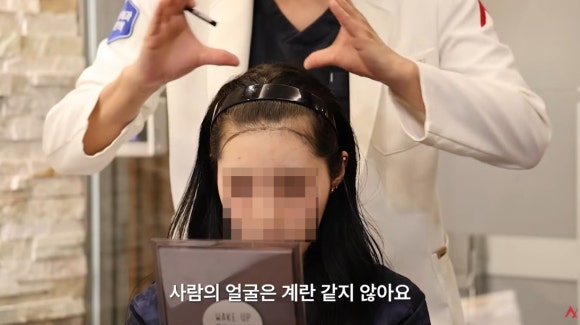
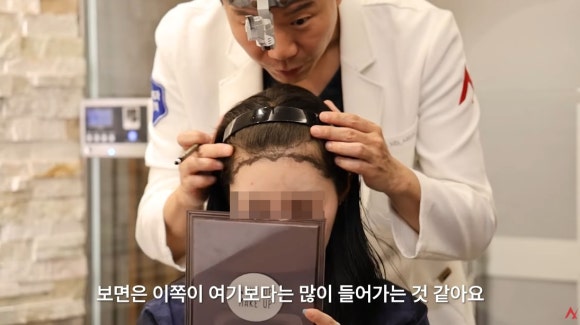
If the central hairline is lowered excessively, the upper part of the face may look cramped or may appear unnatural over time.
One study achieved high satisfaction with an average central shift of approximately 1.33 cm.¹
What matters is not how many centimeters the hairline is lowered, but finding a position that suits the proportions of the entire face.
Q6. Wouldn’t hair transplantation extending to the temples look unnatural?
The temple area is one of the most technically challenging regions.
The hair in this area needs to grow almost flat against the skin, and even a slight difference in direction or angle can make it appear to stick outward.
For this reason, experienced medical professionals design the area while considering the direction and angle of the existing hair.
This is also why the result looks natural not only from the front, but also from a 45-degree angle and from the side.⁵
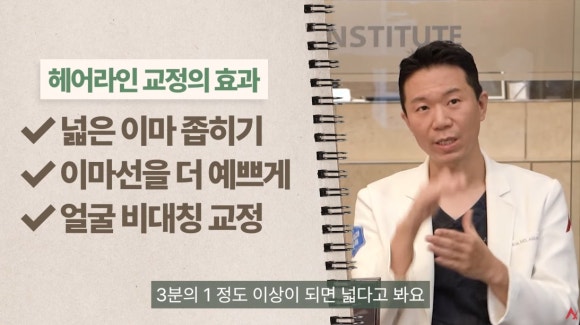
Q7. Why choose hair transplantation when forehead reduction surgery is available?
The two procedures have somewhat different purposes.
Forehead reduction surgery has the advantage of quickly reducing the central height.
Hair transplantation, on the other hand, allows detailed design not only of the center, but also of the M-shaped areas, temples, and sideburns.
In some cases, the two procedures are performed together, with hair transplantation used to improve the appearance of the incision scar.⁴
Q8. Can my hairline be designed to look exactly like a celebrity’s?
Realistically, that is difficult.
This is because facial width, cheekbones, jawline, and head size all differ from person to person, even when the hairline itself is the same.
Photographs can be very helpful as references for communicating the overall look you want.
However, rather than copying the design exactly, it is much more natural to find a hairline that suits your own facial proportions.
| Concern | Helpful approach |
|---|
| The center of the forehead is high | Consultation for forehead reduction surgery or hair transplantation |
| The M-shaped areas are the main concern | Hairline hair transplantation |
| The temples look hollow | Include side hairline design |
| The bone structure looks very prominent | Combine with a skeletal evaluation |
| You often tie your hair back | Design the temple points and sideburns together |
| Hair loss is progressing | Consider treating the hair loss first |
Hairline correction is not simply surgery to reduce the forehead.
It is more accurate to understand it as the process of redesigning the outermost frame of the face.
To achieve a natural result, it is necessary to consider not only how many centimeters are lowered, but also the height and curve that suit the facial shape, the connection between the temples and sideburns, and the direction and density of the hair.
During a consultation, it is important to examine not only front-facing photographs, but also 45-degree and side views, as well as how the face looks with the hair tied back, in order to find the hairline that suits you best.
This has been Jin-oh Kim from New Hair Plastic Surgery, and it is time to welcome a new hair day.
A new hair must grow for life (必生新毛).
Written by: Jin-oh Kim, New Hair Plastic Surgery (Public Relations Director of the Korean Association of Plastic Surgeons / Academic Director of the Korean Association of Laser, Dermatology and Hair Sciences)
-
Visiting Professor, Department of Plastic Surgery, Yonsei University College of Medicine
-
Diplomate of the American Board of Hair Restoration Surgery (ABHRS)
-
Executive Director, Korean Association of Plastic Surgeons
-
Executive Director, Korean Association of Laser, Dermatology and Hair Sciences (KALDAT)
-
Executive Director, Korean Society for Laser Medicine and Surgery
[References]
- Wu, W., Liu, C., Zhang, P. et al. (2025) ‘Enhancing mid-upper facial contours: Hairline transplant solutions for East Asian women with high and wide foreheads’, Journal of Cosmetic Dermatology, 24(8), e70374. doi:10.1111/jocd.70374.
Cited: “A softer and more three-dimensional forehead contour.”
- Mocharnuk, J.W., Wu, C.A. and Pfaff, M.J. (2026) ‘Feminizing the upper third of the face: Forehead, hairline, orbits, and brows’, in Lee, J.C. and Khetpal, S. (eds.) Facial Feminization Surgery. Cham: Springer, pp. 67–79. doi:10.1007/978-3-032-00751-3_6.
Cited: “Continuous mild curvature for a relatively rounder appearance.”
- Khetpal, S., Dahoud, F., Elias, A. et al. (2024) ‘Feminization of the forehead: A scoping literature review and cohort study of transfeminine patients’, Aesthetic Plastic Surgery, 48, pp. 3577–3588. doi:10.1007/s00266-024-04143-6.
Cited: “The overall creation of a harmonic curvature of the forehead with other facial features.”
- Capitán, L., Simon, D., Meyer, T. et al. (2017) ‘Facial feminization surgery: Simultaneous hair transplant during forehead reconstruction’, Plastic and Reconstructive Surgery, 139(3), pp. 573–584. doi:10.1097/PRS.0000000000003149.
Cited: “Redefinition of the hairline by means of an autologous hair transplant.”
- Kashiyama, K., Haraguchi, R., Ban, F. and Tanaka, K. (2021) ‘Study of frontal and temporal hairline patterns in Japanese subjects’, Plastic and Reconstructive Surgery—Global Open, 9(8), e3751. doi:10.1097/GOX.0000000000003751.
Cited: “Differences in the shape of male and female hairlines.”
Related posts