Is Hair Transplantation Possible After Laser Hair Removal? Confusing Myths and Facts
There is a question that many people considering laser hair removal often ask.
"If I undergo laser hair removal several times, will the hair never grow back?"
"What if I need a hair transplant later? Could I become unable to have one?"
Online, some people say, "It is a procedure that eliminates the follicles, so the hair will never grow back," while others say, "It grows back over time," which often causes confusion.
This can be an even greater concern for people who are worried about hair loss or may consider hair transplantation in the future.
To give you the conclusion first, laser hair removal does affect the hair follicles, but it does not completely eliminate every follicle. Its relationship with hair transplantation also varies depending on the area treated.
In this article, I will explain everything from how laser hair removal works to whether hair transplantation is possible in simple terms.
How Does Laser Hair Removal Reduce Hair Growth?
Laser hair removal uses a laser that selectively absorbs melanin, the dark pigment in hair.
As the laser energy travels along the hair, heat is generated around the follicle. This heat damages the tissue that produces the hair.
In other words, it is easy to understand laser hair removal as a treatment that weakens the factory where hair grows, rather than one that burns the skin.
However, not all hair is removed at once.
Body hair repeatedly goes through the growth, regression, and resting phases, and lasers work best on hair in the growth phase.
That is why treatment usually needs to be repeated several times to achieve a satisfactory hair-removal effect.
Will Hair Never Grow Back If I Have Laser Hair Removal Frequently?
This statement is partly true and partly false.
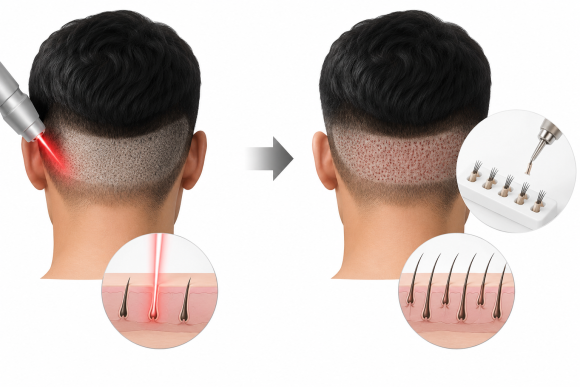
Repeated laser hair removal can damage a considerable number of follicles, causing the hair to become very fine or stop growing for a long time.
However, not all follicles disappear completely.
In fact, some follicles may recover over time, allowing fine hair to grow back.
There are also cases in which new hair that was not previously present begins to grow due to hormonal changes, pregnancy, or certain medical conditions.
For this reason, the medical field often describes laser hair removal not as "a treatment that permanently eliminates all hair," but as "a treatment that reduces the amount of hair over the long term."
Could Scalp Hair Also Stop Growing If It Is Exposed to Laser Frequently?
It is possible.
If the laser repeatedly delivers sufficient energy to the hair follicles on the scalp, the follicles may be damaged.
However, standard laser hair removal is generally performed on areas such as the face, underarms, arms, legs, and bikini line, and the scalp is rarely treated for hair removal.
Rather, because the scalp is an area where hair needs to be preserved, laser treatment is not performed there for hair-removal purposes.
Permanent hair loss occurring immediately after a laser accidentally reaches the scalp once or twice is uncommon. However, repeated exposure to strong energy on the scalp may cause follicle damage.
Is Hair Transplantation Possible in an Area That Has Received Laser Hair Removal?
The answer depends on the area that was treated.
For example, if repeated beard laser hair removal has significantly reduced the number of follicles, it may be difficult to use the beard as a donor hair source later.
This is because hair transplantation is a surgery that moves living hair follicles.
By contrast, hair removal in areas such as the underarms or legs, which are not generally used as donor areas for hair transplantation, does not have a significant effect on standard hair transplantation.
Also, unless the occipital area of the scalp was treated, it generally does not cause problems for most hair-loss surgeries.
In other words, the area where hair removal was performed is much more important than the fact that hair removal was performed.
I Am Considering Beard Hair Removal. What If I Want a Hair Transplant Later?
Recently, there have been more cases in which beard hair is used as an additional donor hair source when there is not enough donor hair on the scalp.
In particular, thick beard follicles can be helpful for patients who have undergone multiple hair transplants or have extensive hair loss.
Therefore, if you are considering hair transplantation in the future, it is advisable not to permanently remove all of your beard hair without careful consideration. Instead, make the decision after consulting thoroughly with a specialist.
If you have already undergone hair removal several times, it is first necessary to evaluate the condition of the follicles that remain.
Does Laser Hair Removal Cause Hair Loss?
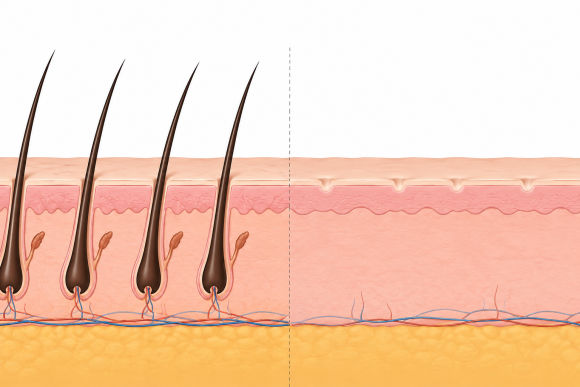
In most cases, it does not.
Laser hair removal is designed to act selectively only on the hair in the targeted area.
For example, removing underarm hair does not cause scalp hair to fall out or lead to hair loss at the crown.
Hair loss is usually caused by a combination of various factors, including genetics, hormones, aging, stress, and medical conditions.
Laser hair removal does not reduce the hair-growth capacity of the entire body.
Laser hair removal is an effective procedure that selectively damages hair follicles to reduce the amount of hair.
However, it does not completely remove every follicle, and some hair may grow back over time.
Also, receiving laser hair removal does not cause hair throughout the body to stop growing or result in hair loss.
However, if you are considering hair transplantation in the future, it is advisable to make a more careful decision about hair removal on the beard or scalp, as these areas may potentially be used as donor hair sources.
Considering not only your current situation but also your future treatment plans can help reduce unnecessary regret and preserve more treatment options.