Understanding the Difference Between White Bumps on the Lips, Herpes with Blisters, and Canker Sores
It is often concerning to discover small white bumps or blister-like lesions on the lips or inside the lips while looking in the mirror.
You may wonder whether they could be contagious or a sign of a serious illness.
However, white bumps or blisters that appear on the lips can have many different causes, and in many cases, they are not serious conditions.
Still, it is important to distinguish between them because some conditions may require treatment depending on their appearance, level of pain, and duration.
In this article, we will explain in simple terms the common causes and symptoms of white bumps and blisters on the lips, as well as how to manage them.
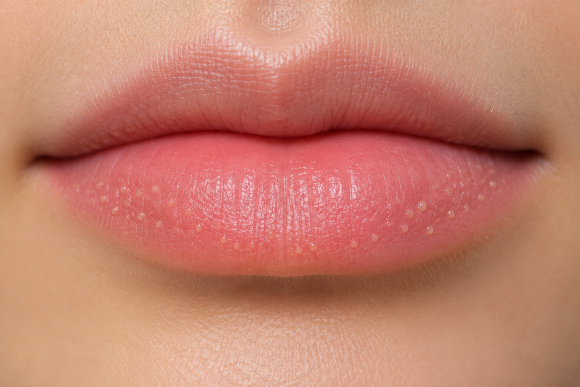
The most common cause is Fordyce spots.
If you see multiple small, yellowish or white bumps along the border or inside of the lips, they may be Fordyce spots.
These are normal structures that are visible because the sebaceous glands are located close to the surface of the skin.
They are neither a disease nor an infection, and they are not contagious.
They usually cause little to no pain or itching, and their size often does not change significantly.
Unless treatment is desired for cosmetic reasons, no special treatment is necessary.
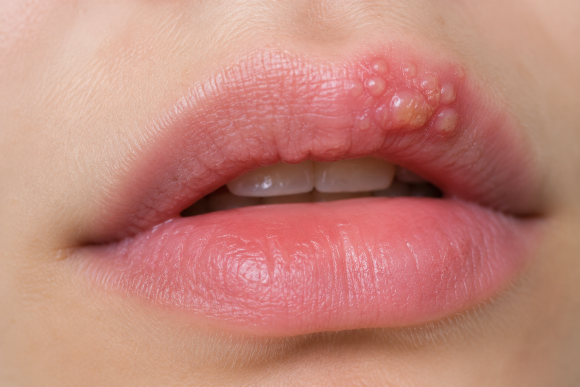
Cold sores on the lips appear as clusters of small blisters.
If a tingling or burning sensation first develops around the edge of the lips, followed by several small blisters appearing in a cluster, herpes simplex, also known as a cold sore, may be suspected.
Herpes is caused by the herpes simplex virus and commonly recurs when you are tired or under significant stress.
After the blisters burst, scabs form, and the lesions typically heal over a period of one to two weeks.
When active blisters are present, the virus can be transmitted to others through contact, so caution is necessary.
If symptoms are severe or you visit a doctor early, antiviral medication may help shorten the recovery period.
Canker sores can also appear white.
If a round ulcer covered by a white or yellowish film develops on the mucous membrane inside the lips and causes significant pain, it may be a canker sore.
Canker sores often occur when you are tired, under severe stress, or have a weakened immune system.
Pain may worsen when eating hot or irritating foods.
Most improve naturally within one to two weeks, but if the pain is severe, a canker sore ointment or mouthwash may be used.
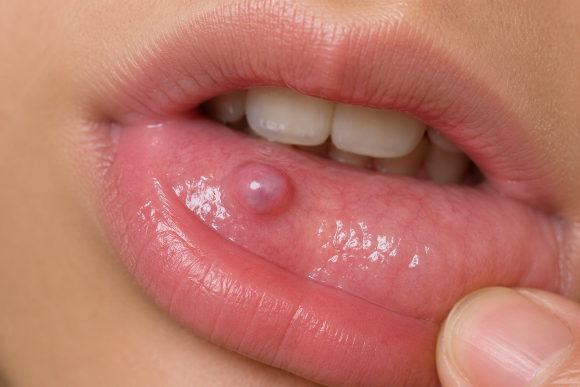
A mucocele can also look like a white lump.
If a soft, blister-like swelling develops after frequently biting the inside of the lip or sustaining an impact, it may be a mucocele.
It is a lump that forms when a small salivary gland duct becomes blocked and saliva accumulates.
It may appear clear, slightly bluish, or white.
Small mucoceles may disappear on their own, but if they recur or become larger, surgical removal may be necessary.
It is best to avoid bursting them forcibly because of the risk of infection.
A Candida infection can also be a cause.
If a white coating develops throughout the mouth and wiping it away reveals red mucous membranes, a Candida infection may be suspected.
It is more likely to occur when the immune system is weakened or after taking antibiotics for a long period.
It can also occur relatively commonly in infants and young children or older adults.
Most cases improve well with antifungal treatment.
When should you visit a doctor?
In the following cases, it is advisable to visit a doctor for an accurate diagnosis.
-
If it does not disappear for more than two weeks
-
If it gradually increases in size
-
If it repeatedly develops in the same location
-
If there is bleeding or severe pain
-
If pus or significant swelling is present
-
If swollen lymph nodes in the neck or a fever also occurs
In particular, although rare, a persistent lip lesion in someone with a long history of smoking or alcohol consumption may need to be differentiated from conditions such as lip cancer.
White bumps or blisters on the lips may be normal structures such as Fordyce spots, or they may be conditions requiring treatment, such as herpes or canker sores.
Even if they look similar, their causes can differ, so it is important to consider whether there is pain, where the lesion occurs, and how long it persists.
Most are not serious conditions, but if symptoms persist for a long time or occur repeatedly, it is advisable to receive an accurate diagnosis.
Above all, avoid bursting or squeezing the lesion yourself, as this can worsen inflammation and infection. The safest approach is to receive care and treatment appropriate for the cause.