The first product people often change when they start worrying about hair loss is their shampoo.
The internet is filled with phrases such as “strengthens hair roots,” “hair loss gene care,” “hair regrowth,” and “hair growth.”
These products are also often several times more expensive than regular shampoos.
So, does using an expensive hair loss shampoo really improve hair loss?
Today, I will organize the actual research findings and clinical experience surrounding the questions patients frequently ask in the clinic.
Summary: Is It Enough to Use Only a Hair Loss Shampoo? The Difference Between Treatment and Shampoo
| Functional hair loss shampoos are functional cosmetics that may help relieve hair loss symptoms, not hair loss treatments.¹² |
|---|
| Even when they contain various ingredients such as caffeine and panthenol, there is not enough evidence that they make new hair grow.³ |
| Shampoos can be expected to help manage sebum, dandruff, itching, and hair damage.⁴ |
| More important than the price is consistently using a product that suits your scalp and hair. |
| If hair loss at the hairline or crown is progressing, it is important to consider diagnosing and treating the underlying cause before focusing on shampoo.⁶ |
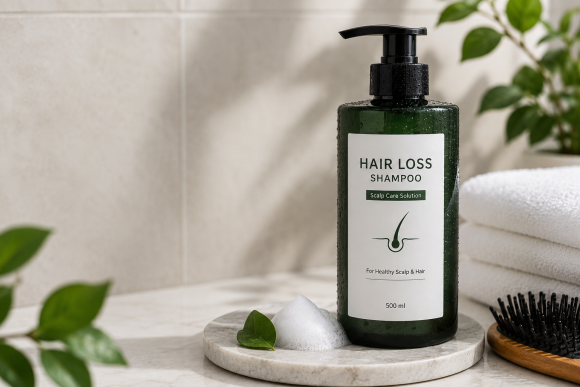
Q1. Can hair loss improve if I use only a hair loss shampoo?
The short answer is that this is unlikely.
In Korea, hair loss functional shampoos are legally classified as “functional cosmetics that help relieve hair loss symptoms.”¹
In other words, they are not treatments that restore hair follicles or create new hair like medications do.
The Ministry of Food and Drug Safety also states that expressions such as hair regrowth, hair growth, and growing hair cannot be used in advertisements for functional cosmetics.²
In clinical practice, I have rarely seen ongoing male-pattern or female-pattern hair loss recover through the use of shampoo alone.
By contrast, I quite often see people miss the period when treatment is needed.
Q2. Wouldn’t a shampoo be more effective if it contains caffeine or biotin?
Many hair loss shampoos contain caffeine, biotin, panthenol, niacinamide, peptides, and other ingredients.
These ingredients may provide some benefit in improving the scalp environment or protecting the hair.
However, results from test-tube or cell experiments are different from the actual treatment effects in people with hair loss.
A systematic review published in 2025 analyzed studies of topical products containing caffeine, but only nine clinical trials were ultimately included.³
In addition, the caffeine concentrations and product formulations varied between studies, and there were not enough randomized controlled trials. The researchers therefore also assessed the level of evidence as low.³
Therefore, it is difficult to expect a treatment effect simply because a product contains a particular ingredient.
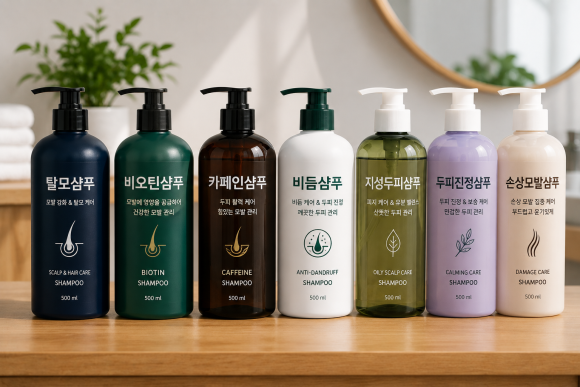
Q3. My hair fell out less after I changed shampoos. Was that just my imagination?
There is no need to assume that it was necessarily your imagination.
People with excessive sebum or severe dandruff may experience reduced scalp inflammation and itching after using a shampoo that suits them.
Damaged hair may also become less tangled and experience less friction when a shampoo with good conditioning properties is used, which can reduce the amount of hair breaking midway along the shaft.⁴
As a result, you may see fewer hairs in the bathroom drain.
However, this means that hair damage has decreased; it is not the same as the hair follicles recovering.
A receding hairline or hair loss at the crown is caused by changes in the follicles themselves and requires separate treatment.⁶
Q4. Is an expensive hair loss shampoo a better product?
A higher price does not necessarily mean that a product is better.
The price of shampoo includes not only the raw materials but also the fragrance, container, brand, and advertising costs.
In fact, people with sensitive scalps may find a simpler formulation more comfortable than a product containing large amounts of fragrance and plant extracts.
On the other hand, people with high sebum production may find that their scalp becomes oily and itchy before the afternoon if they use a product with cleansing power that is too weak.
Ultimately, what matters is not the price but how your scalp responds.
It is helpful to check the following:
-
Whether your scalp stings or feels hot after washing
-
Whether it becomes excessively oily in the afternoon
-
Whether flaking increases
-
Whether your hair feels excessively stiff
-
Whether the price is affordable enough for consistent use
If a product meets these criteria, even an inexpensive shampoo can be a sufficiently good choice.
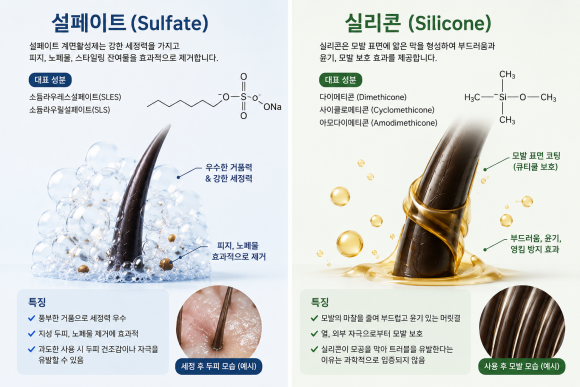
Q5. Do sulfates or silicones need to be avoided at all costs?
No.
Silicones can reduce friction in damaged hair and make it easier to comb.⁴
Sulfates are also simply one type of cleansing ingredient, and the degree of irritation varies depending on the product’s overall formulation.
Mildly acidic shampoos may also help reduce friction in the hair, but their effectiveness in treating hair loss has not been established.⁵
Therefore, rather than choosing a product based on just one particular ingredient, it is much more important to observe the condition of your scalp after actually using it.
Q6. Doesn’t washing your hair frequently make hair loss worse?
This is a common misunderstanding.
Most of the hairs you see while washing are hairs that were already at the stage when they were going to fall out.
They do not fall out newly because of shampoo.
If you have a lot of sebum but go a long time without washing your hair, dandruff and itching may actually become worse.
Rather than counting the number of hairs in the drain, comparing photographs taken one month apart in the same place and lighting is much more helpful for determining whether hair loss is progressing.³
| Question | Key answer |
|---|
| Can hair loss be treated with only a hair loss shampoo? | It is difficult for shampoo to replace treatment. |
| Does caffeine shampoo work? | It may have some potential, but the evidence is still limited.³ |
| Is a more expensive shampoo better? | A product that suits your scalp is more important than the price. |
| Does washing your hair frequently worsen hair loss? | No. |
| Can it be used with minoxidil? | In most cases, they can be used together.⁶ |
Q7. If I continue using only a hair loss shampoo, do I not need medical treatment?
My answer to this question is “No.”
Male-pattern and female-pattern hair loss are conditions in which the hair follicles gradually become smaller.
To date, treatments with sufficient supporting evidence, such as minoxidil and 5-alpha-reductase inhibitors, remain central.⁶
Shampoo is a useful way to support scalp care, but it cannot replace treatment.
If your hairline continues to recede or the crown gradually appears thinner, it is better to receive an accurate diagnosis first rather than continuing to switch shampoos.
Q8. Does leaving the lather on longer make a hair loss shampoo more effective?
Not necessarily.
Some products specify a recommended leave-on time in their instructions, but there is not enough evidence that leaving the product on longer leads to greater absorption into the follicles and increased treatment effectiveness.
In fact, it may worsen irritation and dryness on a sensitive scalp.
The safest approach is to follow the time stated in the product instructions.
Hair loss shampoo is a cosmetic product for maintaining a healthy scalp and hair, not a product that treats hair loss.
It still has sufficient value when it helps reduce sebum and flakes, relieve itching and dandruff, and prevent the hair from becoming excessively tangled.
However, if the hairline is receding or hair loss at the crown continues to progress, considering an accurate diagnosis and treatment before continuing to change shampoos is much more important in the long term.
Ultimately, the best hair loss shampoo is not the most expensive product, but one that suits you—one that keeps your scalp comfortable even with daily use and that you can continue using consistently.
This was Kim Jin-oh, reminding you that now is the time to care for your hair.
May new hair grow for life.
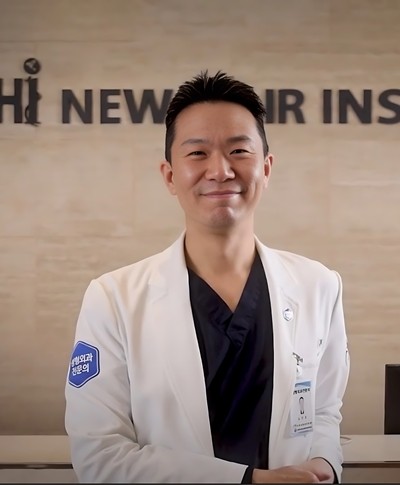
Written by: Kim Jin-oh of New Hair Plastic Surgery (Public Relations Director of the Korean Association of Plastic Surgeons / Academic Director of the Korean Association of Laser, Dermatology and Trichology)
-
Visiting Professor, Department of Plastic Surgery, Yonsei University College of Medicine
-
American Board of Hair Restoration Surgery (ABHRS)
-
Executive Director, Korean Association of Plastic Surgeons
-
Executive Director, Korean Association of Laser, Dermatology and Trichology (KALDAT)
-
Executive Director, Korean Society for Laser Medicine
[References]
-
Ministry of Government Legislation (2026) Enforcement Rule of the Cosmetics Act, Article 2: Scope of Functional Cosmetics. Effective 2 April 2026.
-
Ministry of Food and Drug Safety (2019) Beware of False Advertising Claiming That Cosmetics Promote Hair Growth. Ministry of Food and Drug Safety, Republic of Korea.
-
Szendzielorz, E. and Spiewak, R. (2025) ‘Caffeine as an active ingredient in cosmetic preparations against hair loss: A systematic review of available clinical evidence’, Healthcare, 13(4), 395. doi:10.3390/healthcare13040395.
-
Dias, M.F.R.G. (2015) ‘Hair cosmetics: An overview’, International Journal of Trichology, 7(1), pp. 2–15. doi:10.4103/0974-7753.153450.
-
Dias, M.F.R.G., de Almeida, A.M., Cecato, P.M.R., Adriano, A.R. and Pichler, J. (2014) ‘The shampoo pH can affect the hair: Myth or reality?’, International Journal of Trichology, 6(3), pp. 95–99. doi:10.4103/0974-7753.139078.
-
Kaiser, M., Abdin, R., Gaumond, S.I., Issa, N.T. and Jimenez, J.J. (2023) ‘Treatment of androgenetic alopecia: Current guidance and unmet needs’, Clinical, Cosmetic and Investigational Dermatology, 16, pp. 1387–1406. doi:10.2147/CCID.S385861.
Recommended reading