On the evening of Thursday, July 16, 2026, I attended a lecture held at the Korean Medical Association building as part of the Executive Medical Policy Program. The topic was “The Present and Future of Genomic Information-Based Precision Medicine,” presented by Professor Woong-Yang Park of Sungkyunkwan University School of Medicine.
Although concepts such as precision medicine and genetic analysis are no longer particularly unfamiliar to the public, the various real-world treatment data presented that day were enough to make the changes taking place in clinical medicine tangible.
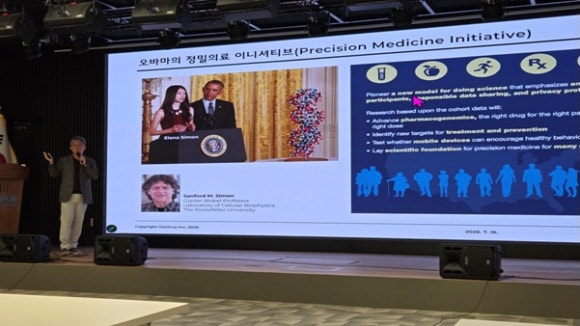
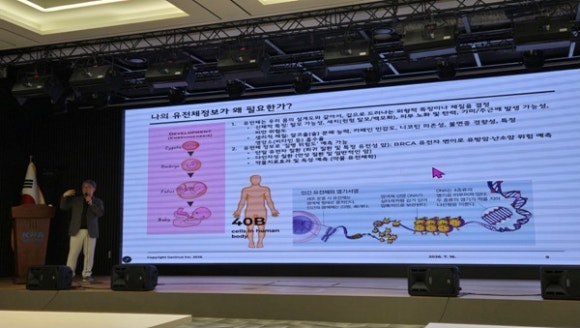
What drew my greatest attention was the actual commercialization of precision medicine: accurately defining the characteristics of a disease and identifying treatments based on an individual patient’s genetic information.
Precision medicine has already begun changing the paradigm of cancer treatment. This includes technologies that analyze the genetic information of cancer patients to predict treatment effectiveness and toxicity, as well as antibody-drug conjugates that, like guided missiles, precisely target cancer cells and deliver a drug payload to them.
What was particularly impressive was the technology capable of detecting invisible minimal residual cancer DNA at an early stage using only a blood test. Even when surgery has been completed cleanly and imaging tests and the physician’s examination suggest that the cancer has completely disappeared, tiny fragments of cancer DNA remaining in the blood can be identified to predict the risk of recurrence in advance.
The specific statistic that recurrence rates decreased by approximately 40% when preemptive anticancer treatment was administered to patients who tested positive was especially interesting. The fact that this method can detect warning signals in the body as much as six months earlier than conventional imaging tests showed that precision medicine is already much closer to us than expected.
After listening to the lecture, I began thinking deeply about how this enormous trend could be applied to hair loss treatment and hair transplantation. If cancer treatment is evolving by analyzing patients’ genetic characteristics to improve effectiveness and identify potential side effects, then hair loss treatment, which I encounter every day in clinical practice, should follow a similar path of development.
Hair loss treatment is also an area that constantly struggles with the challenge of “individual differences.” In the consultation room, even among people with the same type of hair loss, some experience almost miraculous thickening of their hair after taking medication, while others see only minimal effects or experience unexpected discomfort and become hesitant about treatment. Hair transplantation is no different. Even when transplantation is performed using the same methods and standards, there are clear differences in graft survival rates and growth speeds depending on the patient’s scalp environment.
Applying the perspective of precision medicine to hair loss reveals several clues that could improve the quality of treatment.
The first is personalized prescribing of hair loss medications.
If we could first identify the genetic characteristics of the enzymes that break down medications or of hormone receptors, we could determine in advance which drugs—such as finasteride, dutasteride, or minoxidil—would be safer and more effective for each patient. Just as Professor Woong-Yang Park examined his own genetic variants and chose a different class of medication instead of Tylenol to avoid liver toxicity, hair loss patients could also receive personalized prescriptions through genetic screening that reduce the risk of side effects while increasing treatment effectiveness.
The second is understanding the scalp microenvironment beyond the cellular level.
The environment of the scalp in which hair follicles grow is extremely important for a successful hair transplant. We are entering an era in which even the spatial characteristics of how the cells that drive hair growth within the follicle interact with surrounding immune cells can be analyzed. If the scalp microenvironment before and after transplantation could be interpreted at the molecular level, it would be possible to develop a management program that minimizes immune rejection and excessive scar formation while maximizing the graft survival rate of hair transplantation.
The third is the use of early diagnostic markers.
Just as residual cancer can be detected early through blood testing, changes in gene-expression patterns in the hair-root tissue could potentially be detected at a stage far earlier than the point at which hair thinning becomes visible to the naked eye. Using these markers, we could track the rate of hair thinning in advance and begin preventive treatment before hair loss becomes visibly pronounced.
Rather than being satisfied with the immediate physical result of increasing density by implanting several thousand grafts through hair transplantation, the goal should be to integrate the patient’s clinical and genetic information and present the safest and most sustainable treatment pathway. This appears to be the direction in which precision medicine should be applied to hair loss treatment in the future.
Of course, genetic data are ultimately only a useful map that increases the probability of selecting an effective treatment. The essence of medicine will not change: accurately interpreting that map, providing treatment suited to the patient’s actual condition and prescription history, and applying the physician’s clinical philosophy and skilled hands remain essential.
The future of precision medicine presented in the Korean Medical Association lecture hall became more than simple academic knowledge. It served as a new milestone for understanding patients from multiple perspectives and treating them with greater precision in the consultation room. It made me reflect once again on the weight of the clinical care and prescriptions I will face in the future as I keep pace with this enormous trend.
[References]
National Research Council. (2011). Toward Precision Medicine: Building a Knowledge Network for Biomedical Research and a New Taxonomy of Disease. National Academies Press.
Kim, S. T., Park, W. Y., et al. (2017). Clinical Application of Targeted Deep Sequencing in Solid-Cancer Patients and Utility for Biomarker-Selected Clinical Trials. The Oncologist, 22(10), 1169-1177.
Park, K. H., Kim, Y. H., et al. (2022). Genomic Landscape and Clinical Utility in Korean Advanced Pan-Cancer Patients from Prospective Clinical Sequencing: K-MASTER Program. Cancer Discovery, 12(4), 938-947.
Nakamura, Y., et al. (2026). Real-world Clinical Utility of Comprehensive Genomic Profiling in Advanced Solid Tumors. Nature Medicine, 32(1), 45-53.