The question people considering hair transplantation ask most often in the consultation room is surprisingly not, “How many grafts will be transplanted?”
Is it okay to have surgery now?
Do I really need to take medication?
Will the hair at the back of my head really never fall out?
As these questions show, people are much more curious about the preparation process before surgery.
In this article, I will organize the key points you should know before hair transplantation, focusing on questions frequently asked in actual clinical consultations.
Summary of 7 FAQs to Check Before Hair Transplantation: Preparation More Important Than the Surgery
| Accurate diagnosis and assessment of hair-loss progression should come before the surgery itself.¹⁻⁴ |
|---|
| For patients who need medical treatment, preserving existing hair can reduce the area requiring transplantation or produce a more natural result.³ |
| The donor area is not unlimited, so long-term planning that considers the follicles available for lifelong use is important.¹² |
| Scalp inflammation or cicatricial alopecia should be treated first, and surgery should be considered only after confirming that the condition is stable.¹⁶ |
| A good clinic is one that first explains, “Are you in a condition where surgery is appropriate now?” rather than simply asking, “How many grafts should we transplant?”²³ |

Q1. Does hair transplantation also treat hair loss?
No.
This is one of the most common misconceptions.
Hair transplantation does not treat the cause of hair loss; it is a procedure that moves hair follicles to areas where hair is missing.²
In other words, the transplanted hair may grow well, but the existing hair remaining around it may continue to thin.
As a result, a hairline that looked natural immediately after surgery may develop a noticeable boundary years later as the surrounding hair falls out.
This possibility must be considered, particularly when hair loss is still progressing in younger patients.²³
This is also why, in clinical practice, the scope of surgery is determined while predicting not only the patient’s current appearance but also the possibility of future hair-loss progression.
Q2. Can I not have hair transplantation if I do not take medication beforehand?
Not necessarily.
Hair-loss medication is not essential for every patient.
However, when a substantial amount of existing hair remains, beginning medical treatment first is often helpful.³
If the existing hair becomes thicker after medical treatment, the number of grafts needed to achieve the same result may be reduced.
Conversely, if there is little treatment response, it may be advantageous to design the hairline conservatively by anticipating a wider future area of hair loss.
International expert consensus statements also emphasize the importance of stabilizing hair loss and providing medical treatment before surgery.³
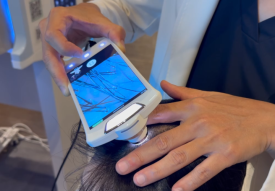

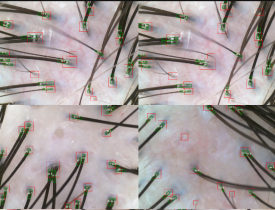
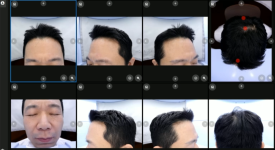
Q3. Is scalp and hair dermoscopy necessary?
Typical male-pattern hair loss can be diagnosed to some extent by visual examination.
However, in planning the actual surgery, magnified examination provides significantly more information.¹
The main findings that can be assessed include:
-
Differences in hair thickness
-
Subtle follicular miniaturization
-
Safety of the donor area
-
Inflammation around the follicles
-
Empty follicular openings
Especially when female-pattern hair loss, diffuse hair loss, or cicatricial alopecia is suspected, it may be necessary to reconsider whether surgery should be performed at all.¹
Q4. Isn’t the hair at the back of the head hair that never falls out?
That is partly true and partly false.
Many people believe that “hair at the back of the head never falls out,” but in reality, there are individual differences.
The safe donor area, its density, and hair thickness vary from person to person, and some patients develop diffuse hair loss that also causes thinning in the occipital region.¹
Recent studies have also reported the possibility that the occipital hair diameter index may improve in some patients after finasteride treatment.⁵
In other words, the donor area must also be measured and evaluated before it is used.
Q5. Isn’t it better to have surgery quickly even if hair loss is still progressing?
In many cases, the opposite is true.
If hair loss has progressed rapidly over the past 6–12 months, the priority is to first assess its rate of progression.²
If surgery is rushed, the transplanted hair may remain while the existing hair continues to fall out, making the result look unnatural.
Conservative hairline design that takes the long-term extent of hair loss into account is particularly important for people in their 20s and 30s.²³
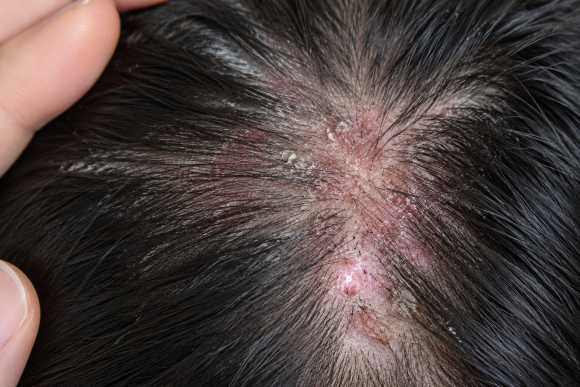
Q6. Can’t I simply have surgery even if I have scalp inflammation?
If it is mild seborrheic dermatitis of the scalp, surgery may be possible after treatment.
However, not all cases of scalp inflammation are the same.
In cicatricial alopecias such as frontal fibrosing alopecia or lichen planopilaris, surgery while active inflammation remains may reduce the graft survival rate.⁶
Currently, some cases are managed by confirming stability for a certain period and, when necessary, performing a test transplant before proceeding with the full procedure.⁶
Therefore, if you repeatedly experience scalp stinging, burning, or redness, you must inform the medical staff during your consultation.
Q7. Doesn’t transplanting more grafts produce a better result?
No.
Transplanting 3,000 grafts does not always mean a better result than transplanting 2,000 grafts.
The result is influenced more strongly by the following factors than by the number of grafts:
That is why experienced physicians explain a long-term follicle-allocation plan rather than simply recommending the maximum number of grafts.²
| What you want to know | Why it needs to be checked |
|---|
| Hair-loss diagnosis | It is necessary to differentiate it from other hair-loss conditions.¹ |
| Whether hair loss is progressing | It determines the future design.² |
| Possibility of medical treatment | It helps preserve existing hair and adjust the number of grafts.³ |
| Condition of the donor area | It confirms the safe harvesting range.¹ |
| Presence of scalp inflammation | It helps determine the graft survival rate and timing of surgery.⁶ |
| Long-term hairline 5–10 years later | It takes future naturalness into account.²³ |
A good hair transplant does not begin in the operating room.
The first steps are to accurately diagnose the current cause of hair loss, predict how far it may progress, and confirm how safely the donor area can be used.¹⁻⁴
More important than transplanting a large number of grafts is having a long-term plan that can maintain a natural-looking result in the years ahead.
When you have a consultation, ask not only, “How many grafts will be transplanted?” but also, “Why do you recommend surgery now?” and “Is it possible to choose not to have surgery at this time?”
The answers may become the most important criteria determining the result several years from now.
This was Jin-oh Kim, reminding you that now is the time for hair.
A lifetime of new hair.
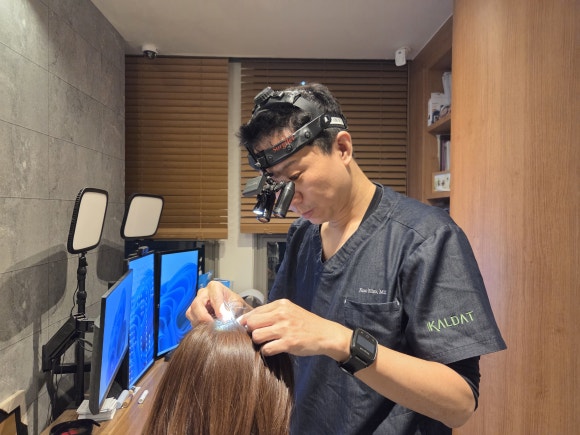
Written by: Jin-oh Kim of New Hair Plastic Surgery (Public Relations Director of the Korean Association of Plastic Surgeons / Academic Director of the Korean Academy of Laser, Dermatology and Trichology)
-
Adjunct Professor, Department of Plastic Surgery, Yonsei University College of Medicine
-
American Board of Hair Restoration Surgery (ABHRS)
-
Standing Director, Korean Association of Plastic Surgeons
-
Standing Director, Korean Association of Laser, Dermatology and Trichology (KALDAT)
-
Standing Director, Korean Association for Laser Medicine and Surgery
[References]
-
Issa, N.T. and Tosti, A. (2021) ‘Trichoscopy for the Hair Transplant Surgeon—Assessing for Mimickers of Androgenetic Alopecia and Preoperative Evaluation of Donor Site Area’, Indian Journal of Plastic Surgery, 54(4), pp. 393–398. doi:10.1055/s-0041-1739245.
-
Mysore, V., Kumaresan, M., Garg, A., Dua, A., Venkatram, A., Dua, K., Singh, M., Madura, C., Chandran, R., Rajput, R.S., Sattur, S. and Singh, S. (2021) ‘Hair Transplant Practice Guidelines’, Journal of Cutaneous and Aesthetic Surgery, 14(3), pp. 265–284. doi:10.4103/JCAS.JCAS_104_20.
-
Vañó-Galván, S., Bisanga, C.N., Bouhanna, P., Farjo, B., Gambino, V., Meyer-González, T., Silyuk, T. and Hair Transplant Surgery Expert Group (2023) ‘An International Expert Consensus Statement Focusing on Pre and Post Hair Transplantation Care’, Journal of Dermatological Treatment, 34(1), article 2232065. doi:10.1080/09546634.2023.2232065.
-
Kash, N. (2026) ‘Notes from the Editor Emeritus, 2023–2025:
Good Hair Restoration Surgery Starts Before Surgery’, Hair Transplant Forum International, 36(3), p. 81. doi:10.33589/36.3.81.
-
Wang, Q., Yang, K., Lin, J., Liu, Q., Zhu, Y., Li, Z., Ni, C., Lin, J. and Wu, W. (2023) ‘Investigation of Oral Finasteride Enhanced Occipital Hair Diameter Index in Different Types of Male Androgenetic Alopecia’, Journal of the American Academy of Dermatology, 89(6), pp. 1292–1294. doi:10.1016/j.jaad.2023.08.027.
-
Queen, D. and Avram, M.R. (2025) ‘Hair Transplantation in Primary Cicatricial Alopecias: A Review and Update’, Surgeries, 6(4), article 80. doi:10.3390/surgeries6040080.

Related articles