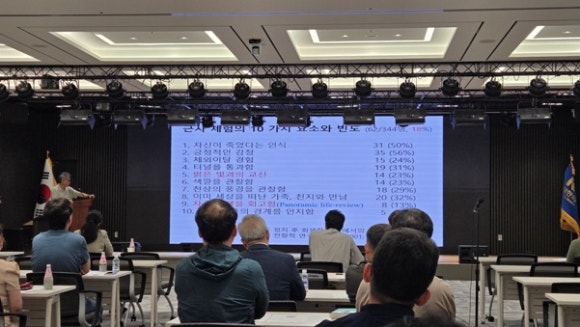
On July 23, 2026, I attended a lecture by Jung Hyun-chae, an emeritus professor at Seoul National University College of Medicine, in the auditorium on the first basement level of the Korean Medical Association building. The title of the lecture was “The Meaning and Preparation for Life Viewed Through Well-Dying and Thanatology.”
Death is something no one can avoid, but it is also one of the most difficult subjects to bring up in everyday life. When we talk about death while healthy, it may be taken as an ill-omened remark. Yet when death draws near because of illness or an accident, we hold back again, afraid of hurting the person involved. In this way, we face the most certain event in life without having prepared for it.
Professor Jung is an internal medicine physician who has treated patients for many years, as well as a researcher who has studied and lectured on thanatology for nearly 20 years. The lecture began with the question of whether we should view death not merely as a medical event, but as a process that completes a person’s life.
How Do Doctors View Death?
In medicine, death is often regarded as an enemy to be defeated. When a patient recovers, it is considered a successful treatment, while a death can sometimes feel like a failure of medicine. Doctors encounter dying patients more frequently than anyone else, yet conversations about the meaning of death are often left to philosophers or religious leaders.
Philosophers think deeply about death, but they do not have many opportunities to repeatedly witness people at the moment of death. Apart from some hospice workers, religious leaders also do not meet dying patients every day. Doctors, meanwhile, witness countless deaths at close range but do not study death itself sufficiently.
Medicine has made remarkable advances in prolonging life. However, how long a life can be maintained and how a person can complete their life well are different questions. We need to reconsider whether continuing treatment to the very end is always in the patient’s best interest, and whether stopping treatment necessarily means giving up.
In the past, many people died in their own homes, surrounded by family members. Children also learned that death was part of life by watching their grandparents pass away. Today, death has moved from the home to the hospital. When consciousness declines and breathing becomes unstable, patients are moved to intensive care, and some are intubated and placed on ventilators before dying alone in the early hours of the morning, separated from their families.
Advances in medical technology have saved many lives. At the same time, they have also contributed to the perception of a natural dying process as a failure of medicine. While listening to the lecture, I felt that “medicine that saves lives” is just as important as “medicine that helps people leave this world well.”
Death Does Not Come with Warning
We generally think of death as something in the distant future. This is even more true when we are healthy and have no particular ailments. However, the clearest characteristic of death is that it is difficult to predict.
Professor Jung told us about a medical school classmate who had been living a healthy life, collapsed on the way to work one day, and died that evening. He had looked healthier than anyone and enjoyed cycling. Yet death does not tell us to prepare in advance because it will arrive six months later.
Those who suddenly lost their lives in major accidents probably did not know that something would happen to them that morning. No one knows whether the day they will encounter death after turning a street corner will be tomorrow, a year from now, or ten years from now.
That is why preparing for death is not something to begin after death has drawn near. While healthy, we need to think about our final days, complete an advance directive for life-sustaining treatment, and discuss with our families how our property and personal belongings should be organized. Even if it is not a legally valid will, writing down the words we want to leave for our loved ones can also be meaningful.
Trying to begin such conversations suddenly after receiving a terminal diagnosis is much more difficult. A family member may bring up a will or life-sustaining treatment and hear the response, “Are you telling me to die?” When the conversation is truly needed, it may already have become too difficult to have.
Preparing for death does not mean hastening death. It means accepting that life has an end and viewing the time that remains more clearly.
Is Death a Wall or a Door?
A large part of the lecture was devoted to near-death experiences and end-of-life experiences.
Professor Jung asked whether we should view death only as an impenetrable wall behind which everything disappears, or as a door leading to another dimension. He also introduced a scene from the Japanese film <em>Departures</em> in which an elderly man who had worked at a crematorium for many years describes death as “a door leading to the next world.”
Elisabeth Kübler-Ross, known as a pioneer of thanatology, compared the human body to a shell surrounding the eternal self. Her explanation was that, just as a caterpillar sheds its cocoon and becomes a butterfly, death is a process of moving into another state rather than the disappearance of existence.
Of course, these claims cannot be regarded as established facts confirmed by current medicine. The relationship between the brain and consciousness, and whether consciousness exists after death, remain controversial areas. However, the professor examined them not merely as religious beliefs, but through near-death experiences and end-of-life experiences reported in actual clinical settings.
A near-death experience is a phenomenon in which a person whose heart has stopped and who has been revived through cardiopulmonary resuscitation says they had a particular experience while unconscious. Experiences of leaving the body, feeling as though one is passing through a tunnel, encountering a bright light, seeing family members who had already died, and reviewing one’s life repeatedly appear in these accounts.
In a Dutch study published in the medical journal <em>The Lancet</em> in 2001, 62 of 344 patients who had been revived after cardiac arrest—approximately 18%—said they had experienced a near-death experience. What was even more interesting was what happened afterward. When the researchers followed them over an extended period, those who had experienced near-death experiences showed greater empathy and understanding toward others, more gratitude for small things in daily life, and less fear of death.
A brief experience had changed one person’s values and direction in life for a long time.
The accounts of life reviews during near-death experiences were also striking. A person’s life unfolds like a panorama, and scenes in which they hurt someone are experienced not from their own perspective, but from the perspective of the person who was hurt. The emphasis, they said, is not on how much one owned, but on how much one loved and cared for others.
There is no need to accept this story as proof of an afterlife. However, simply imagining experiencing our words and actions again from the other person’s position has the power to make us reflect on the way we are living now.
What People Near Death See
End-of-life experiences were introduced alongside near-death experiences.
Patients nearing death sometimes see family members or acquaintances who have already passed away, or say that someone has come to take them. In hospice settings, this phenomenon is sometimes called a “final gift” that eases the anxiety of patients and their families.
The lecture introduced the case of a woman who was dying from severe bleeding after childbirth and said that she saw her father, who had died long ago, as well as a younger sibling whose death had not been disclosed to her. The patient said the two had come to meet her and wore a peaceful expression.
The professor explained that if medical staff judge such scenes only as hallucinations or delirium and immediately administer sedatives, they may interrupt an important final experience for the patient.
Of course, dying patients may have various causes that need to be medically assessed, including hypoxia, medication effects, metabolic abnormalities, and delirium. This does not mean that necessary treatment should be withheld. However, before declaring every experience to be pathological, we need to listen carefully to what the patient is seeing and whether the experience is causing fear or bringing peace.
Medicine is the study of classifying and treating symptoms, but not everything in the world a patient experiences can be explained through test results. During the dying process, what may be needed more than correcting the patient’s words is listening to them until the end.
The Reason to Study Death Is to Live Well
The film <em>Ikiru</em>, directed by Akira Kurosawa, appeared in the latter part of the lecture.
The protagonist is a civil servant living listlessly at city hall. One day, he learns that he has terminal stomach cancer and realizes that he does not have much time left. He devotes himself to creating a park that local residents had requested for years but that no one had addressed. After overcoming numerous obstacles and completing the park, he dies on a snowy night while sitting on the swing he had built and singing a song.
The lecture introduced a scene in which he looks at the evening sunset on his way home from work and says, in effect, “I lived for so long without knowing that something this beautiful existed.” Only after learning that he was going to die did he recognize how beautiful an ordinary evening sunset could be.
Death is not an event on the opposite side of life. The fact that life has an end gives value to today. If time were infinite, there would be many things we could put off. But when we know that time is limited, we become less reluctant to say “I love you,” and the time spent on meaningless arguments begins to feel wasteful.
Thanatology is not a field that studies only how to die. It asks what kind of life we will live, what we will leave behind, and what attitude we will show the people we meet today.
Questions About Death Education and Physician-Assisted Dying
The question-and-answer session also addressed death education and the issues of physician-assisted dying and euthanasia.
The professor emphasized the need for death education in our society. At one school in Japan, twelve sessions of death education were held, covering topics such as the death of a companion animal, choices when diagnosed with a terminal illness, planning one’s own funeral, and discussions about the afterlife. The lecture also introduced a case in which school violence, bullying, and suicide decreased after this education was provided.
Teaching children about death does not instill dark thoughts in them. Understanding that their own lives and the lives of others are finite and precious may make it more difficult for them to treat someone carelessly. This means that death education can also be education in respect for life and in how to live.
Regarding physician-assisted dying and euthanasia, the professor expressed the view that patients’ extreme suffering and right to self-determination should be respected, while emphasizing that the issue must not be approached as a way to reduce medical expenses or social costs. If economic considerations begin to take priority, invisible pressure may be placed on older adults, people with disabilities, and seriously ill patients to choose death.
Before discussing the right to choose death, we should examine whether patients are receiving adequate pain control and care, and whether they are being pressured to make that choice because they feel like a burden to their families or society. Choices concerning death should be an issue of human dignity, not cost reduction.
After the Lecture
Although I have not often had to face death directly while working as a physician, death is not a distant subject for anyone whose profession deals with the human body and life. Medicine has diligently taught us how to diagnose and treat disease, but it has not taught us sufficiently how to talk with patients about death.
I do not think we need to accept every part of the lecture as a single scientifically proven conclusion. In particular, various interpretations exist regarding the afterlife and the independence of consciousness. However, dismissing all patients’ experiences simply because they are difficult to explain with current science cannot be called scientific either.
What stayed with me the longest was not the explanation of the afterlife, but the idea that our attitude toward death can change the way we live in the present.
We do not need to live solemnly in every moment, thinking that today could be our last day. But if we occasionally remember that life will one day end, we may be able to avoid becoming excessively angry over trivial matters and be a little kinder to those close to us. We may tell someone we always thought would be by our side that we are grateful, begin something we have been putting off, or look once more at the evening sunset.
Preparing for death does not end with deciding on funeral arrangements or whether to receive life-sustaining treatment. More fundamentally, it may mean taking good care of the relationships that will remain after I am gone, gradually resolving conflicts that have not been settled, and not putting off what I can do now.
Death used to feel like the final period at the end of life, but after attending the lecture, that period came to seem more like a mirror reflecting the life we are living now.
Dying well is ultimately inseparable from living well. And living well may begin not with grand achievements, but with treating the people we meet today with a little more respect and not taking the ordinary day we have been given for granted.
Written by: Jin-oh Kim, New Hair Plastic Surgery (Public Relations Director of the Korean Association of Plastic Surgeons / Academic Director of the Korean Laser, Dermatology and Hair Society)
-
Adjunct Professor, Department of Plastic Surgery, Yonsei University College of Medicine
-
American Board of Hair Restoration Surgery (ABHRS) Diplomate
-
Executive Director, Korean Association of Plastic Surgeons
-
Executive Director, Korean Association of Laser, Dermatology and Hair Technology (KALDAT)
-
Executive Director, Korean Society for Medical Laser