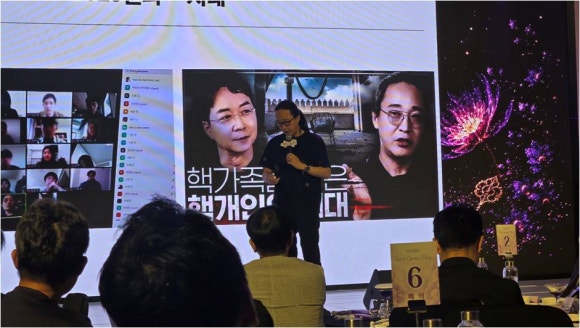
I attended author Song Gil-young’s lecture at a symposium held on July 18, 2026.
I was glad to hear about the lecture because I had read all of his books. I had not realized it while reading them, but the live lecture had a real sense of momentum. The topics moved quickly, from kiosks to artificial intelligence, and from running to K-beauty, but each story was ultimately saying the same thing.
When people’s lives change, the way they work changes, and when the way they work changes, industries and consumption move along with it. The future does not suddenly arrive one day; it gradually reveals itself within our everyday lives, which are already changing.
The Person Who Gives Change a Name
Author Song Gil-young began his lecture with the term “core individual,” which he coined. It refers to a society in which people make their own judgments and choices rather than relying on the decisions of organizations and groups. He said that giving new changes a name is important. Only when something has a name can we recognize it and share it with others. It is like the poet Kim Chun-su’s line, “When I called his name, he came to me and became a flower.” Terms such as “core individual,” “the society of naming,” and “lightweight civilization,” coined by Song Gil-young, do not create entirely new phenomena. Rather, they organize changes that have already been happening around us so that they are easier to recognize.
Even when change is right in front of us, we often cannot explain exactly what it is. That is because it is mixed into our familiar daily lives. Once we give it a name, concepts scattered here and there begin to appear connected as one. This is also why I like Song Gil-young’s books. Rather than predicting the distant future, he closely observes what is happening now and reads the next direction within it.
Innovation Becomes a Basic Requirement, Not a Benefit
Early in the lecture, he talked about kiosks, which spread rapidly after the pandemic.
Installing a kiosk can reduce the number of employees working at the counter by one. It may seem that the store’s profits would increase by the amount of the saved labor cost, but reality does not always work that way. If all the nearby stores also adopt kiosks, the reduced costs are absorbed again through rent or other expenses in the course of competition.
In the end, a kiosk becomes not a technology that gives the stores that install it a special advantage, but a basic requirement that pushes stores without one out of the competition.
The speaker described it this way: “Adopting innovation does not create an advantage; failing to adopt it leads to falling behind.”
When a new technology first appears, a clear difference emerges between those who use it and those who do not. But when the technology quickly becomes widespread, that difference soon disappears. Yesterday’s innovation becomes today’s competitive advantage, and by tomorrow it becomes a standard that everyone must have.
Then simply adopting technology is not enough. What matters is what you will do differently with the same technology. This is why the standards of the people who choose and use technology last longer than the technology itself.
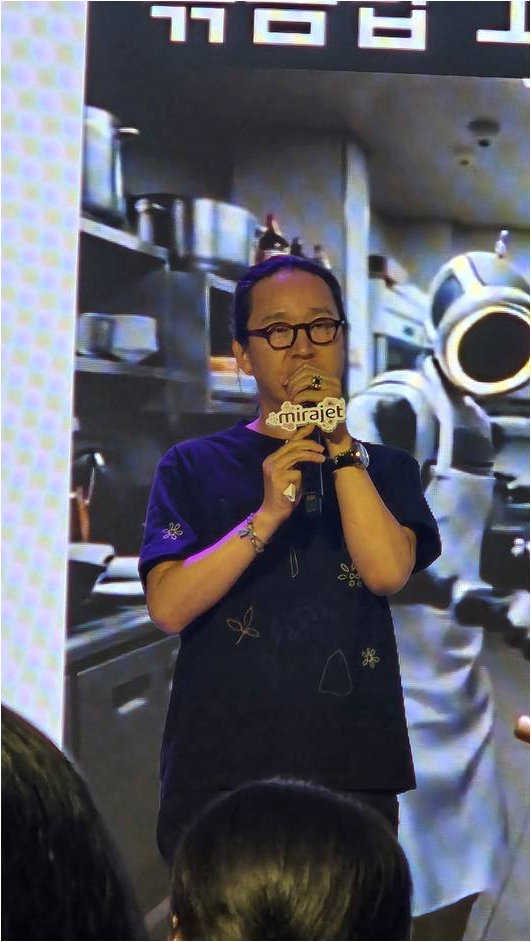
The Future of Work May Not Be About Doing Things Faster
One of the statements I remember most clearly that day came in the section explaining changes in work.
The past of work was “Work hard,”
The present of work is “Work smart,”
And the future of work is “Do not do that work.”
When I first heard it, it sounded strange to say that in the future we should not work. But looking back, many tasks have already disappeared from our lives.
We do not go to bank counters, receive parking tickets, or tell restaurant employees our orders. Tasks that someone once had to perform are now naturally disappearing.
Artificial intelligence is moving in the same direction.
At first, it helped people perform the work they were already doing more quickly. Now, beyond asking which person should handle a task, it is beginning to ask whether a person needs to do it at all.
In the past, it was important to divide work among several people, check their progress, and compile the results. That was because multiple people had to move together. But if one person can use artificial intelligence to handle research and analysis, writing, and production, the roles in the middle inevitably become fewer.
The lecture explained this amusingly by connecting two works that had recently become the subject of discussion.
If you combine The Story of Manager Kim, Who Owns a Home in Seoul and Works for a Major Corporation and No Other Choice,
“Manager Kim, who owns a home in Seoul and works for a major corporation, has no choice but to quit his job.”
That was the resulting sentence.
It was funny enough to make the audience burst out laughing, but it was also a somewhat serious message: the era when organizations and titles served as substitutes for explaining an individual’s abilities is coming to an end.
In the future, what a person can understand, judge, and produce independently from beginning to end is likely to matter more than which organization they belong to or what position they hold.
What Should We Teach Artificial Intelligence If We Want It to Handle Our Work?
The lecture also introduced the progression from large language models to AI agents and then to ontologies.
Until now, we have asked artificial intelligence questions and received answers. Going forward, it will develop beyond answering questions toward taking on and carrying out specific tasks.
The question is what we can entrust to artificial intelligence.
Simply providing information is not enough for it to perform a task properly. It needs to know what to check first in a given situation, what to prioritize among several options, and how to make a judgment when an exception arises.
When an expert evaluates a problem, they do not look only at a single result visible in front of them. They also consider when the problem began, what process it went through, and how previous choices have affected the present. They must decide whether to resolve it immediately or observe it a little longer, as well as the order in which to apply several methods.
Much of this process is difficult to explain using only the knowledge written in books or manuals. Intuition and judgment built through long, repeated experience with similar situations also come into play.
It is a natural process for a skilled person, but difficult to explain when they try to put it into words.
An ontology is the process of structuring the concepts, experiences, relationships, and standards of judgment scattered throughout one’s mind so that artificial intelligence can understand them as well. It enables AI to use one’s accumulated approach to solving problems, rather than merely serving as a search box.
Therefore, rather than asking whether artificial intelligence will replace experts, it may be more useful going forward to consider how large the difference will become between people who can connect their experience with AI and those who cannot.
From a Life of Buying Things to a Life of Actually Living
The latter part of the lecture moved on to changes in consumption and lifestyle.
In the past, what a person owned—good furniture, a car, or luxury goods—was an important way of showing their standard of living and taste. If they bought beautiful things and decorated their home well, their life also appeared equally stylish.
Recently, however, what people actually do and how they live has become more important than what they own.
Song Gil-young described this as “a shift from Buying to Living.” It means that the center of gravity is moving from a life of buying things to a life of directly living in the way one wants.
Running is a representative example of this change.
Buying running shoes and workout clothes is not difficult. But a lifestyle of running consistently for months or years cannot easily be imitated. The body and posture change, while distance and time accumulate on a smartwatch. The time one has actually lived remains in the body and in the records.
In the past, one’s job was the most important part of their identity.
When asked, “What do you do?” people introduced themselves by their company and position. Exercise was a hobby undertaken to perform better at work.
Now, however, more people first describe themselves as runners, travelers, or creators. Their job becomes a means of maintaining the lifestyle they want. The company is no longer the core that explains who they are; it becomes a device they use to support the life they want for themselves.
We are entering an era in which how a person lives, rather than what they have bought, reveals who they are.
People Look for Stages on Which They Can Stand
The discussion of high-priced running brands and HYROX was also memorable.
Even when a set of running clothes costs several hundred dollars and race entry fees are quite high, many people are willing to pay. It is not simply because they need athletic clothing or want to exercise for a few hours.
People are buying, together, the identity of being a runner, the experience of standing at the starting line after months of preparation, and the sense of achievement they feel when crossing the finish line.
HYROX is a competition that combines running with several other athletic disciplines. Participants have to prepare for months, and spectators also pay to visit the venue.
Song Gil-young explained that, observing this phenomenon, people are once again looking for stages on which they can stand.
When we were young, there were many stages: school performances, sports days, piano recitals, and various competitions. After becoming adults, however, work became almost the only stage. Promotions, performance results, and awards such as Employee of the Month were important scenes of social recognition.
Now that a company can no longer represent an individual’s entire life, people create separate stages of their own. They complete marathons, compete in events, and share experiences with people who have similar interests, gaining a sense of achievement.
What people spend money on changes accordingly. They pay not only for a product’s functions but also for the process of becoming the person they want to be.
I understood this as a message that we should not focus only on what customers purchase, but also understand what kind of life they hope to live through that purchase.
Brands Are Created Among People Who Live the Same Kind of Life
The explanation of running-focused brands and select shops was also interesting.
The employees working there were not simply salespeople; they were people who actually ran. The people buying the products were runners, and the people selling them were runners too. Because they engaged in the same activity and understood the same culture, they could communicate without having to explain the product’s functions at length.
The seller and buyer meet not as parties in a separated relationship, but as people belonging to the same community.
Author Song explained that branding is the ongoing process of bridging the gap between the ideal one wants to become as a brand and one’s current position. He said that the word “branding” ends in “-ing” because it is not something completed with a single declaration.
A brand is not completed simply by creating a clever phrase and running advertisements. It must actually live the life it talks about and show that attitude repeatedly every day.
Customers no longer look only at what a brand says. They also look at whether the people saying those things really live that way.
People Travel to Seoul for K-Beauty
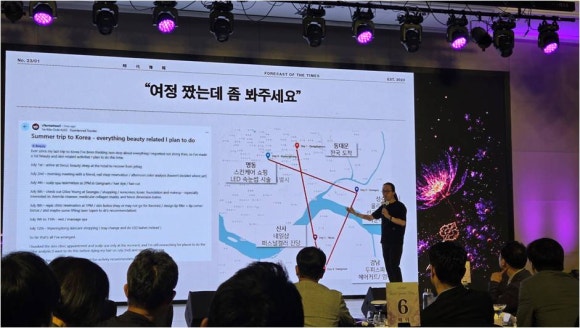
One of the scenes that drew the most attention at the lecture was a travel itinerary written by an overseas tourist visiting Korea.
The slide showed a route moving around Seoul over eight days.
In Sinsa-dong, the traveler receives a manicure and a personal color consultation, while in Gangnam they get a scalp spa and hair care. They buy cosmetics at Olive Young in Seongsu-dong, shop for skincare products in Myeong-dong, and also receive an eyelash treatment.
This was not a matter of using a beauty service midway through a trip to Seoul. The traveler was moving throughout the city in order to experience beauty.
K-beauty no longer means only cosmetics made in Korea. It has become a connected experience encompassing personal color, hair and scalp care, skin treatments, cosmetics stores, and even the atmosphere of neighborhoods and spaces.
People do not come to Korea simply to buy one product. They come to directly experience how people in Korea care for themselves, consume, and live.
It was clear that Korea’s beauty industry is expanding from a product-centered industry into a lifestyle industry combining travel, spaces, and services.
The World Is Curious Not About Korean-Made Products, but About Koreans’ Choices
He said that questions from overseas consumers are also changing.
In the past, they might have asked, “Can you recommend a good Korean brand?” Now they ask:
“What do people in Korea actually use?”
They do not choose a product simply because it was made in Korea. They check what Korean consumers actually buy and use. Apparently, many people even visit the Korean Olive Young website, use a translation tool, and examine domestic sales rankings.
As K-beauty has become known around the world, Korean consumers’ choices themselves have become a standard of verification.
Becoming famous overseas is important, but the fact that a product was chosen first in Korea can create even stronger trust. It signifies that the product has made it through competition among demanding Korean consumers.
Song Gil-young described the Korean market as “the major leagues.” He meant that brands must first earn recognition in Korea before going out into the world.
The fact that Korea has attracted attention through the growth of K-beauty does not mean that every Korean brand will automatically succeed. What matters is not the name Korea itself, but the experience of being genuinely chosen within Korea.
From Korean Brands to the Korean Way of Life
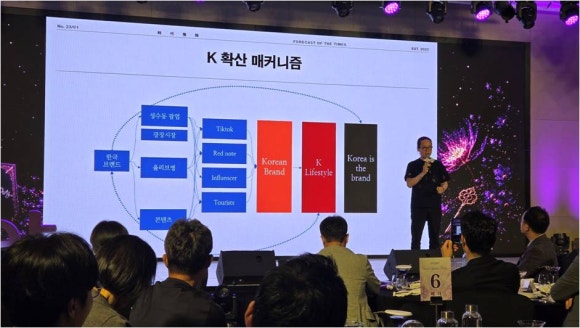
The “K-Expansion Mechanism” introduced toward the end of the lecture showed these changes on a single page.
Korean brands meet people in spaces such as pop-up stores in Seongsu-dong, Gwangjang Market, and Olive Young. The experiences created there spread around the world through TikTok, Xiaohongshu, influencers, and tourists.
At first, people like one Korean brand. Next, they become curious about the lifestyle of the Koreans who use that brand. Eventually, Korea itself becomes a brand.
Korean Brand
→ K Lifestyle
→ Korea is the brand
Interest in a product expands into interest in a way of life, and eventually people come to visit the places where that life is created.
The increasing number of people visiting Korea and the attention being drawn to places such as Seongsu-dong, Gwangjang Market, Bukchon, and Seochon were also connected to this trend.
K-beauty does not mean only the success of cosmetics. Everything experienced in Korea—including fashion, food, spaces, medical care, and services—is being tied together into a single image.
And he said that this trend is still only in its early stages.
“Do Something, Anything”
Song Gil-young said to the audience several times during the lecture:
“Everyone, please do something, anything.”
It was probably meant to elicit laughter, but it was the line I remembered most after the lecture ended.
Of course, he probably did not mean that we should move around busily in just any direction.
First, we need to observe the direction in which change is taking place. We need to look at what people are choosing and what they are abandoning. Then, when we discover a growing trend, we need to place our own experience and abilities on top of it.
Song Gil-young also explained, in a surprisingly simple way, how to see the future.
When change arrives, people choose some parts of it. What is chosen becomes the future, while what is not chosen becomes the past. Therefore, by observing people’s choices, we can read the direction of the future.
The future is not a scene lying far away. If we look at what clothes people are wearing now, where they spend their time, what they spend money on, and what names they use to describe themselves, the next era is already contained within those things.
This is probably also why I have always liked his books. Rather than offering grand predictions about the future, they make us look again at the present that we had overlooked because it was so familiar.
Leaving the Lecture Hall
Listening to the lecture naturally led me to reflect on my own work.
Learning about new technologies and artificial intelligence has now become difficult to avoid. However, it will become increasingly difficult to create a difference simply by acquiring the latest technology. Once everyone can use similar tools, what ultimately matters is the standards by which we make judgments and how we take responsibility.
The experience I have accumulated through providing care over many years may not be enough if it remains only in my head. I need to organize more clearly what information I consider important, the order in which I make judgments, and the situations in which I change the direction of care. Only then can I connect it with new technologies and make better use of them.
When patients’ lives change, what they expect from medical care changes as well. Treating hair loss and performing hair transplantation are not limited to simply increasing the number of hairs. We also need to understand how people want to live and what they hope to regain in their daily lives through treatment.
Technology changes quickly, and some of the tasks we are familiar with today will disappear. Even so, observing people, making judgments suited to each situation, and taking responsibility for results in our own names are unlikely to disappear easily.
If change has already begun, what will I try now?
The answer may be as simple as Song Gil-young’s words:
Observe carefully, choose a direction, and start something—anything.
Written by: Jin-oh Kim, New Hair Plastic Surgery (Public Relations Director, Korean Association of Plastic Surgeons / Academic Director, Korean Association of Laser, Dermatology and Hair)
-
Adjunct Professor, Department of Plastic Surgery, Yonsei University College of Medicine
-
Diplomate of the American Board of Hair Restoration Surgery (ABHRS)
-
Executive Director, Korean Association of Plastic Surgeons
-
Executive Director, Korean Association of Laser, Dermatology and Hair (KALDAT)
-
Executive Director, Korean Society for Laser Medicine