Is it possible to treat the underlying cause of male pattern hair loss directly without taking hair-loss medication?
We still need to wait for more clinical trial results. However, this is no longer merely a matter of discussing possibilities. RNA technology targeting the androgen receptor is being applied to human scalps, and two Korean companies are developing products using different approaches.
Bioneer was the first to commercialize CosmeRNA, a topical RNA product applied to the scalp.
OliX is developing OLX104C, an RNA drug injected into the scalp.

Source: Yonhap News Agency
Recently, OliX completed dosing all patients in its Phase 1b clinical trial conducted in Australia.
Once the final follow-up observations and data analysis are complete, the company plans to evaluate the actual hair-growth effects in a Phase 2a trial. It is not yet a treatment that can be prescribed, but it is significant that RNA-based hair-loss treatment has reached the stage of verifying its effects after repeated administration to humans.
Could RNA treatments repair hair-loss genes?
When people hear the term RNA treatment, they may easily think of therapies that cut or alter genes.
However, the RNA hair-loss treatments currently in development are not gene-editing therapies that permanently alter DNA. They are treatments designed to temporarily reduce the production of specific proteins involved in hair loss.
The cells in our bodies contain DNA. DNA stores the information needed to make various proteins. When a cell needs a protein, it copies the relevant section of DNA into a temporary copy called messenger RNA, or mRNA. The cell reads this copy to produce the actual protein.
Small interfering RNA, or siRNA, can be designed to find and break down specific mRNA with a matching base sequence. When the amount of mRNA decreases, the protein produced based on its instructions also decreases.
If DNA is the original blueprint, mRNA is a work order delivered to the production site. RNA interference treatment does not alter the original blueprint. It is closer to selecting one problematic work order from among many and preventing it from being delivered for a certain period.
Therefore, the treatment effect is also unlikely to be permanent. Once the period during which the RNA acts has passed, the relevant protein may be produced again. However, if the effect lasts long enough, treatment at regular intervals may become possible instead of taking or applying medication every day.
Source: Nature
How is it different from existing hair-loss medication?
Dihydrotestosterone, or DHT, plays an important role in male pattern hair loss.
When DHT binds to androgen receptors in hair follicles susceptible to hair loss, the hair-growth phase becomes shorter. Hair that once grew thick and long gradually becomes thinner and shorter.
Finasteride and dutasteride inhibit the conversion of testosterone into DHT. They reduce the amount of hair-loss signaling delivered to the hair follicles.
RNA hair-loss treatments currently under study target a different point in the process.
If DHT is a broadcast signal, the androgen receptor is the antenna that receives it. While finasteride and dutasteride weaken the broadcast signal, RNA treatment aims to reduce the number of antennas in the hair follicles.
The target of OliX and Bioneer is the mRNA that produces the androgen receptor. The aim is to reduce the follicles’ response to DHT by causing follicle cells to produce fewer androgen receptors. Bioneer evaluated the potential of this approach in a human study, while OliX advanced to drug clinical trials after preclinical studies using animal models and human scalp tissue.
The main reason this mechanism is attracting attention is the possibility of localized treatment.
If androgen receptors can be sufficiently reduced only in the scalp and hair follicles while minimizing the amount of drug that enters the bloodstream, hair-loss signaling could be regulated without substantially reducing DHT throughout the body.
For people who have been unable to start treatment because they are concerned about the systemic side effects of oral hair-loss medication, this could become a new option.
Two Korean companies pursuing the same target
One interesting aspect of the RNA hair-loss field is that two technologies targeting the androgen receptor are both being developed by Korean companies.
Bioneer and OliX are heading toward the same destination, but their product-development strategies are quite different.
| Category | Bioneer CosmeRNA | OliX OLX104C |
|---|
| Target | Androgen receptor mRNA | Androgen receptor mRNA |
| RNA technology | SAMiRNA-AR68 | Cell-penetrating asymmetric siRNA |
| Administration method | Applied to the scalp | Injected into the scalp dermis |
| Product classification | Cosmetic | Investigational drug candidate in clinical trials |
| Place of use | Used directly by consumers | Administered at a medical institution |
| Development focus | Convenience and accessibility | Consistent delivery and treatment effects |
| Human data | 24-week human application study reported | Phase 1b dosing completed; Phase 2a being prepared |
Bioneer first introduced its RNA hair-loss technology as a product applied at home, while OliX is developing a formal injectable treatment targeting the same receptor for administration at medical institutions.
One company prioritized accessibility. The other chose to bypass the skin barrier in an effort to demonstrate more consistent and stronger effects.
Source: Bioneer
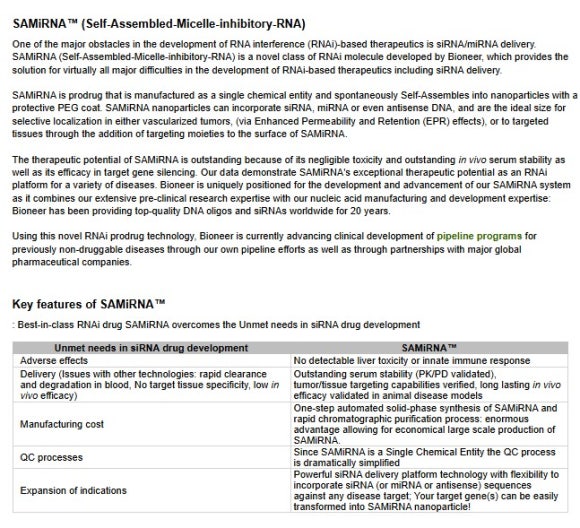
Bioneer applies RNA in the form of nanoparticles
RNA does not easily enter cells when simply applied to the skin. It is susceptible to degradation in the external environment and must pass through the skin’s stratum corneum.
Bioneer’s SAMiRNA was designed by combining hydrophilic and hydrophobic structures with RNA so that it forms nanoparticles on its own in water. Instead of placing the RNA inside a separate delivery vehicle, the RNA itself forms a spherical micelle structure. This structure is intended to improve the RNA’s stability and ability to enter cells. (Bioneer)
CosmeRNA is applied to the scalp and massaged in to facilitate delivery through the hair follicles. Its greatest advantage is that it can be used regularly at home without needles.
Source: Nature
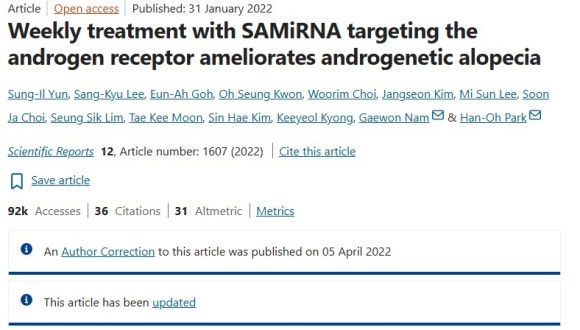
In a randomized, double-blind study published in 2022, the treatment group that used high-concentration SAMiRNA-AR68 once a week showed an average increase of approximately 7.7 hairs/cm², or 4.4%, after 24 weeks. Although the study was not large and did not directly compare the treatment with existing hair-loss medication, it demonstrated the potential for applying RNA to the scalp in humans.
CosmeRNA is currently a cosmetic product, not a drug. Therefore, it has not been approved as a hair-loss treatment that replaces finasteride or dutasteride.
That does not mean its technological significance is minor. It is close to being the first commercial model for RNA hair-loss technology in that it transformed unstable RNA into a form that consumers can apply to the scalp and confirmed changes in hair in humans.
However, topical products must pass through the stratum corneum and the openings of the hair follicles. The amount of RNA that actually enters follicle cells may vary depending on scalp sebum, skin debris, the amount applied, and the massage technique. Although the product is convenient to use, it is difficult to control the delivered dose consistently.
Source: PubMed
OliX bypasses the skin barrier and injects the treatment directly into the scalp
OliX’s OLX104C is also known by the substance name OLX72021. It is a cell-penetrating asymmetric siRNA treatment targeting androgen receptor mRNA.
In conventional siRNA, the two strands are similar in length, whereas OliX’s asymmetric siRNA was designed with strands of different lengths. A structure that enhances its ability to enter cells was also incorporated. In preclinical studies, it reduced androgen receptor mRNA and protein levels, and changes related to hair growth were observed in an animal model of DHT-induced hair loss. The possibility of suppressing androgen receptors was also evaluated in experiments using human scalp tissue.
The administration method is intradermal injection into the scalp.
An injection can bypass the stratum corneum on the skin’s surface and deliver a defined dose directly to the desired area. Compared with a topical product, it is easier to provide a consistent amount to each patient. This approach is advantageous for developing a drug intended to achieve a more pronounced treatment effect.
However, injections must be administered at multiple sites at a medical institution. Pain, procedure time, treatment cost, and the interval between repeated treatments will be important issues for eventual commercialization.
Therefore, for OliX’s treatment to succeed, an increase in hair alone will not be enough. The effect must be clear enough to justify undergoing injections, and it must last long enough.

Source: Yakup.com
Why the OliX Phase 2a trial is important
On July 27, 2026, OliX completed dosing the final patient in its Phase 1b trial in Australia. In Phase 1b, safety and tolerability were evaluated through repeated administration in two dose groups, and possible effects on sexual function were also monitored. In the subsequent Phase 2a trial, the company plans to compare three dose groups with a placebo group to evaluate the actual hair-growth effect in humans.
At this stage, researchers need to examine how much more hair the treatment group gains than the placebo group, whether the diameter of miniaturized hairs recovers, and whether a reduction in androgen receptors leads to actual changes in hair.
The duration of the effect is also important.

Source: Clinical trial registry
The registered clinical trial was designed to evaluate safety, tolerability, pharmacokinetics, and efficacy in men with mild to moderate male pattern hair loss. If the RNA interference effect remains in the scalp for several weeks or longer, an administration schedule different from daily oral or topical treatment may become possible.
If the effect can be maintained with treatment at monthly or longer intervals, the way patients continue treatment itself could change.
In hair-loss treatment, consistent use is as important as the drug’s efficacy. Even an effective medication may not produce the expected results if doses or applications are frequently missed. If the effect can be maintained simply by receiving treatment at a medical institution at scheduled times, this would offer a practical advantage for people who have difficulty maintaining daily treatment.
How likely is it to replace oral hair-loss medication?
It is too early to say that RNA treatments will completely replace finasteride and dutasteride.
Current oral hair-loss medications have been used for a long time, and substantial data on their efficacy and safety have accumulated. They are taken once a day and are relatively inexpensive. Even if an RNA injection is approved, many people will continue to find oral medication more suitable depending on its efficacy, cost, and treatment interval.
However, it would provide a new treatment option for people who have difficulty taking existing medications.
People who stopped treatment because of sexual-function-related symptoms or psychological concerns, as well as those who do not want treatment that lowers DHT throughout the body, could have a new option in localized RNA treatment.
It could also be meaningful for people who have difficulty taking medication every day. If the effect of a single treatment lasts for several months, it could reduce problems with treatment adherence.
There is also the possibility of combination treatment for people who do not respond sufficiently to existing medication.
Finasteride and dutasteride reduce DHT production, while RNA treatment reduces androgen receptors. They block the same hair-loss signal at different stages. Whether the effects are greater when the two treatments are used together, and whether the dose of existing medication can be reduced, will be worth studying in the future.
The most realistic role of RNA treatments may not be to replace all existing hair-loss medications.
People who respond well to oral medication may continue taking it, those who have difficulty using medication may choose localized RNA treatment, and those with an insufficient response may combine treatments with different mechanisms.
This represents a shift from fitting every patient to one medication toward selecting a mechanism suited to each individual.
Source: Clinical trial registry
Could it also be used for female hair loss?
OliX’s current clinical trial is being conducted in men with male pattern hair loss. Therefore, it is not yet at the stage where the treatment can be said to be suitable for women.
However, if the approach of locally reducing androgen receptors demonstrates sufficient efficacy and safety, it may also be studied for female pattern hair loss.
Women face more restrictions on the use of finasteride and dutasteride because of pregnancy potential and hormone-related concerns. If a localized RNA treatment with low systemic exposure is developed, there may also be considerable need for it in female hair loss.
Of course, a finding that a treatment is safe in men cannot be directly applied to women. Pregnancy, reproductive toxicity, and systemic exposure through the scalp would need to be evaluated separately.
Should you stop your current medication and wait?
If you are responding well to finasteride, dutasteride, or minoxidil, there is no reason to stop your current treatment in order to wait for an RNA treatment.
Male pattern hair loss can continue to progress while you wait. Once hair follicles have become substantially miniaturized, the extent of recovery may be limited even if a new treatment becomes available.
Losing hair that could be preserved now while waiting for a future treatment is not a good choice.
The significance of RNA treatments does not lie in eliminating existing treatments. It lies in creating one more option for people who have not been able to receive treatment and adding a new mechanism for those who have not achieved enough with existing treatments.
What can we expect in the future?
The first results most anticipated from the OliX Phase 2a trial are increases in hair count and hair diameter that can be distinguished from the placebo group. Considering natural hair-cycle changes, photography conditions, and the placebo effect, researchers will need to assess how much better the treatment group performs than the placebo group.
The second is the duration of the effect.
If the effect lasts only a few weeks after injection, it would be difficult to regard the treatment as more convenient than existing topical products. Conversely, if the effect continues for several months, RNA treatment would have a clear advantage of its own.
The third is systemic exposure and side effects.
If the treatment acts sufficiently within the scalp and is rapidly broken down after entering the bloodstream, it may have a safety profile different from that of existing oral treatments. This must be confirmed for the expectation of a “locally acting hair-loss treatment” to have practical significance.
The fourth is combination treatment.
After the extent of RNA treatment’s standalone effect has been confirmed, researchers can also study what changes occur when it is used together with finasteride, dutasteride, or minoxidil. If different mechanisms work together, this may help people who have had an insufficient response to existing treatments.

Hair-loss treatment targets are becoming more precise
For a long time, treatment for male pattern hair loss focused on reducing DHT or stimulating hair growth.
RNA treatment narrows the therapeutic target to the stage at which specific proteins are produced inside follicle cells.
Bioneer first demonstrated the potential of RNA hair-loss technology in humans by developing RNA in a form that can be applied to the scalp. OliX chose to bypass the skin barrier to deliver a more consistent amount and demonstrate a clear effect as a drug.
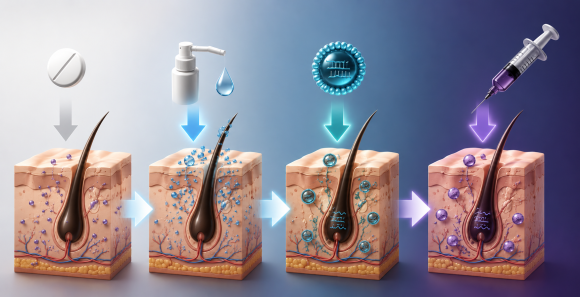
Topical RNA products may develop into convenient options for initial management or maintenance treatment. Injectable RNA drugs may become more intensive treatments for people who have difficulty with existing treatments or do not achieve sufficient results from them.
Results from the Phase 2a trial are not yet available. However, RNA hair-loss treatment is no longer merely an idea confined to cell or animal experiments. One approach has already become a product that consumers can use, while the other has entered the stage of verifying actual hair-growth effects after repeated administration to humans.
It will not immediately replace oral hair-loss medication. However, it could mark the beginning of a new treatment for people who have been unable to use oral medication. It may also add another option for people who have not achieved enough with existing medication.
Two Korean companies are bringing that possibility closer to reality through different approaches.
Written by: Jin-oh Kim, New Hair Plastic Surgery Clinic (Public Relations Director, Korean Association of Plastic Surgeons / Academic Director, Korean Society of Laser, Dermatology and Hair Research)
-
Adjunct Professor, Department of Plastic Surgery, Yonsei University College of Medicine
-
Diplomate of the American Board of Hair Restoration Surgery (ABHRS)
-
Executive Director, Korean Association of Plastic Surgeons
-
Executive Director, Korean Association of Laser, Dermatology and Hair Research (KALDAT)
-
Executive Director, Korean Society for Laser Medicine and Surgery
[References]
-
Moon IJ, Yoon HK, Kim D, et al. Efficacy of asymmetric siRNA targeting androgen receptors for the treatment of androgenetic alopecia. Molecular Pharmaceutics. 2023;20(1):128–135. doi:10.1021/acs.molpharmaceut.2c00510.
-
Yun SI, Lee SK, Goh EA, et al. Weekly treatment with SAMiRNA targeting the androgen receptor ameliorates androgenetic alopecia. Scientific Reports. 2022;12:1607. doi:10.1038/s41598-022-05544-w.
-
Jin SE, Sung JH. Delivery strategies of siRNA therapeutics for hair loss therapy. International Journal of Molecular Sciences. 2024;25(14):7612. doi:10.3390/ijms25147612.
-
ClinicalTrials.gov. A study to evaluate safety and efficacy of OLX72021 in medically healthy males with androgenetic alopecia. NCT07327359.
-
Sang-hyun Park. “OliX Completes Dosing in Australian Phase 1b Trial of Hair-Loss Treatment.” Yonhap News Agency. August 4, 2026.