Some women say that because of a wide forehead, they always wear their bangs down, or that they feel self-conscious about the M-shaped areas and temples on both sides when tying their hair back.
In such cases, they may consider female hairline hair transplantation, and the questions most frequently asked during consultations are surprisingly similar.
How much can the forehead be lowered?
Will it look obvious that I had surgery?
Is it different from male hair transplantation?
In reality, the scalp hair itself is not completely different between men and women.
A study analyzing the characteristics of normal scalp hair in Korean people also found no clear sex-related differences in hair thickness or density.¹
However, there are differences in the contours of the hairline, baby hairs, and the direction and arrangement of the hair.
Therefore, female hairline hair transplantation should not simply fill in an empty forehead. It is important to consider the overall proportions of the face together with the flow of the existing hair.
Female Hairline Hair Transplantation: Should It Be Done Differently for Women Than Men? FAQ Summary
| Female hairline hair transplantation is not simply a procedure to lower the forehead; it is a process of redesigning the hairline contours to suit the shape of the face. |
|---|
| For a natural result, it is important to place fine single-hair grafts at the front and gradually increase density toward the inside. |
| The M-shaped areas and temples should be transplanted while considering the direction of the existing hair and a low angle, so that they look natural when the hair is tied back or swept away from the face. |
| Lowering the forehead as much as possible or designing a smooth semicircular shape does not automatically lead to a good result. |
| Neither strip nor non-shaven extraction is unconditionally better for women. Donor-area density, the number of grafts needed, and hairstyle should all be considered together. |
Q1. Is female hairline hair transplantation different from male hair transplantation?
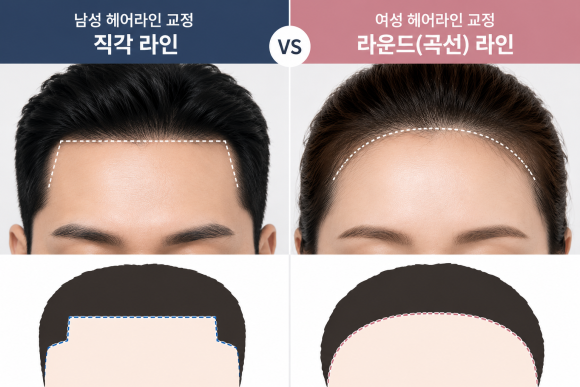
Yes. There are differences, particularly in hairline design and the way the hair is placed.
A male hairline often has a relatively distinct frontotemporal angle, and the contour extending from the center toward the sides may also show a certain degree of angularity.
In women, by contrast, the line extending from the center to both sides is generally softer, and the frontotemporal areas are commonly connected in a rounded shape.²
That does not mean that a female hairline should simply be made into a rounded semicircle.
When a natural hairline is examined closely, the heights and curves on the left and right differ subtly, and irregular baby hairs are mixed along the edge.
Therefore, clinically, it is more important to create natural irregularity that suits the existing hairline and facial shape than to draw a single “pretty line.”
A female hairline looks natural when it has a soft curve but is not excessively straight or even.
Q2. If the forehead is wide, is it best to lower the hairline as much as possible?
No.
In female hairline hair transplantation, making the hairline lower and making it attractive are not the same thing.
If only the central hairline is lowered excessively, the connection with the M-shaped areas on both sides may look awkward.
Conversely, if the M-shaped areas and temples are filled in too much, the upper part of the face may appear cramped and heavy.
In addition, the greater the amount of lowering, the larger the transplantation area becomes.
If the same number of grafts is distributed over a larger area, density may decrease, and securing sufficient density requires a correspondingly larger supply of donor hair.
Therefore, rather than first deciding how many centimeters the hairline can be lowered, it is better to assess the central height, the depth of the M-shaped areas, the temples, and the widths of the cheekbones and jaw together.
Q3. Would a rounded design make a female hairline look more natural?
Not necessarily.
Although it is true that female hairlines tend to have softer forms than male hairlines, a natural hairline is not a smooth semicircle drawn with a compass.²
There may be subtly protruding areas in the center, larger and smaller curves may alternate along both sides, and the thickness and density of the hair may change as it moves toward the temples.
If these characteristics are ignored and hair of the same thickness is placed at equal intervals along a uniform curve, the result may instead look like the edge of a wig.
Women in particular often expose the entire hairline when they tie their hair back or sweep it away from the face.
For this reason, it is necessary to check not only the frontal design but also how the M-shaped areas connect to the temples from 45-degree and side angles.
Q4. Will placing only single-hair grafts in the front row make the result look natural?
Using single-hair grafts is important, but that alone is not enough.
If the area immediately in front of the hairline is densely filled with thick hair, the boundary may look sharply defined even when only single-hair grafts are used.
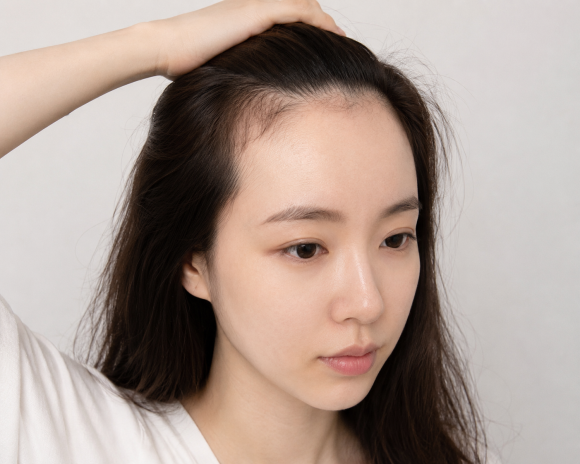
A close look at a natural hairline shows relatively fine, sparse hair at the very front, with the hair gradually becoming thicker and denser farther back.
Therefore, creating a gradient in hair thickness and density is important in female hairline transplantation.
A 2025 study of 60 East Asian women also used a technique that placed fine single-hair grafts at the front of the hairline, followed by the gradual placement of thick single-hair grafts and two-hair follicular units in the approximately 2 cm area behind them.³
Although the study had limitations in scale, it provides an example showing the importance of creating a natural transition zone in female hairlines.
Q5. Is a female hairline hair transplant better when there are more baby hairs?
With baby hairs, where and how they are placed is more important than simply having “a lot” of them.
Fine baby hairs remaining along the existing hairline can help create a natural connection between newly transplanted hair and existing hair.
Therefore, there is no need to remove all existing baby hairs simply because they lie outside the design line.
Conversely, if some baby hairs are excessively detached from the new hairline contour or extend far down in the center and interfere with the overall shape, tidying them may be considered.
Ultimately, female hairline hair transplantation is a procedure in which deciding what to preserve among the existing hair is just as important as deciding what to newly implant.
Q6. Can’t the direction of the hair be changed through styling after surgery?
It is difficult to change it completely freely.
This is because transplanted hair grows under the influence of the angle and direction in which it was initially implanted.
In particular, women’s bangs often lie relatively close to the scalp and grow forward or diagonally.
The direction also differs between the central area and the M-shaped areas, and the hair may lie even closer to the scalp as it approaches the temples.
If these differences are ignored and all grafts are implanted in similar directions, the bangs may stand stiffly after growing out or may seem to move separately from the existing hair.
For people who have maintained a side part for a long time, it is advisable to reflect the parting direction in the design before surgery.
Q7. Is non-shaven hair transplantation unconditionally better for women?
No.
Both strip and non-shaven techniques can be selected for female hairline hair transplantation.
With the strip technique, a thin, long strip of scalp is removed from the back of the head and then separated into individual follicular units. A linear scar may remain, but it is easy to conceal with long hair, and the technique may be advantageous for securing a relatively large number of grafts.
With the non-shaven technique, follicles are extracted one by one. A long linear scar does not remain, but small dot-shaped marks may be left at each extraction site, and partial shaving may be required depending on the surgical method.
In particular, if non-shaven extraction is performed excessively on women with fine or low-density donor hair, the possibility that reduced density at the back of the head could make the scalp more visible should also be considered.
Therefore, rather than comparing only “strip versus non-shaven,” it is necessary to evaluate the number of grafts needed, the thickness and density of the donor hair, and the person’s usual hair length and hairstyle together.
Q8. Can the results of female hairline hair transplantation be known immediately after surgery?
Immediately after surgery, the design and the locations of the transplanted grafts can be checked, but it is too early to assess the final result.
The shafts of transplanted hair may generally shed once between 2 and 6 weeks after surgery.
New hair usually begins to grow from the follicles around 3 to 4 months after surgery.
It initially appears fine and short, then gradually becomes longer and thicker over time.
Changes generally begin to become noticeable around 6 months, but it is advisable to observe the progress for approximately 1 year to assess the final density and shape of the hairline.⁴
Q9. Can existing hair also fall out after female hairline hair transplantation?
It is possible.
When follicles are transplanted between existing hairs, surrounding hair may temporarily fall out due to the effects of surgery. This is known as shock loss.
However, female hairline correction often involves newly transplanting hair onto forehead skin where there is little or no existing hair, so this does not occur in the same way in every patient.
If density enhancement is needed inside the M-shaped areas or within the existing hairline, it is advisable to evaluate the condition of the existing hair and the possibility of shock loss together before surgery.
Q10. When choosing a clinic for female hairline hair transplantation, shouldn’t I compare only the number of hairs?
The number of hairs is an important criterion, but it is difficult to predict the result based on that alone.
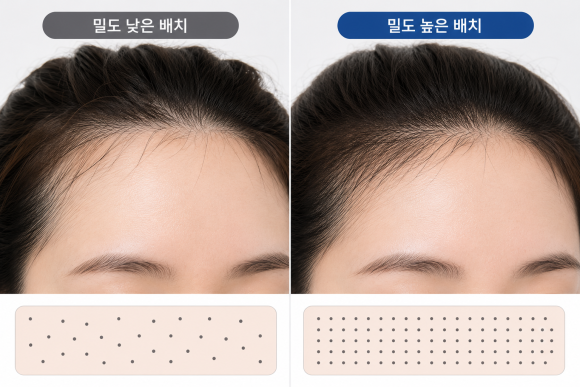
Even when the same 2,000 hairs are transplanted, the result may vary depending on how they are distributed between the central area and the M-shaped areas, what thickness of hair is used in the foremost row, and how wide a gradient is created.
Therefore, during a consultation, it is advisable to check not only the estimated number of hairs but also the design process and the follicle-placement plan.
It is worth examining whether the 45-degree and side designs are checked in addition to the frontal view, how existing baby hairs will be used, whether the thickness of the single-hair grafts used in the front row is selected, and how the direction of the hair in the temple area will be set.
Key Points of Female Hairline Hair Transplantation
| What to check | Why it matters |
|---|
| Hairline height | If it is too low, the face may look cramped, and the transplantation area may increase. |
| M-shaped areas and temple design | Affects not only the frontal appearance but also the impression when the hair is tied back and the side profile. |
| Single-hair grafts at the front | Important for reducing an artificial boundary that may result from thick hair. |
| Hair thickness | Necessary for a natural transition from fine hair to thick hair. |
| Gradient | Softens the boundary between the transplanted area and the existing hair. |
| Direction and angle | Important for reducing the likelihood that the bangs will stand up or move separately from the existing hair. |
| Existing baby hairs | Can be used to create a natural hairline boundary. |
| Donor-area condition | Affects the amount of hair that can be transplanted and the choice between strip and non-shaven techniques. |
If the goal of female hairline hair transplantation is considered simply to be lowering the forehead, important aspects of the design may be overlooked.
A good hairline is not a straight line as if it had been drawn with a ruler; it is closer to a shape that blends in naturally, as though it had always been your own hairline.
To achieve this, the overall contour suited to the shape of the face, the connection between the M-shaped areas and temples, fine single-hair grafts at the front, increasing density toward the inside, and the direction and angle connecting with the existing hair should all be considered together.
Therefore, during a consultation, it is advisable to ask not only, “How many centimeters can it be lowered?” or “How many hairs will be transplanted?” but also, “What type of hairline would look natural on my face?”
Ultimately, what matters in female hairline correction is not creating the lowest possible hairline, but achieving a result that looks like your original hairline even when you lift your bangs or tie your hair back.
Now is the time for hair to grow; this was Jin-oh Kim.
New hair must grow.

Written by: Jin-oh Kim, New Hair Plastic Surgery (Public Relations Director, Korean Association of Plastic Surgeons / Academic Director, Korean Laser Dermatology and Hair Society)
-
Visiting Professor, Department of Plastic Surgery, Yonsei University College of Medicine
-
Diplomate of the American Board of Hair Restoration Surgery (ABHRS)
-
Executive Director, Korean Association of Plastic Surgeons
-
Executive Director, Korean Association of Laser, Dermatology and Hair (KALDAT)
-
Executive Director, Korean Society for Laser Medicine and Surgery
[References]
-
Kim, S.N. et al. Phototrichogram analysis of normal scalp hair characteristics with aging. European Journal of Dermatology. 2013;23(6):849-856. doi:10.1684/ejd.2013.2164.
-
Jung, J.H., Rah, D.K. and Yun, I.S. Classification of the female hairline and refined hairline correction techniques for Asian women. Dermatologic Surgery. 2011;37(4):495-500. doi:10.1111/j.1524-4725.2011.01910.x.
-
Wu, W. et al. Enhancing mid-upper facial contours: Hairline transplant solutions for East Asian women with high and wide foreheads. Journal of Cosmetic Dermatology. 2025;24. doi:10.1111/jocd.70374.
-
Ramos, P.M. et al. Female-pattern hair loss: therapeutic update. Anais Brasileiros de Dermatologia. 2023;98(4):506-519. doi:10.1016/j.abd.2022.09.006.