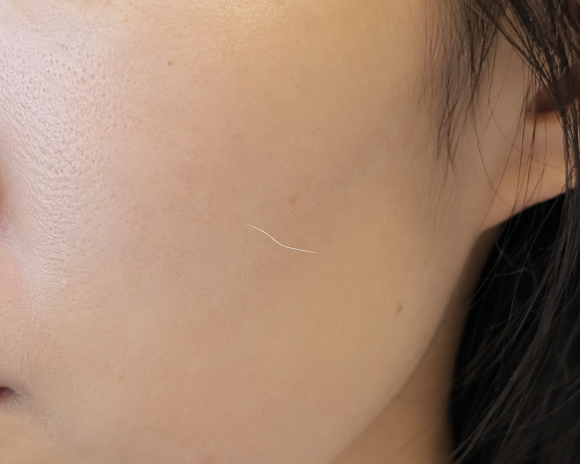
Why Does a Single Long White Hair Suddenly Grow on the Body?
When examining your arms, face, neck, shoulders, or other areas, you may occasionally discover one unusually long, white hair.
The surrounding hairs may be short and dark, while this one hair has grown long and white on its own, making you wonder, “When did this appear?”
Sometimes, it is first noticed only after it has grown several centimeters long.
On the internet, this type of hair is sometimes called a hair that brings good luck or given a special meaning.
Medically speaking, however, the phenomenon of a single long white hair growing on the body is not particularly unusual.
That is because all the hair on our bodies does not grow at the same speed or have the same color.
Then why does only one particular hair among so many grow long and white?
Body hair also contains pigment, like scalp hair
Hair appears black because of the effects of melanin pigment produced in the hair follicles.
The basic principle is similar for body hair growing on the arms, legs, face, and other areas.
However, if melanin production decreases in a particular follicle, the hair produced by that follicle may look grayer or whiter than the surrounding hair.
Simply put, just as one or two gray hairs can appear on the scalp, only certain hairs on the body can also grow white.
Therefore, there is no need to think that aging throughout the body has suddenly begun just because one white hair has appeared.
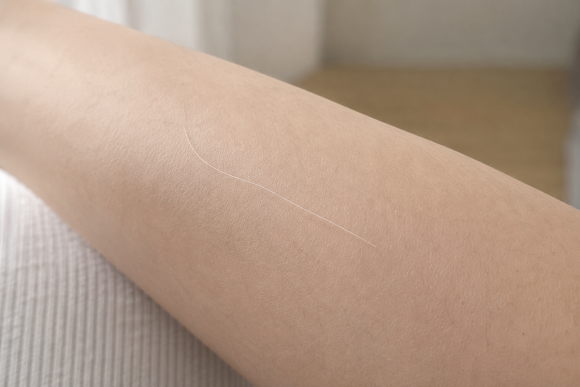
Why does only one hair grow unusually long?
In fact, the color white and the length of the hair can be viewed as separate issues.
The growth cycles of body hair differ slightly from one follicle to another.
Hair goes through a growing phase, a phase when growth stops, and a process in which it falls out and is replaced by new hair.
Most body hair has a short growth phase, so it does not continue growing long like scalp hair.
However, if the hair from a particular follicle continues growing for relatively longer than the surrounding hair, it may look much longer than other body hair.
If that follicle also produces less pigment, the result is a “single long white hair.”
This means that white hair does not necessarily grow faster.
There is also a reason it may seem to appear suddenly
When you discover a long white hair, it is easy to think that it suddenly grew several centimeters in just a few days.
In reality, it is likely that it had been growing slowly for some time but was not easy to notice.
Body hair that is white or nearly transparent, in particular, can be harder to spot than dark hair because it blends in with the skin tone.
Then, when it catches light or sunlight from a certain direction, it may sparkle and suddenly become noticeable.
In other words, it may be a hair that was “noticed late” rather than one that “appeared suddenly.”
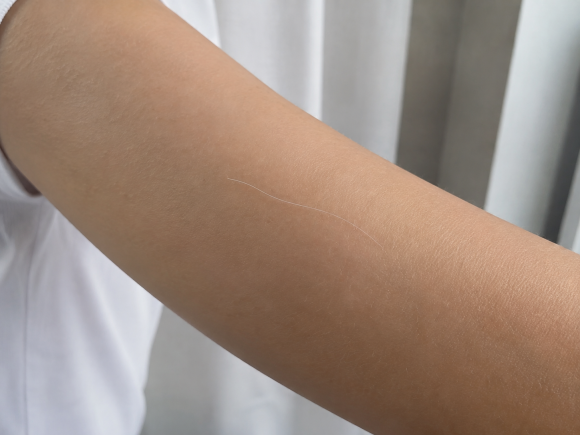
Will pulling out a long white hair cause more to grow?
There is a belief that pulling out one white hair will cause several more to appear nearby, but there is generally no basis for thinking that this happens.
Each hair grows from its own follicle, so pulling out one hair does not suddenly make the pigment disappear from the surrounding follicles.
However, repeatedly pulling out hair can irritate the skin and the area around the follicles.
If the area is prone to redness or folliculitis, trimming the hair short near the skin may be an option instead of pulling it out by the root.
Also, even if a white hair is pulled out, the hair that grows again from the same follicle may also appear white.
That is because pulling out the hair does not restore the pigment-producing state of a follicle that has already changed.
Should a long white hair on the body raise concerns about disease?
In most cases, discovering one or two white body hairs alone does not mean that a specific condition should be suspected.
Especially if there are no noticeable changes in the surrounding skin and only one or two particular hairs appear white, this can be understood as an individual follicle characteristic or a pigment change.
However, if several hairs in one area suddenly turn white along with the skin becoming lighter, or if changes in body-hair color appear over a broad area, it is important to distinguish this from the simple appearance of one long white hair.
In such cases, observe whether changes in the skin’s pigmentation are also present, and if necessary, have the area checked by a dermatologist.
When a single long white hair appears on the body, its difference from the body hair you normally see may seem unusual, and you may worry that it indicates a health problem.
However, our bodies contain numerous hair follicles, and each follicle can differ slightly in its hair-growth cycle and the amount of pigment it produces.
If pigment production decreases in a particular follicle, the hair can turn white, and if that hair’s growth period is longer than that of the surrounding hair, it may be discovered as an unusually long white hair.
Therefore, there is no need to conclude that one or two long white hairs appearing on the arms, face, neck, or other areas are a special sign of a health problem or aging.
However, if white hairs suddenly increase over a broad area or other changes occur, such as a change in skin color as well, it is advisable to have the situation evaluated separately from an ordinary change in body hair.
Ultimately, a single long white hair appearing on the body can be understood not as a mysterious phenomenon, but as one of the natural occurrences that can result from individual hair follicles functioning in slightly different ways.