Peanut-Shaped Face Lifting: Suitable Devices and Treatment Direction
The face is an important factor in determining one’s impression.
However, as we age, if the volume in the temples, cheekbones, and cheeks decreases and the skin begins to sag, a change known as a peanut-shaped face may appear. This face shape can make a person seem harsher or older because of hollow areas and an uneven contour.
People concerned about a peanut-shaped face often ask, “How can I fill in these hollow areas?” and “Can sagging skin be lifted naturally?” One of the most effective and safe ways to address these concerns is a noninvasive lifting procedure.
In particular, Thermage FLX lifting and Ulthera lifting are drawing attention as procedures that can address both sagging skin and hollow cheeks, which are the main causes of a peanut-shaped face. In this article, I will explain in detail the principles behind these two procedures, how they are actually performed, and why they are effective for a peanut-shaped face.
- Causes of a Peanut-Shaped Face: The Combination of Sagging and Hollowness
Peanut-Shaped Face Lifting: What Causes It?
A peanut-shaped face is mainly caused by the combination of the following two factors.
- Reduced skin elasticity
As collagen and elastin in the skin decrease with age, the skin becomes thinner, loses elasticity, and sags. As a result, the areas around the cheekbones and temples become hollow, while the jawline area stretches downward, creating an uneven contour.
- Shifting of the fat layer
The fat layer plays an important role in maintaining facial volume, but with aging, fat moves downward or becomes unevenly distributed, causing certain areas to appear hollow while others become more prominent.
To improve these structural changes, an approach that lifts the skin, repositions the fat layer, and restores skin elasticity is needed.
Lifting Laser Effective for a Peanut-Shaped Face
- Thermage FLX lifting: Harmonious improvement through fat repositioning and SMAS-layer lifting

Thermage FLX lifting targets the facial fat layer and the SMAS layer, improving a peanut-shaped face by lifting sagging tissue and filling in hollow areas. Using radiofrequency (RF) technology, it delivers energy deep into the skin, helping the fat layer and SMAS layer reorganize through heat response. This makes the facial contour smoother and more three-dimensional.
Before the procedure, the medical team precisely analyzes the sagging and hollow areas around the temples, cheekbones, deep cheek area, and jawline, then designs the treatment direction and energy intensity. Thermage FLX lifting sets the appropriate energy delivery direction for each area, considering not only the lifting of sagging tissue but also the balance of volume.
The sagging fat layer below the cheekbones is lifted upward through radiofrequency energy. Fat that has moved downward around the cheekbones is pulled upward toward the center of the cheekbones, filling hollow areas and dispersing fat that had gathered in the lower face.
As a result, the three-dimensional appearance of the cheekbones is restored, hollow cheeks are eased, and the facial contour becomes softer and more natural.
For the deep cheek area, the radiofrequency energy vector is adjusted toward the temples to lift the sagging fat layer. In this process, the fat is repositioned in a way that fills the hollow area of the front cheek, and the SMAS layer, which has lost elasticity, is pulled upward together with it, restoring volume.
The lifted deep cheek and front cheek areas give the central face more dimension and improve the overall face shape to appear more youthful.
The sagging areas along the jawline and below the cheeks are refined by lifting the fat layer that has gathered in the lower face.
Radiofrequency energy contracts the fat layer and lifts the SMAS layer together, making the jawline smoother and more defined. In this way, the cheekbones, deep cheek area, and jawline are lifted in harmony, naturally refining the uneven contour of a peanut-shaped face.
- Ulthera lifting: Fundamental sagging improvement by targeting the SMAS layer

Ulthera lifting uses high-intensity focused ultrasound (HIFU) to deliver energy directly to the face’s SMAS layer. The SMAS layer is an important structure that supports the skin and fat, and when it weakens or sags, facial contours become less defined and hollow cheeks worsen. Ulthera addresses this issue at its root, restoring elasticity from deep within the skin.
The procedure is carried out using DEEP SEE technology, which allows the condition of each skin layer to be checked in real time. After analyzing the condition of the SMAS layer, the medical team focuses ultrasound energy on the necessary areas.
The SMAS layer around the temples and cheekbones receives ultrasound energy in a horizontal direction, causing it to coagulate and contract. In this process, the sagging area of the cheekbones becomes firmer, and the hollow temple area is naturally filled, organizing the facial contour.
The deep cheek and front cheek areas are tightened by applying ultrasound energy upward from the center of the deep cheek area toward the eye area. This fills the hollow front cheek area and improves sagging in the deep cheek area, giving the center of the face more dimension.
For the jawline and lower face, ultrasound energy is applied vertically, causing the sagging SMAS layer to coagulate and contract. This makes the jawline smoother and more defined, and the heavy appearance of the lower face becomes lighter. Because Ulthera continues to promote collagen and elastin production even after the procedure, facial contours become more defined and elasticity increases over time.
Peanut-Shaped Face Lifting: Precautions When Choosing a Dermatology Clinic
Lifting procedures for improving a peanut-shaped face can be effective, but the results can vary greatly depending on the medical team’s experience and the procedure process.
Because these procedures deal with structural facial issues in particular, choosing the right clinic and medical team is most important.
- A place where one-on-one consultation with a doctor is provided
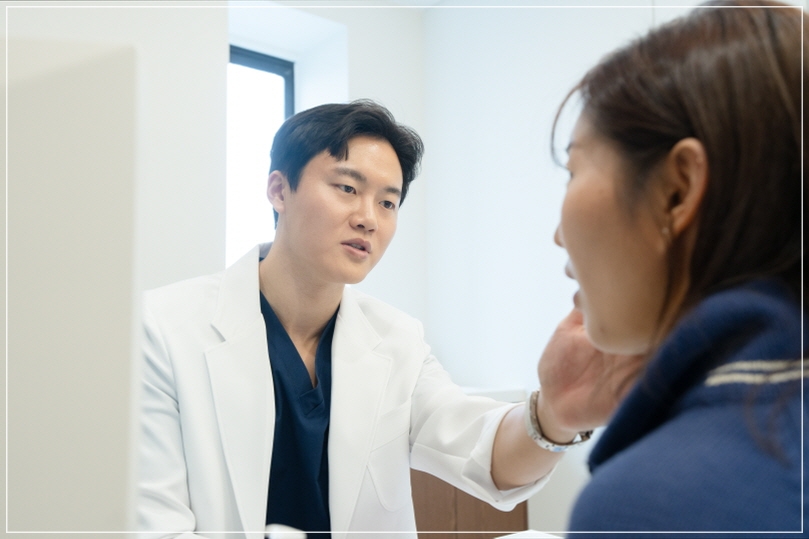
Improving a peanut-shaped face requires an approach that differs depending on the individual’s facial condition and structural characteristics. Therefore, a one-on-one consultation with a doctor before the procedure is essential. Rather than simply listening to what the patient wants, the medical team should thoroughly analyze the patient’s facial condition and present a specific improvement plan.
The consultation should not end with the simple question, “Which area should be improved?” The doctor should examine the main areas of the face step by step, including the temples, cheekbones, deep cheek area, and jawline, and evaluate the degree of sagging and hollowness in each area.
For example, the medical team checks and analyzes things such as “How much has the fat below the cheekbones sagged?”, “How severe is the hollowing in the deep cheek area?”, and “How much has the jawline contour collapsed?”
Based on these results, the doctor explains what effects Thermage FLX or Ulthera lifting can each produce and sets the treatment goals in detail.
 Peanut-Shaped Face Lifting: Why Consultation with the Medical Team Matters
2. A place that carefully performs personalized design before the procedure
Peanut-Shaped Face Lifting: Why Consultation with the Medical Team Matters
2. A place that carefully performs personalized design before the procedure
A peanut-shaped face has an imbalance in facial volume distribution and contour, so personalized design before the procedure is essential.
Only by identifying the degree of sagging and hollowness in each area and precisely designing the direction and intensity of energy delivery can a natural and harmonious result be achieved.
- The need for personalized design
For example, a patient with hollowness around the cheekbones and temples needs lifting in the direction of pulling the sagging fat layer below the cheekbones upward.
On the other hand, a patient whose deep cheek area looks hollow needs volume created by repositioning fat toward the front cheek. If the jawline is sagging, the contour should be refined by delivering energy from the lower face toward the jawline.
If these steps are not carried out properly, some areas may be lifted too much while others remain unchanged, making the face look unnatural.
- Problems when personalized design is not actually applied
If the procedure is performed mechanically without personalized design, energy may be delivered to unnecessary areas, causing excessive fat reduction or an uneven lifting effect.
For example, if the cheekbones become overly prominent while the deep cheek area remains hollow, the patient’s facial shape may become even more unnatural.
A peanut-shaped face is a complex issue involving both sagging and hollowness. To address it, a lifting procedure that carefully analyzes each area and takes a customized approach is needed.
Thermage FLX lifting targets the fat layer and SMAS layer to improve both sagging and hollowness at the same time, while Ulthera lifting directly stimulates the SMAS layer to address the underlying sagging. These two procedures help restore facial balance in a harmonious way and provide a natural, three-dimensional contour.
However, the effectiveness of these procedures can vary depending on the medical team’s experience and the precision of the treatment plan.
It is important to choose a place that analyzes the individual’s facial condition through one-on-one consultation with a doctor and carefully performs personalized design before the procedure.
Careful selection will be the first step toward improving a peanut-shaped face and returning to a natural, youthful-looking face.
Try regaining a confident face with your own customized lifting procedure!