Hello.
I’m Dr. Taeo Park, the chief doctor at Relieve, who even worries that fillers might hurt.
“Will forehead filler make my forehead look too full?”
“Could it make my side profile look more natural?”
“Can a small change really make a difference in how I look?”
I’ve brought together the questions I hear most often in the consultation room.

These questions all share one common assumption.
It is the fear that touching the forehead can make the face look unnatural.
Because the forehead and nose area are the center of the face,
people worry that any change will be immediately noticeable.
That is why forehead filler is not simply a procedure that adds volume,
but something closer to rebalancing the harmony of the entire face.
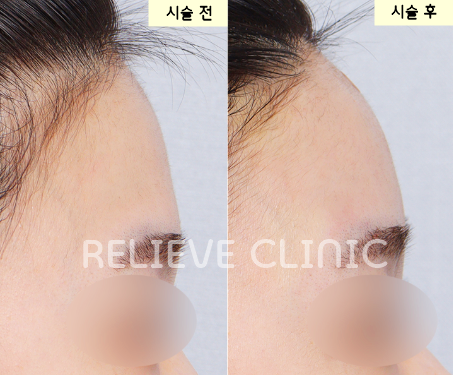
The apex determines the expression of the forehead
The first thing I look at when designing forehead filler is the “apex.”
That is because the impression changes depending on where the highest point of the forehead is located.
If the apex is closer to the center, the look becomes softer and more youthful,
and as it moves upward, it creates a more mature and neat image.
Especially for people with a narrow forehead,
even a slight mismatch in this position can make the lower part look bulgy,
which can make the procedure obvious.
That is why I first set the most natural apex while also looking at
the width of the forehead, the slope, and the distance from the eyebrows.
If this process is accurate, the volume that follows can settle in naturally and without looking excessive.
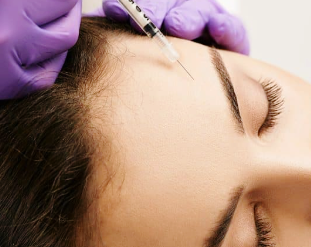
The forehead must be viewed together with the entire face
Sometimes the forehead alone looks fine,
but it feels awkward when seen in the context of the whole face.
In most cases, this happens when the forehead is filled without a three-dimensional analysis.
For people with pronounced cheekbones or a defined nose,
even a little volume in the forehead can help the overall balance look more harmonious,
but
for people with a flatter face, structurally speaking,
making only the forehead stand out can make the midface look more sunken.
That is why I design by looking at the flow from the forehead, glabella, temples, and bridge of the nose all at once.
Only when this connection is correct do both the side profile and the front view feel natural.
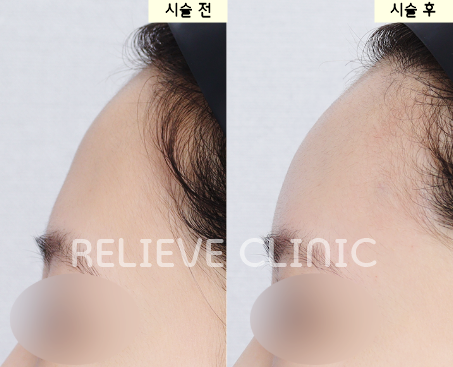
Forehead filler is a procedure that creates “shape”
The forehead is an area where the skin and muscles keep moving,
so it is difficult to create a smooth curve by simply filling in volume.
You have to consider the injection depth, direction, and even how the filler spreads in order to create a natural line.
Rather than first worrying about whether forehead filler is 1 cc or 2 cc,
the filler amount should be determined after going through a systematic process.
Before the procedure, I first check
the movement of the muscles and the slope of the forehead,
then design the curve that can flow most stably before injecting the filler.
A systematic preparation process is necessary to minimize lumpiness and unevenness.

Care after the procedure completes the result
The forehead is an area where the shape can change little by little over time.
That is why I do not think of the procedure as a one-time event or a single session.
After a certain period, I recheck it,
and if necessary, make fine adjustments to balance the left and right sides and the overall flow.
It may seem like a small process,
but I believe these details determine the “level of completion” of the result.

Two things to remember at the end
The most important criteria for forehead filler are
the “position of the apex” and a “three-dimensional perspective” that looks at the entire face.
If you follow just these two points,
you can create a much softer and more refined impression without looking excessive.
When choosing a forehead filler clinic,
I hope you consider not just how much is injected,
but how well they understand the face and how responsibly they manage the follow-up.
Thank you. This was Dr. Taeo Park.