Hello.
I’m Dr. Park Tae-oh from Apgujeong Rilive Clinic.
When consulting with patients about lifting,
I often hear the question,
“Can the face actually be lifted without surgery?”
The answer is yes.
However, the important point is
not the name of the device, but how energy is delivered deep into the skin.
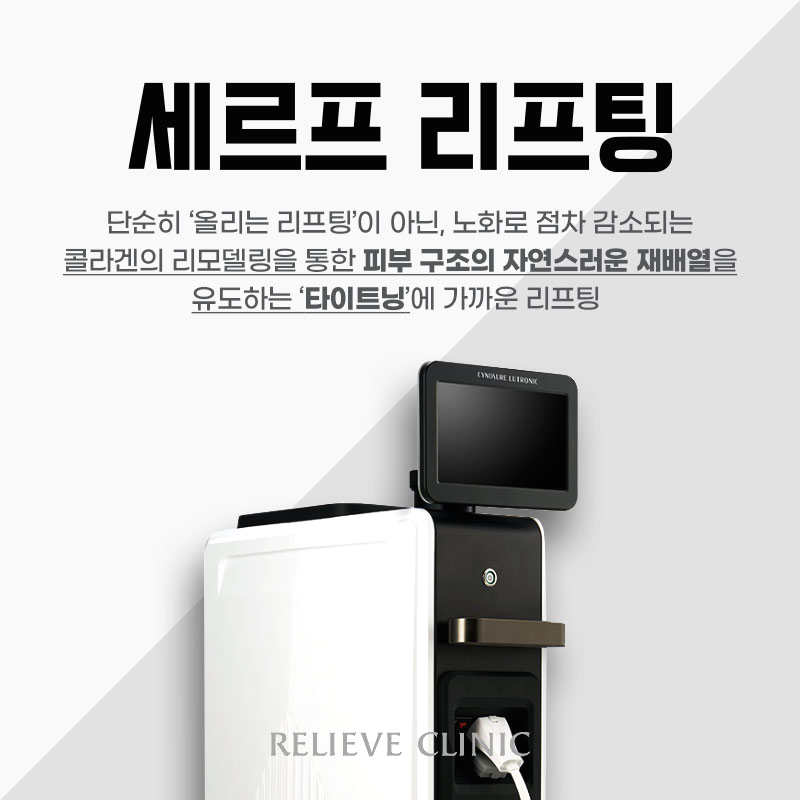
Among recent radiofrequency lifting devices, the one that attempts this kind of structural change is
XERF.
XERF was developed by combining technologies from Lutronic and Cynosure.
It is a monopolar RF lifting device,
and while it uses the same 6.78MHz radiofrequency as the Thermage line,
it is characterized by a dual RF system that adds a 2MHz frequency.

Principles of Radiofrequency Lifting
Current lifting devices can be broadly divided into
three methods: ultrasound (HIFU), radiofrequency (RF), and laser (photothermal).
Ulthera and Shurink are ultrasound,
Titanium lifting is laser,
and Thermage and XERF fall under radiofrequency lifting.
The key to radiofrequency lifting is
uniformly delivering thermal energy into the skin.
This thermal stimulation induces collagen contraction and regeneration in the dermis and activates fibroblasts,
creating a structure in which skin elasticity gradually recovers over time.
In other words, it is closer to a process of making the skin structure itself firmer again
rather than physically pulling the skin.

Technical Features of XERF
The biggest feature of XERF is the precision of its energy delivery.
First, three depth modes can be selected: Shallow, Middle, and Deep.
Depending on the skin condition and area,
the depth at which heat acts can be adjusted, allowing for a more precise lifting plan.
In particular, in Deep mode,
6.78MHz and 2MHz frequencies work simultaneously.
Generally, the lower the frequency, the deeper the energy can be delivered,
so this combination helps create a thermal response in the deeper layers of the skin and induce collagen remodeling.

Another important point is the efficiency of energy delivery.
At Apgujeong XERF, during the procedure,
skin resistance is continuously measured through real-time impedance tracking.
As a result, it has a structure that reduces unnecessary energy loss and increases the efficiency of energy delivered to the actual skin tissue.
In addition, thanks to the patented spider-pattern effector and the relatively wide tip size,
the range of energy delivered per shot is also relatively broad.


About XERF Pain and Recovery
The biggest concern for people considering radiofrequency lifting is pain.
To improve this aspect,
XERF applies a Wave Fit Pulse structure and a gas cooling system.
Rather than delivering energy all at once,
it is divided into multiple sub-pulses and delivered while cooling is repeated in between.
Thanks to this structure, the strong pain characteristic of radiofrequency lifting is relatively reduced,
and in many cases the procedure can be performed with just a numbing cream.

Also, because it is not a method that damages the skin surface,
it is not a treatment that requires a long recovery period after the procedure.
There may be temporary warmth or slight swelling,
but most normal daily activities are possible right away.

Lifting devices continue to evolve.
But in actual clinical practice,
the difference in results is determined more by how energy is used and designed than by the name of the device.
Depending on skin thickness, fat layer, elasticity, and the direction of sagging,
the number of shots, depth, and energy intensity should all be different, in my opinion.
Even with XERF,
results can vary depending on the treatment plan, even if the device is the same.

If you are wondering whether your skin condition
is suitable for radiofrequency lifting,
or which type of lifting is right for you,
we will directly check your skin condition in the consultation room at Apgujeong Rilive Clinic
and explain it to you more accurately and carefully.
Thank you. This was Dr. Park.