Hello. I’m Director Park Tae-oh of Relieve.
This is a common question for people considering lifting procedures.
"Is Ulthera better, is XERF better, or is Onda better?"
All three devices are non-surgical lifting devices,
but the type of energy they use and the target layer within the skin are different.
Therefore, rather than saying one device is always better,
it is more accurate to view these as procedures where the differences between ultrasound, radiofrequency, and microwave lifting are clear,
and the appropriate choice changes depending on the skin condition and the cause of sagging.
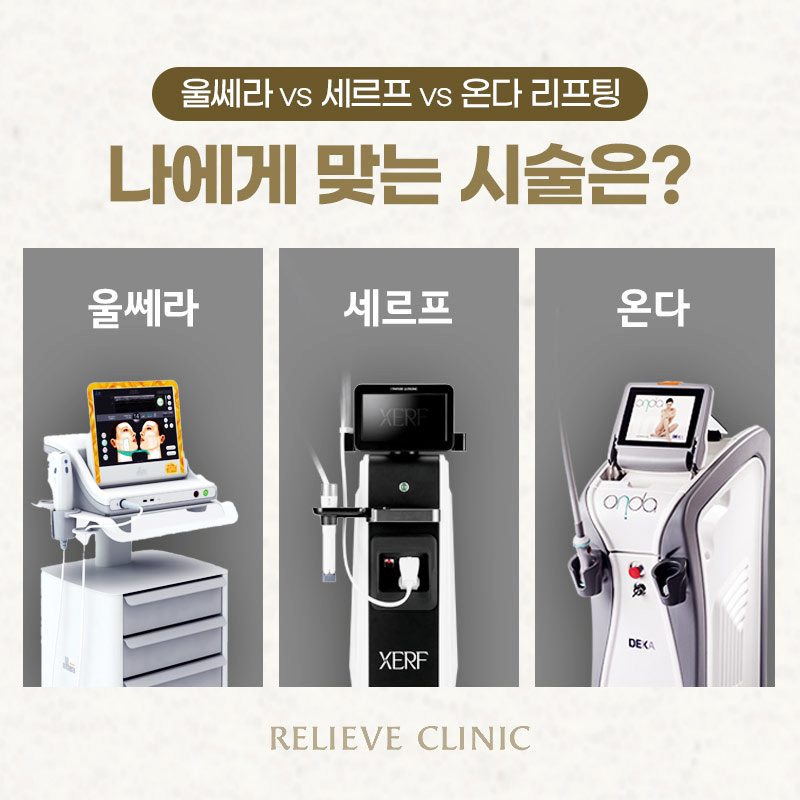
Ulthera (ULTHERA): Ultrasound lifting that targets deeper layers
Ulthera
is an ultrasound lifting device that uses MFU-V (Microfocused Ultrasound with Visualization) technology.
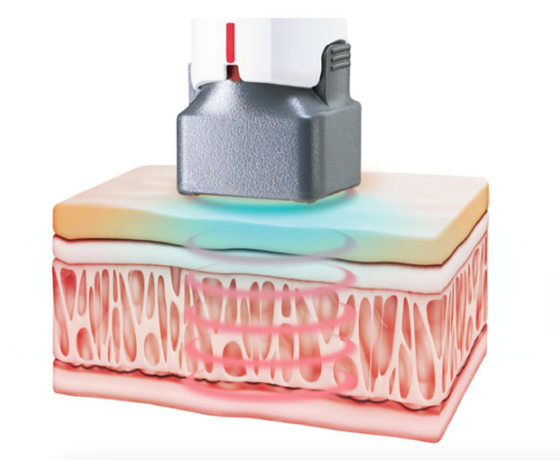
It works by concentrating ultrasound energy in the deeper layers of the skin to create thermal coagulation points and induce tissue contraction and collagen regeneration.
Because this technology can deliver energy accurately to the deeper layers of the skin,
it is known as the device that targets the deepest layer among non-surgical lifting devices.
Recently, not only lifting effects but also skin quality improvement effects have been reported.
In the 2021 international consensus,
skin quality was defined by four factors: elasticity, surface smoothness, evenness of skin tone, and radiance,
and Ulthera has shown clinical effects especially in improving elasticity and skin texture.
With a protocol using a 1.5 mm transducer, Ulthera effects were observed in pore and skin texture improvement,
and in general, the most noticeable changes are known to appear about 3 months after the procedure.
XERF: Radiofrequency lifting centered on dermal elasticity regeneration
XERF
is a lifting device that uses a dual monopolar RF structure.
It is characterized by sequentially delivering two frequencies, 6.7 MHz and 2 MHz.
This structure induces a thermal response in the dermis and at the dermis-subcutaneous fat boundary,
promoting collagen regeneration and elastic fiber remodeling.
In preclinical studies, this energy delivery structure was observed to promote fibroblast activation and collagen remodeling.
XERF is also known as a radiofrequency lifting device with an advanced cooling system,
and it has a structure that lowers the burden of pain by controlling the temperature of the skin surface while delivering thermal energy during the procedure.
In early clinical studies, positive results were reported for facial elasticity improvement and skin quality improvement,
and XERF is especially mentioned as an effective lifting option in the early aging stage when skin elasticity begins to decline.
Onda (ONDA): Microwave lifting that affects the fat layer
Onda
is a device that uses 2.45 GHz microwave energy.
Unlike ultrasound or radiofrequency, its feature is that it can affect the subcutaneous fat layer.
This energy induces a thermal response not only in collagen regeneration in the dermis but also in the subcutaneous fat and fibrous septa structure.
Therefore, rather than simple skin sagging,
when there is fat around the jawline or in the lower face, contour improvement effects can be expected.
Recent clinical studies have also reported that in patients with submental laxity,
skin tightening and contour improvement were observed after the procedure.
It is more accurate to understand Onda not so much as a lifting device,
but as a tightening device that considers both the fat layer and skin elasticity.

Key points in choosing a lifting device
If we summarize the characteristics of the three devices, they are as follows.
-
Ulthera is ultrasound lifting that targets deeper layers
-
XERF is radiofrequency lifting that induces elasticity regeneration centered on the dermis
-
Onda is microwave tightening that deals with the subcutaneous fat layer and elasticity at the same time
Therefore, rather than simply saying which device is best,
it is important to consider skin thickness, amount of fat, the cause of sagging, and the direction of the desired change together.
With non-surgical lifting, results are not determined simply by the name of a good device,
but differences in outcomes are created in the process of understanding the skin structure and designing energy delivery.

As the director of Relieve Clinic in Apgujeong,
I believe that in actual consultations,
rather than choosing a device first,
it is necessary to accurately evaluate the current skin condition and facial structure first.
Thank you for reading this long post.
This was Director Park.