Hello.
I’m Baek Won-seon, the chief director of Reub Dental Clinic, the clinic that comes to mind when people think of teoksigun botox dentistry near Sinsa Station.
Today’s post is for people who want to make a mouthguard (teeth-grinding appliance) because their teeth grinding is severe.
It is also for people who had cheap Botox at a general clinic but struggled because their teeth grinding did not improve.
The masseter muscle. If we understand the Korean term 깨물근, we will understand why Botox is used, right?
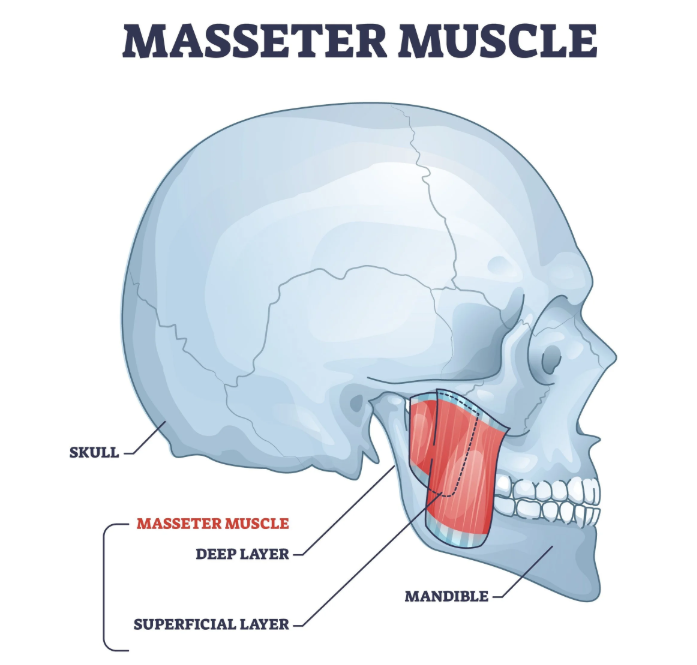
Source: Masseter Muscle - Origin, Insertion, Function, Exercise
If you are receiving treatment with the goal of relieving teeth grinding,
you should control the strength of the muscles mainly used when grinding your teeth.
So the two target muscles are the Masseter Muscle (masseter, 깨물근) shown above, and
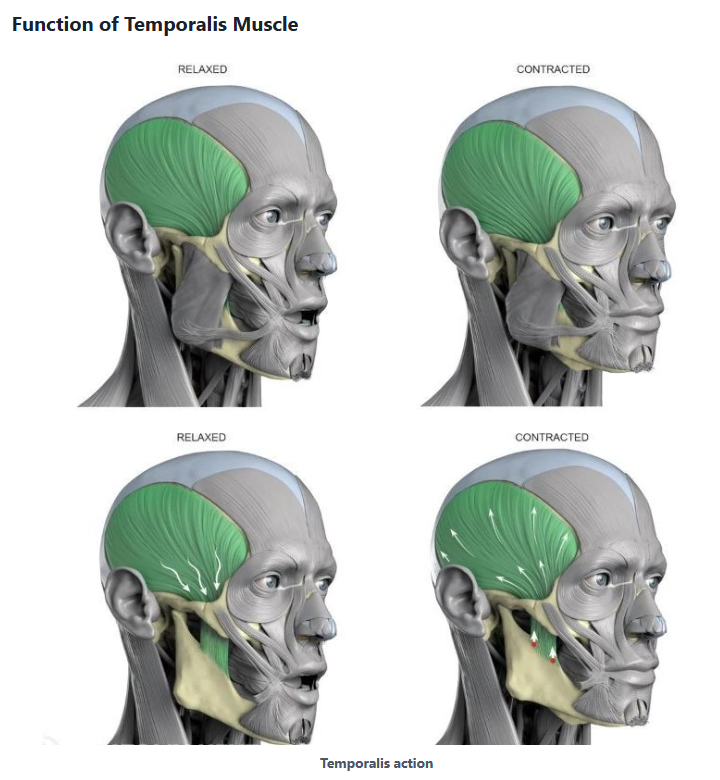
Source: Temporalis Muscle - Origin, Insertion, Function, Exercise
Temporalis (temporalis, 관자근).
This is where Botox is injected when the goal is to make the face look slimmer: the masseter.
What does the temporalis do???
I found a photo that very well shows the movement of the temporalis, the star of today’s post, so I borrowed it!...
The temporalis originates from the temporal fossa. (the muscle’s origin)
Source: File:Temporal fossa.jpg - Wikipedia, the free encyclopedia
The temporal fossa is, simply put, the side of our head~!
Think of it as a muscle that attaches broadly and roundly to the side of the head. It has a fan shape.
And it attaches to the coronoid process shown in red in the photo above.
In short...
You can think of it as a muscle that holds the side of the head and pulls the lower jaw upward.
Then the mouth closes, right??
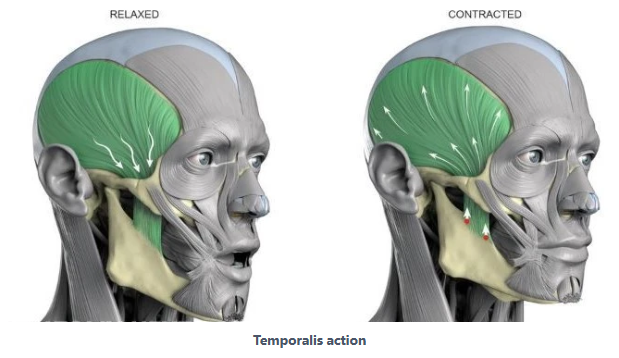
When the muscle is resting like on the left, the mouth opens,
and when the muscle contracts and shortens like on the right, the mouth closes.
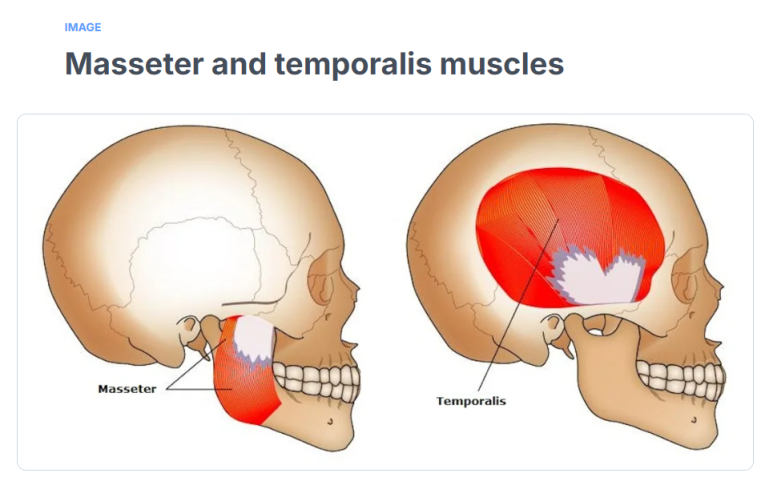
In three dimensions, you can see that the masseter pulls the lower jaw upward relatively on the outer side of the face (the side you can touch with your hand) to close the mouth, while the temporalis pulls the lower jaw upward relatively on the inner side of the face (the side you cannot touch with your hand, the side you can feel from inside the mouth).
Therefore, when closing the mouth, the masseter and temporalis always work together in balance.
What is the proportion of the roles of the masseter and temporalis in teeth grinding?
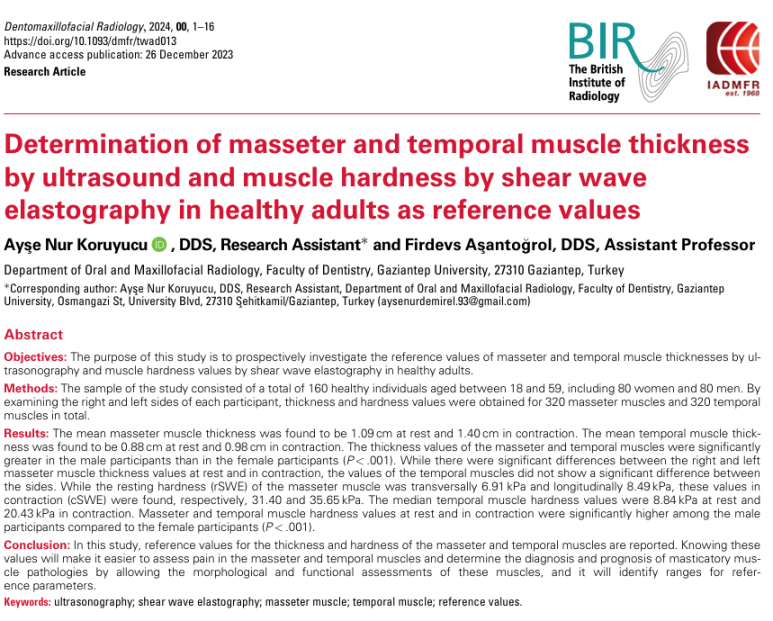
This is from one paper. Of course, I am not saying this paper represents every fact without exception,
but it reports that the average thickness of the masseter is 1.09 cm at rest and 1.40 cm when functioning, and the average thickness of the temporalis is 0.88 cm at rest and 0.98 cm when functioning.
Thickness will vary depending on the muscle’s location, age, and sex, so more samples would be needed...
Still, in conclusion, we can estimate that the temporalis is just as thick and large a muscle as the masseter, which is the one we can feel with our hand when chewing.
So... for people with severe teeth grinding, before making a teeth-grinding mouthguard (teeth-grinding appliance, splint), I wanted to say that you should not only receive Botox treatment in the masseter, but also try Botox treatment in the temporalis once.
Temporalis Botox. Where is it injected?
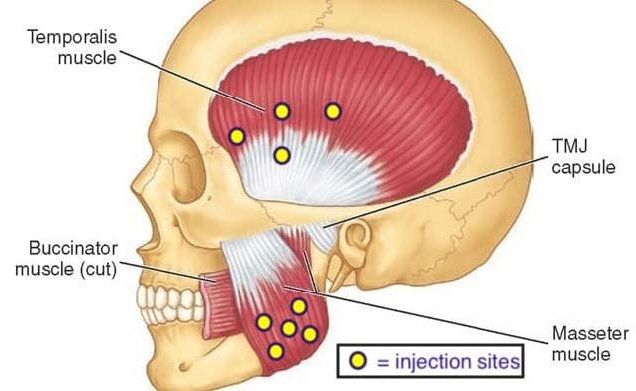
When you are told to clench your teeth, the thickest area is used as the injection point for temporalis Botox.
Usually, the injection is done in about three places where the muscle is thickest.
Because this area has a fairly tough fascia, it is a place where injections need to be given with more care than you might expect!
Temporalis Botox. Do you have to get it only at a dental clinic?

When I searched on Naver, most of them seemed to be “clinics” or “dermatology clinics.”
They also often advertise it as Botox that makes the face smaller.
There is nothing especially difficult to watch out for when performing temporalis Botox, but if too little is injected, the effect will be minimal, and if too much is injected, the muscle will lose all its strength and it will become difficult to eat.
You need to meet a primary doctor who has a good understanding of chewing function.
Of course, the effect of Botox treatment decreases over time, so you will need to get it periodically, but it is naturally better to receive it at an appropriate dose.
Also, if teeth grinding remains even after both masseter Botox and temporalis Botox, or if headaches are severe, it is better to consider that it is truly time to make a teeth-grinding mouthguard (teeth-grinding appliance, splint).
At Sinsa Reub Dental Clinic, we use good Botox without resistance generously and honestly.

Coretox and Xeomin are representative Botox products with no resistance.
This is because they are refined as much as possible so that only the molecules that “produce exactly the desired effect” are left.
At Sinsa Reub Dental Clinic, we use Coretox in the masseter and temporalis for teeth-grinding Botox treatment.
Because dermatology clinics or general clinics face fierce competition over fees more than expected, there are many cases where it is difficult to use good Botox.
The purchase price of domestic low-cost Botox and Xeomin differs by more than 20 times.....
Xeomin is of course good, but Coretox is also an equivalent domestic product, so at the very least, go to a place that uses Coretox!
If one 100-unit vial is used, enough Botox can be prepared to cover both the left and right masseter and temporalis.
I recommend going to a clinic that uses a generous amount of around 100 units!!
To treat teeth grinding or clenching, the best approach is to combine Botox treatment with an appliance.
Teeth grinding happens unconsciously more often than expected, so it is very difficult to eliminate the behavior itself.
Stress is said to be the biggest factor... Can modern people really live without stress ㅠㅠ..
** Botox treatment has the effect of reducing the strength of the muscle itself.
Therefore, as muscle strength decreases and volume shrinks, it reduces muscle pain and also reduces the resulting tooth pain or headaches.
Also, if Botox treatment is performed periodically (every 3 months), the muscle’s baseline volume itself significantly decreases after 1 to 2 years. In that sense, it has a permanent effect as well.
** A teeth-grinding mouthguard (teeth-grinding appliance, splint) is meaningful because it reduces the bad consequences caused by teeth grinding.
Many people with severe teeth grinding lose their oral health because their teeth crack, which leads to sensitivity and reduced chewing function when eating. Furthermore, inflammation begins to develop in the temporomandibular joint itself. This can be the beginning of degenerative arthritis.
If you use a teeth-grinding appliance, you can prevent damage to the body from such negative harm.
Therefore, it is best to combine the two treatments, but if you must choose an order, it is better to first undergo Botox treatment and then consider a teeth-grinding appliance.
If the Botox treatment works well, there will in fact be no bad outcomes from teeth grinding!!!
Botox treatment is not included much in the standard curriculum, more than you might think. So I hope you go to a dentist who thinks carefully, studies a lot, and performs the procedure often! It would be nice if they also handle splints well, right~?
That concludes Dr. Baek’s dental study.
Thank you for reading this long post.