Are you feeling stressed by rough skin and flakes that keep falling off?
If you are thinking, "Why do I have to go through this alone?" because of these problems, this article may be helpful.

Skin is not just a covering that wraps around the body.
It is the body's first line of defense and like a signpost that shows health and beauty.
When the skin is healthy, a person's impression looks brighter, and confidence naturally follows.
Perhaps because of that, many people put all their effort into skin care to maintain healthy skin.
But sometimes, caught up in a busy daily life, skin care can be neglected.
And at times like that, our skin sends a signal saying, "Please take care of me!"
Among the signals the skin sends, psoriasis is like an SOS message.
Today, at a psoriasis phototherapy dermatology clinic, I would like to explain in detail about "psoriasis," a condition that forms thick scales across the skin among various skin diseases.
I hope this article from a psoriasis phototherapy dermatology clinic will be of some help to those who are stressed by skin flaking and itching.
-Today's column outline-
- Symptoms by type of psoriasis
- Psoriasis treatment methods (ointment treatment, phototherapy)
- Precautions for psoriasis phototherapy

This is the many faces of psoriasis.
Psoriasis is more than a simple skin disease; it is characterized by a wide variety of symptoms.
And depending on how the symptoms appear, it is also classified in various ways.
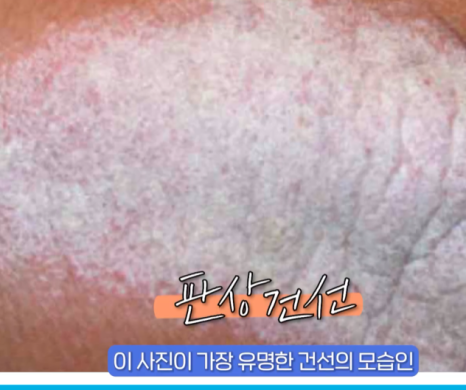
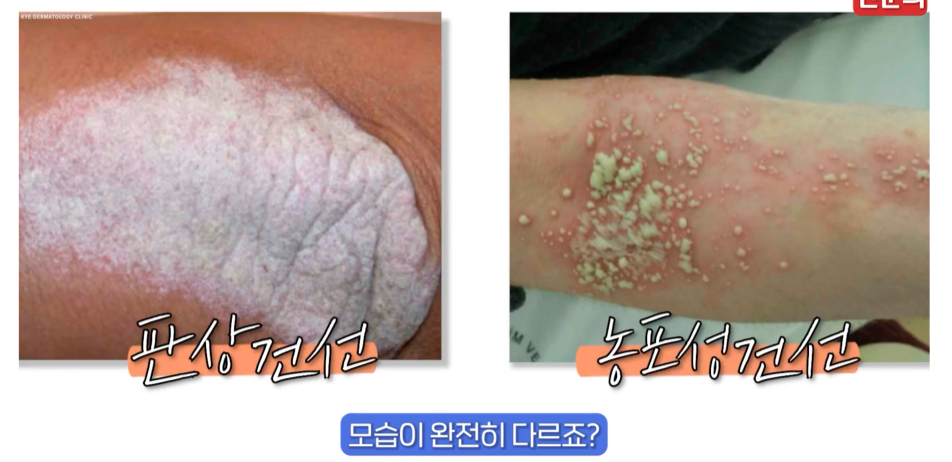
First, the most common type, plaque psoriasis, appears in the form of a "plaque," as the name suggests, and mainly occurs on areas where bones protrude, such as the elbows, knees, and scalp.
Also, guttate psoriasis, as the name implies, can appear as small drop-like lesions scattered over the skin.
It usually occurs in adolescence and is often triggered after tonsillitis.
Lastly, pustular psoriasis can form pus on the skin and is characterized by a strong inflammatory response.
This disease may appear locally or spread throughout the body, and in severe cases, it can have a significant impact even on the joints and cardiovascular system.

Psoriasis treatment can be carried out in several ways.
Psoriasis is a skin disease that tends to improve and worsen over time.
And in some cases, it can also cause various secondary complications.
That is why, if you are suffering from psoriasis symptoms, it may be advisable to visit a hospital and plan the appropriate treatment.
First, in the early stages of psoriasis, lesions are often relatively small and localized, so ointment treatment may be performed first.
Psoriasis ointment treatment uses steroid ingredients and vitamin D derivatives, and these two ingredients can help suppress inflammatory responses and regulate skin cell growth.
However, when psoriasis symptoms progress to a moderate or more severe level, it may be difficult to expect satisfactory results with ointment treatment alone.
At this point, you need to move on to a stage called phototherapy.
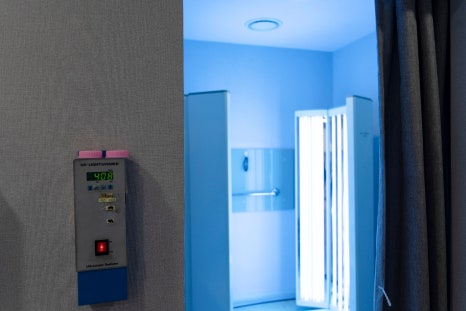
Phototherapy works by penetrating the skin with ultraviolet light of a specific wavelength, regulating the skin's immune response and suppressing inflammation.
Through this, you can expect improvement in severe skin rashes, thick scales, and itching that occurs day and night.
In addition, phototherapy has the advantage of delivering energy easily to a large area, and because no separate surgical procedure is involved, it has the benefit of relatively little pain.
However, since it is a treatment method that uses light, patients with photosensitivity or cataracts may have difficulty undergoing treatment, so please visit the hospital for a detailed diagnosis.
Psoriasis phototherapy: you must be careful about this.
Phototherapy is characterized by a relatively safe approach.
In addition, it has the advantage of requiring no separate recovery period, to the point that you can go to work right away.
However, just as too much sunlight can be a problem, if too much ultraviolet light is applied during phototherapy, the skin may suffer major or minor damage.
Not only can inflammation worsen further, but the skin may also suffer severe burns.
In severe cases, it can also increase the risk of skin cancer.
The key to phototherapy is the right intensity.
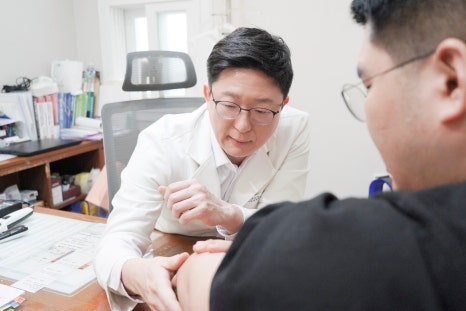
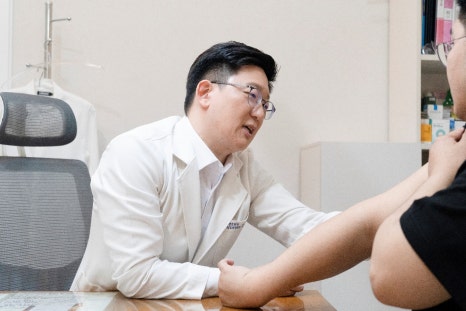
So, if you want a treatment that is both safe and effective, it is best to receive treatment from medical staff with extensive clinical experience who can delicately adjust the energy exposure intensity according to the patient's skin condition.
Since phototherapy is a treatment method that uses specific energy, the skin may react very sensitively after treatment.
Because of this, it may be advisable to pay extra attention to skin moisturizing than usual.
Also, after treatment, the skin may react more sensitively to ultraviolet rays, so it is good to protect the skin by applying enough sunscreen regardless of the season.
In addition, since psoriasis is a chronic disease that requires continuous management, it is important to use a humidifier to maintain appropriate indoor humidity so that the skin does not become dry again.
Lastly, stress is the enemy of psoriasis.
So, please maintain peace of mind by meditating for 10 minutes a day or taking a walk.
If you have any questions beyond the information provided today by the psoriasis phototherapy dermatology clinic, please inquire through the comment box below.
I will answer kindly. Thank you.
| This post was written for informational purposes in compliance with Article 56, Paragraphs 1 to 15 of the Medical Service Act. All treatments carry a risk of side effects and complications depending on the individual. Before treatment, please be sure to have a thorough consultation with experienced medical staff before making a decision. |