Today, I’d like to talk about a skin condition that many people have probably heard of at least once: vitiligo.
Vitiligo is, quite literally, a skin condition in which white patches appear on the skin.
However, when people hear the word vitiligo, many think of it as an “incurable disease” and give up on treatment.
Of course, it is true that vitiligo treatment can take quite a long time.
As a result, some people feel disappointed when treatment seems to progress slowly, and others become skeptical, wondering, “Does this really work?”
But like other skin conditions, vitiligo can be expected to improve through consistent treatment and care.
Also, although vitiligo treatment requires a certain amount of patience, you are absolutely not alone on this journey.
Today, I’ll explain in detail why vitiligo occurs, how it should be treated, and what kinds of care are needed after treatment.
I hope this post from a dermatology specialist for vitiligo will be of some help to patients with vitiligo.


Vitiligo: What causes it?
To understand what causes vitiligo, you need to know more about the melanocytes in our skin.
Melanocytes extend their arms like tree roots and play a role in delivering melanin pigment to surrounding cells.
In short, you can think of them as playing the role of forming skin color.
However, if melanocytes with this function do not work properly or are lost, clearly defined white patches can appear in various places on the skin.
So, what on earth causes problems with melanocytes?
First of all, the biggest cause of vitiligo can be said to be an “autoimmune reaction.”
Autoimmunity refers to a situation in which our immune system attacks our own cells rather than external enemies.
In particular, when the melanocytes that form skin color are attacked, skin pigment can disappear and white patches can appear on different parts of the body.
And vitiligo is not caused by autoimmunity alone; rather, multiple factors work together.
Although vitiligo cannot be said to be a genetic disease in the strict sense, family history is known to have an influence.
In addition, stress, sun exposure, and chemical or physical trauma are also cited as causes of vitiligo.
In particular, if you often scratch your skin or have a habit of wearing tight clothing, Koebner vitiligo caused by repeated skin irritation can occur.



Vitiligo: What treatment methods are available?
As mentioned at the beginning, many people worry about vitiligo because it is seen as difficult to treat.
However, thanks to advances in modern medicine, a path to treatment and improvement has opened up.
First, if vitiligo is in its early stage or in an active phase where white patches are spreading, treatment to suppress inflammation may be applied first.
After that, “light therapy” may be used to target the melanocytes themselves.
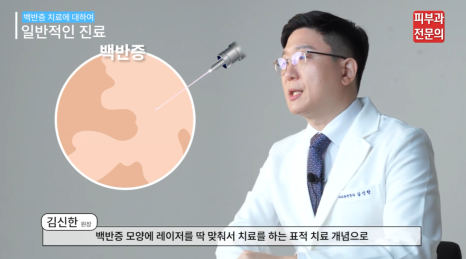
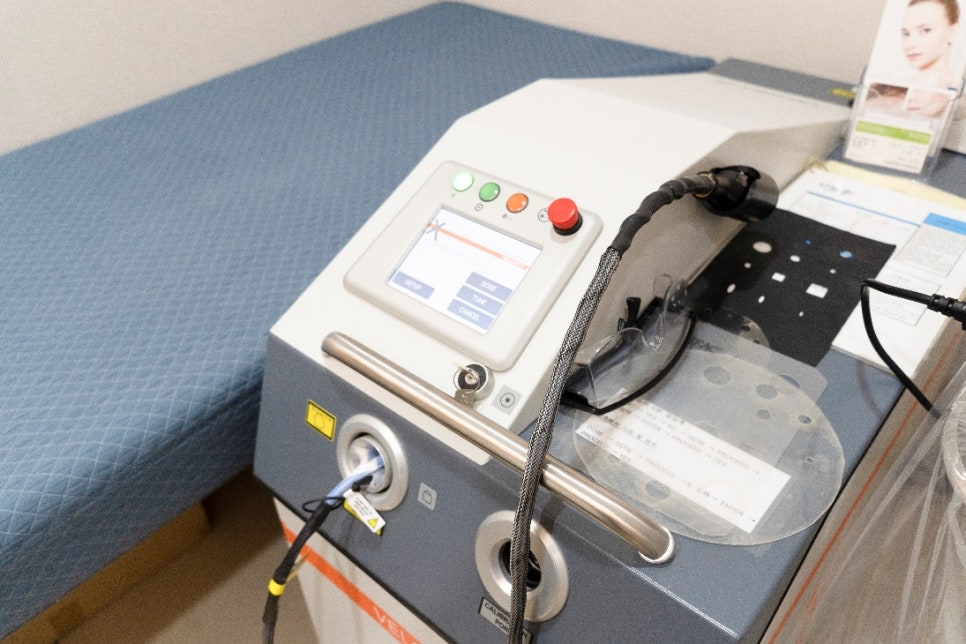
Light therapy is classified in many ways depending on the wavelength used, and the excimer laser treatment I will explain today is a treatment method that uses a wavelength of 308 nm.
Through this, the melanocytes in the skin are directly stimulated.
As a result, the melanocytes in the skin become active again, and the white patches can gradually become lighter.
In addition, because the light is directed only at the area that needs treatment, it has the advantage of having a relatively smaller effect on normal skin tissue.
However, because vitiligo develops as habits repeated day after day accumulate over time, it is difficult to expect satisfactory improvement with just one treatment.
Therefore, it may be advisable to continue treatment consistently according to the medical staff’s instructions.
Vitiligo treatment is generally performed about 2 to 3 times per week, and continuing treatment steadily for more than 6 months may be helpful.
However, the treatment period may be shorter or, conversely, longer depending on the patient’s skin condition, so please plan treatment after sufficient consultation.



Vitiligo: The real start begins after treatment.
Finishing vitiligo treatment does not mean everything is over.
Rather, this may be where the truly important beginning starts.
If vitiligo treatment is the process of removing white patches, then post-treatment care is the process of preventing those patches from appearing again.
As mentioned earlier, vitiligo is a skin condition in which white patches appear because melanocytes are destroyed.
That is why, even if pigment is restored through treatment, melanocytes may still remain sensitive.
Therefore, if care is neglected, the melanocytes may be damaged again, or the autoimmune reaction may recur.
First, ultraviolet rays are one of the main causes of melanocyte destruction, so even after treatment, it is best to pay close attention at all times to ensure the skin is not excessively exposed to ultraviolet rays.
And as mentioned earlier, if you keep scratching the skin, vitiligo caused by the Koebner phenomenon may recur, so it is advisable to avoid irritating the skin.
Lastly, stress is one of the main culprits that encourages autoimmune reactions, so I hope you will strengthen your immunity through a regular lifestyle, exercise, and sufficient sleep.


Vitiligo is not a condition defined simply by a single white patch.
In particular, because the severity of symptoms, skin condition, and location of occurrence differ from person to person, treatment should also be designed on a one-on-one customized basis.
Also, skin conditions that cause white patches are classified in many different ways besides vitiligo.
So, it would be a good idea to visit a clinic that performs a Wood’s lamp examination so the condition can be distinguished in detail.
If you have any questions in addition to the information shared today by the dermatology specialist for vitiligo, please inquire through the comment box below.
We will kindly answer based on the experience of a dermatology specialist for vitiligo.
Thank you for reading to the end.
| This post was written for informational purposes in compliance with Article 56, Paragraphs 1–15 of the Medical Service Act. All treatments carry the risk of side effects and complications depending on the individual. Before treatment, be sure to have a thorough consultation with a medical professional with extensive experience before making your decision. |