When people think of dead skin cells, many have negative ideas about them.
Things like:
'It makes the face look rough'
'It is the main reason makeup does not go on well'
and so on.
However, dead skin cells play a very important role in protecting the skin.
The stratum corneum acts like a "protective barrier" that protects the skin from the external environment and prevents moisture from evaporating.
And in normal skin, old dead skin cells shed at regular intervals while new skin cells regenerate.
The process and timing in which this kind of change occurs is called the "skin cell turnover cycle."
Of course, if dead skin cells continue to shed and regenerate in a regular cycle, healthy skin can be maintained for a long time.
However, if this turnover cycle becomes imbalanced, dead skin cells may build up excessively on the skin surface, or the skin barrier may become severely weakened.
It can even lead to a skin condition called "psoriasis," which forms silvery-white scales in various areas of the skin.
Are you perhaps feeling stressed because of "skin scaling" that seems to be getting worse day by day?
Today, as a specialist at a psoriasis treatment clinic, I would like to discuss chronic skin disease psoriasis in detail, so please focus on the following article and take away some helpful information.
-Today's column outline-
-
Symptoms that may suggest psoriasis
-
What happens if psoriasis is left untreated
-
Psoriasis treatment methods
Psoriasis: Could I have it too?
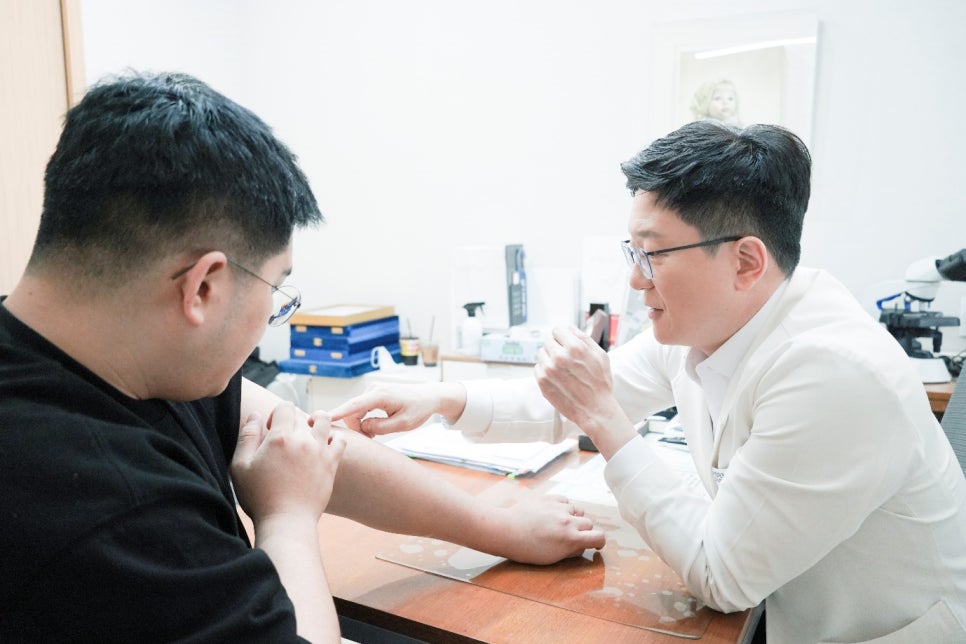
The most representative symptoms of psoriasis are red patches and thick silvery-white scales.
These usually appear on the elbows, knees, scalp, and lower back.
In addition, unlike atopic dermatitis, it is not accompanied by severe itching, but as inflammation worsens, itching that becomes hard to ignore may appear.
Also, psoriasis is divided into many different types depending on the form of the symptoms.
First, let’s talk about plaque psoriasis, which many people already know about.
Plaque psoriasis, as the name suggests, tends to cause plaque-like lesions on the elbows, knees, scalp, and other areas, and it is characterized by the possibility that the lesions can spread rapidly over time.
By contrast, guttate psoriasis appears as small drop-shaped spots that spread across the body, and it often occurs after infections such as a cold or tonsillitis.
Pustular psoriasis is classified as a very severe inflammatory condition, and when pustular psoriasis occurs, yellow pustules (pus-filled pockets) may develop on top of red patches.
It can even be accompanied by heat and pain, causing major effects on the whole body.
As such, psoriasis is not a simple skin disease and can appear in very complex forms, so please visit a clinic and receive a detailed skin examination.



What happens if psoriasis is left untreated?
Psoriasis is not a simple skin disease.
It is a "chronic inflammatory disease" whose symptoms worsen over time and can lead to serious complications.
First, as mentioned earlier, when psoriasis becomes severe, itching is accompanied, and it is never easy to endure this itching.
And if you cannot resist scratching, the skin becomes damaged, the scales fall off, and bleeding occurs.
In addition, inflammatory substances can enter the area where bleeding has occurred, which may cause secondary complications.
Not only that, but psoriasis is a disease that can have a major effect on the whole body, and it is known that about 30% of psoriasis patients actually suffer from psoriatic arthritis.
If psoriatic arthritis develops, the fingers, knees, ankles, and other joints may swell and pain may occur, and in severe cases it can progress to joint deformity.
And if this is left untreated, the likelihood of being exposed to various cardiovascular diseases can increase rapidly.
For that reason, do not take psoriasis lightly, and it may be helpful to visit a clinic and actively plan treatment.



How should psoriasis be treated?
Psoriasis is not just a simple skin issue; it is a complex disease caused by abnormalities in the immune system.
This is why symptoms cannot be controlled with simple moisturizing care alone.
Therefore, if you want to address the root cause of psoriasis, it is advisable to visit a clinic and plan appropriate treatment.
Psoriasis treatment can be carried out differently depending on symptoms, the extent of the lesions, lifestyle patterns, and so on.
For mild psoriasis, treatment with steroid ointments or vitamin D analogues may be used.
By applying these ointments directly to the skin, it may help correct inflammatory and immune responses and control excessive scale production.
Also, for those with relatively widespread lesions, phototherapy using specific ultraviolet light may be used. Since no separate surgical procedure is involved, it has the advantages of less pain and a quicker return to daily life.
However, if symptoms are too severe to improve with ointment treatment or phototherapy, oral medication and biologics may be used.
Among these, biologics have the characteristic of helping directly regulate the immune response, which is the root cause of psoriasis.
I plan to cover biologics for psoriasis in more detail in a future column, so please add this blog to your favorites and take away useful information.



As mentioned earlier, psoriasis is not just a simple skin problem but a chronic disease caused by abnormalities in the immune system.
This is why continuous care and ongoing treatment are necessary.
Also, many psoriasis patients often stop treatment when their symptoms improve.
However, if treatment is stopped abruptly, the symptoms are likely to worsen again, so please continue treatment according to the guidance of the medical staff.
I hope the information I shared today as a specialist at a psoriasis treatment clinic was helpful in some way.^^
If you have any questions other than those covered above, please ask in the comment box below.
I will answer in an easy-to-understand way.
Thank you for reading this post by a specialist at a psoriasis treatment clinic to the end.
| This post was written for informational purposes in compliance with Article 56, Paragraphs 1 to 15 of the Medical Service Act. All treatments carry the risk of side effects and complications depending on the individual. Before treatment, be sure to have a thorough consultation with experienced medical staff before making a decision. |