When you look in the mirror, what catches your eye first?
Your facial features? Your hairstyle?
Of course, facial features and hairstyle are important, but the key factor that determines a person's impression is the skin.
If the skin is clear and maintains an even tone, the overall image can look very healthy.
On the other hand, if the skin tone is reddened, blotchy, or uneven, the skin may appear more sensitive and tired than it really is.

Of course, it would be ideal if the skin could maintain an even tone, but skin does not always stay the same color.
When exposed to sunlight, the skin gets darker, and when a wound occurs, pigmentation may remain.
And after acne clears, red or brown marks may also be left behind.
In this way, our skin becomes discolored for various reasons.
But what if distinct white spots with clear borders appear all over the skin?
Vitiligo is a skin condition that forms white patches on various parts of the skin, and this change has a meaning that is different from simple pigmentation.
Today, I would like to explain in an easy-to-understand way why vitiligo occurs and how it should be treated.
I hope this article will be of even a little help to people with vitiligo.
- Causes of vitiligo
- How to prevent vitiligo
- Skin discoloration treatment: excimer laser

Causes of vitiligo: What is happening inside my skin?
Inside the skin, countless cells carry out their own roles and maintain perfect harmony.
But what if the melanocytes responsible for 'skin color' in this harmonious system fail to do their job?
White patches with clear borders can appear on skin that was previously normal.
So why do melanocytes suddenly disappear?
This phenomenon is closely linked to the body's immune system.
The immune system protects our body from external enemies such as bacteria and viruses.
However, when this immune system loses its direction and attacks healthy cells, an autoimmune reaction occurs and various problems can arise.
Vitiligo is one of the 대표적인 autoimmune diseases, and it occurs when immune cells mistake healthy melanocytes for enemies and destroy them.
The exact reason why this autoimmune reaction occurs has not yet been fully identified, but severe stress, physical overwork, hormonal changes, thyroid disease, and autoimmune diseases such as rheumatoid arthritis are known to have a significant impact.



How can I protect my skin from vitiligo?
As mentioned earlier, vitiligo occurs due to abnormalities in the immune system.
Vitiligo is not just a skin condition; it is an autoimmune disease.
That is why maintaining a healthy immune system in our body may be the most important thing.
First of all, sleep is the most basic foundation of immunity.
Just as staying up all night weakens the body and causes skin problems to flare up, lack of sleep can disrupt immune balance and become a factor that worsens vitiligo.
Therefore, it is advisable to get enough sleep for 7 to 8 hours a day, and to reduce smartphone use and TV viewing before bedtime.
And because stress is one of the causes of immune system disruption, it is good to manage stress by taking a 30-minute walk a day or practicing meditation or deep breathing.
Also, vitiligo is characterized by a close connection not only to immune responses but also to external environments and irritation.
In particular, excessive exposure to ultraviolet rays can destroy melanocytes, so it is advisable to consistently apply sunscreen with SPF 30 or higher.
And outdoor activities should be reduced between 12 p.m. and 3 p.m., when sunlight is strongest.
In addition, vitiligo often occurs in areas where the skin is irritated.
Therefore, it is best to avoid wearing tight clothing, underwear, and belts, and please be careful not to scratch or rub the skin too hard.


Skin discoloration treatment: How excimer laser treatment can awaken pigmentation inside the skin
Once melanocytes are destroyed, they do not naturally regenerate.
In addition, as time passes, the degree of melanocyte destruction may become more severe.
Therefore, even if the symptoms are mild, you should not leave them untreated and should plan treatment as soon as possible.
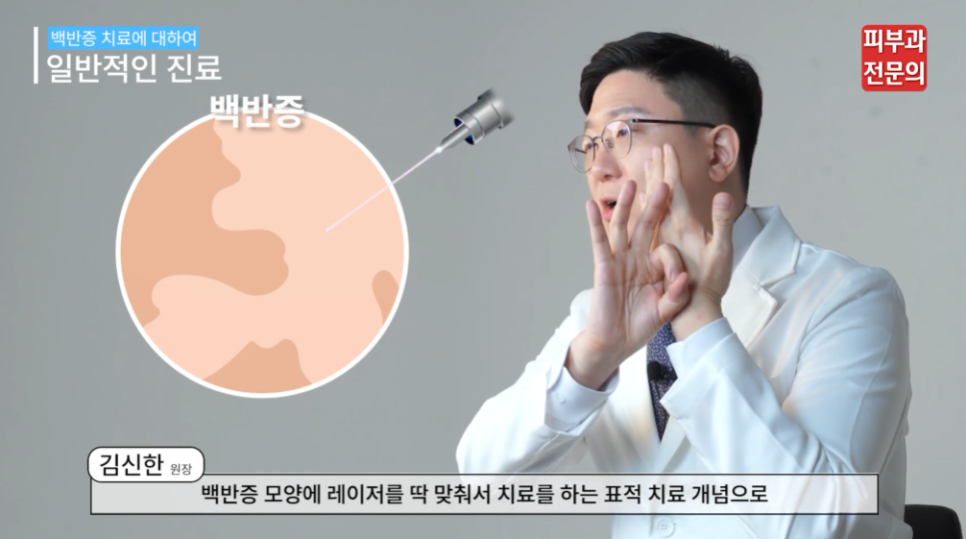
Skin discoloration treatment with excimer laser uses a wavelength of 308 nm and is a treatment method that may help awaken melanocytes within the skin.
Through repeated treatments, you can expect the white patches with clear borders to gradually improve.
Also, because excimer laser treatment targets only the vitiligo area, it has the characteristic of causing less impact on the surrounding normal skin tissue.
In addition, the treatment time is not long, so the treatment burden may be somewhat reduced.
And because it does not produce the strong heat sensation typical of general laser treatments, it has the advantage of causing almost no pain.
(*The degree of pain felt may vary from person to person.)
However, depending on the progression of vitiligo, it may take several months to more than a year to expect satisfactory results.
That is why you should not be impatient and should continue treatment consistently.
Also, the area that received excimer laser treatment may react sensitively to ultraviolet rays, so you need to pay extra attention to sun protection.


So far, we have looked in detail at everything from the causes of vitiligo to treatment methods.
Now, the important thing is how to apply this information to your own skin.
Vitiligo is a skin condition that requires ongoing management along with treatment.
So please pay attention at every moment so that you do not neglect care.
And there is no need to feel discouraged just because you have vitiligo.
Our skin is all different, and each person's skin has its own individuality and beauty.
So while consistently managing the parts that can be corrected through treatment, I hope you can maintain a positive attitude and accept yourself as you are.
I hope today's column has been helpful to people with vitiligo.
Thank you for reading to the end.
| This post was written for informational purposes in compliance with Article 56, Paragraphs 1 through 15 of the Medical Service Act. All treatments carry the risk of side effects and complications depending on the individual. Before treatment, please be sure to have sufficient consultation with experienced medical staff and then make your decision. |