When people hear the word vitiligo, the first thing many of them probably think of is “refractory.”
This is because the white spots that appear on the skin do not disappear easily, and the treatment period is often long.
For this reason, the perception that vitiligo is “hard to cure” has become widespread.
But in reality, it is a little different.
The course and response you can expect from vitiligo treatment can vary greatly depending on when treatment is started.
In particular, if it is found early and treatment begins, you can expect the function of melanocytes to recover and pigmentation to regenerate more quickly.
On the other hand, if treatment is delayed, the lesions may spread and the borders become clearer, so treatment may take a little longer.
However, even if the lesions have already spread, there is no need to give up.
This is because vitiligo is a skin condition in which sufficient symptom improvement can be expected by combining systematic treatment with consistent care.
I will explain this in detail through an article by a specialist at Sinchon Station Dermatology, so please focus from here on.
-Specialist’s column outline-
- What if the vitiligo symptoms are progressing?
- What if the progression of vitiligo symptoms has stopped?
- How can you prevent vitiligo from recurring?

What if the vitiligo symptoms are spreading?
If vitiligo is already in progress, the focus should be on stopping the spread of the lesions.
First, vitiligo is a condition that occurs when melanocytes are destroyed by an autoimmune reaction, and once lost, these cells are not easy to regenerate.
Therefore, it is advisable to block immune attacks so that more melanocytes are not destroyed in additional areas.
The form and progression of vitiligo vary from person to person.
In some cases, such as segmental vitiligo, it stops about a year after onset, but non-segmental vitiligo is difficult to predict and the speed of progression can suddenly increase.
At this time, steroid or immunosuppressive ointments can be used to stop the excessive attack of immune cells.
This can help slow the rapid spread of vitiligo.
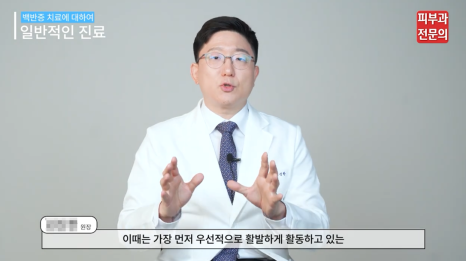

What if the vitiligo symptoms have stopped to some extent?
There is an important turning point in the vitiligo treatment process.
That is the point when the spread of the lesions stops.
From that point on, the goal of treatment changes from “suppressing progression” to “reforming pigmentation.”
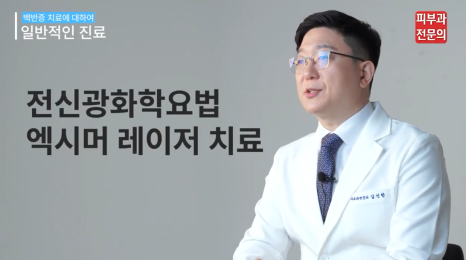
In such cases, phototherapy may be applied, and phototherapy has the feature of helping stimulate the remaining melanocytes.
Among phototherapy options, excimer laser treatment has the advantage of targeting only the problematic melanin, with little effect on the surrounding normal skin tissue.
As a result, the borders of the white spots gradually become lighter, and the noticeable symptoms of vitiligo can be expected to improve.
However, not all areas respond at the same speed.
In particular, depending on the body part, some areas may show faster pigmentation recovery while others recover more slowly.
So rather than expecting symptom improvement in a short period of time, it is preferable to set up a long-term, consistent treatment plan.

How can you manage vitiligo to prevent recurrence?
One of the main causes of vitiligo is an autoimmune disease.
It is when our body’s immune system mistakenly attacks its own melanocytes instead of external invaders.
In this process, melanocytes are destroyed, and the affected area turns into white skin with lost pigmentation.
That is why, in order to prevent recurrence after treatment, it is advisable to continue steady care so that a healthy immune system can be maintained.
In particular, it is advisable to maintain a healthy immune balance by getting enough sleep, keeping a regular daily routine, and managing stress.
In addition, consuming fruits and vegetables rich in antioxidants can also help.
Also, since vitiligo often occurs due to skin friction, it may be advisable to avoid tight clothing and repeated rubbing.
Lastly, excessive exposure to sunlight can stimulate or damage melanocytes again, so please be sure to always use sunscreen.

Vitiligo is not simply a condition in which skin color changes, but a condition deeply connected to immune reactions and overall health.
And although the treatment process can be long, if it is detected early and managed systematically, sufficient improvement can be expected.
However, in order to expect satisfying improvement, it is necessary to consider not only the lesion area itself but also the health condition of the whole body.
Also, regular medical visits can help adjust the treatment direction and detect signs of recurrence early.
Please remember that even if changes during vitiligo treatment are slow, it is important not to give up and to continue managing it.
I hope today’s column was helpful for patients who are stressed by vitiligo symptoms.
If you have any questions beyond the content above, please ask in the comments below.
I will kindly answer them.
Thank you for reading the specialist’s article from Sinchon Station Dermatology to the end.
| This post was written for informational purposes in compliance with Article 56, Paragraphs 1–15 of the Medical Service Act. All treatments carry the risk of side effects and complications depending on the individual. Before treatment, be sure to have a thorough consultation with experienced medical professionals and make your decision afterward. |