Our skin is not created overnight; instead, skin cells are born, age, and shed according to a regular cycle.
In a healthy skin barrier, this cycle usually takes about 28 days.
Simply put, the skin changes into a new set of clothes every month.
This cycle consists of new cells being born deep within the skin, gradually pushed upward over time, becoming harder, and eventually turning into dead cells, or keratin, that naturally fall off.
And this balance must be maintained for the skin to stay smooth and moisturized.
But when changes occur in the body, the story becomes different.
When changes happen in the body, the human skin starts producing new cells much faster than usual.
As a result, thick keratin builds up, the skin turns red, and unsightly scaly plaques may form.
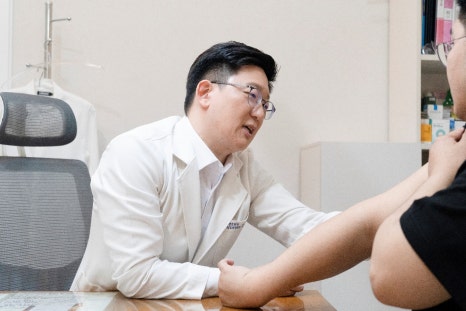
Today, a dermatology specialist at Daerim Station will explain in detail the representative symptoms of psoriasis and the treatment methods for it.
-Column outline by the Daerim Station dermatology specialist-
- Symptoms that suggest psoriasis
- Psoriasis treatment methods
- Psoriasis recurrence prevention guidelines

What symptoms does psoriasis show?
Have you ever suddenly developed red, scaly plaques on your skin?
It is easy to think of it as a simple skin problem, but this may actually be a typical sign of psoriasis.
Psoriasis is a chronic condition caused by skin cells growing and accumulating much faster than normal.
Because of this, the symptoms go beyond simply “dry skin” and appear in a much more distinct and characteristic way.
First, plaque psoriasis is the most common form, accounting for 80-90% of all patients.
It appears as thick silvery-white scales covering a broad red plaque, and it commonly develops in areas with frequent friction such as the elbows, knees, and scalp.
Second, guttate psoriasis appears as small red dot-like rashes scattered like droplets.
It often develops suddenly after an infection such as a cold or pharyngitis, and is commonly seen in younger age groups.
Lastly, pustular psoriasis is a form accompanied by white pustules that look as if pus has formed on the skin.
Because the inflammatory response is strong, it may also be accompanied by pain and fever, and can lead to systemic symptoms, so caution is needed.
How should psoriasis be treated?
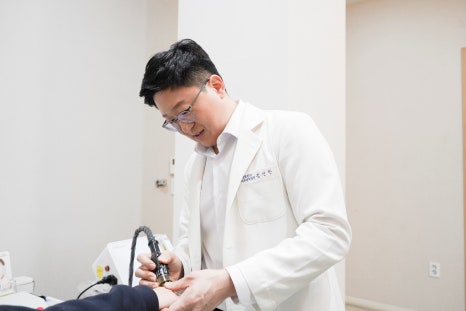
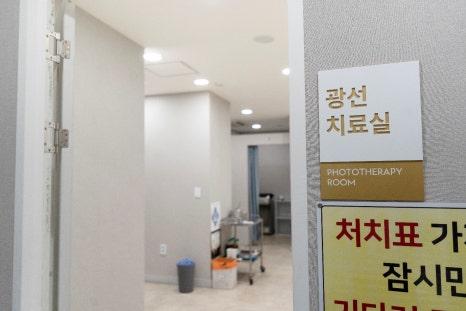
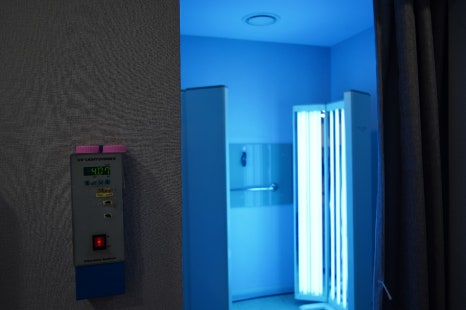
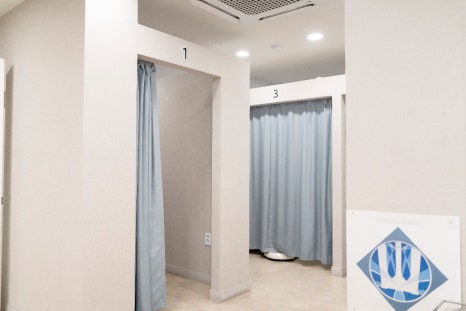
The phototherapy introduced today is a treatment method widely applied to various skin diseases, including psoriasis.
As the name suggests, phototherapy is a treatment that uses light, and it has the 특징 of helping to suppress excessive cell proliferation while also regulating immune responses.
Therefore, with this treatment, over time you can expect improvement in the red rash and thick scales caused by psoriasis.
However, because symptoms do not fully improve after just one treatment session, it may be preferable to establish a treatment plan according to the medical staff’s instructions.
Phototherapy may be performed two to three times a week, and the exposure time and intensity may be gradually adjusted depending on the patient’s skin condition.
However, excessive ultraviolet exposure can cause erythema and stinging, so it is advisable to receive treatment only after undergoing a thorough diagnostic process.
How can you manage psoriasis to prevent recurrence?
Psoriasis is characterized as a chronic disease that does not completely disappear once it appears, but rather improves and then appears again.
The reasons psoriasis recurs can be broadly divided into immunological factors and environmental factors.
First, there is the nature of the immune system.
In psoriasis, the problem is not simply that skin cells proliferate rapidly; rather, an autoimmune response lies behind it.
In other words, because the tendency of immune cells to excessively stimulate the skin and trigger inflammation does not go away, symptoms can reappear even after treatment.
For that reason, it may be advisable to stabilize the immune system through quitting smoking, reducing alcohol intake, exercising regularly, and getting enough sleep.
In addition, taking up healthy hobbies such as meditation and yoga can also help maintain immune balance.
Second, in cold winter weather or dry environments, the skin barrier can weaken and symptoms may worsen again.
In particular, when the skin becomes dry, itching and inflammation become more severe, so it is necessary to make a habit of applying moisturizer every day.
Psoriasis is a condition for which the concepts of management and control are more appropriate than the word cure.
And if you combine consistent treatment with proper lifestyle habits, you can expect sufficient symptom improvement.
What matters most is not worrying alone and leaving it untreated, but establishing a long-term management plan together with medical staff.
Please remember that small changes in daily habits can play a major role in reducing psoriasis recurrence and helping treatment benefits last longer.
I hope today’s column was helpful for patients with psoriasis.
If you have any questions beyond what was covered above, please ask in the comments section below.
I will be happy to answer kindly.
Thank you for reading the post by the dermatology specialist at Daerim Station all the way to the end.
| This post was written for informational purposes in compliance with Article 56, Paragraphs 1-15 of the Medical Services Act. All treatments carry the risk of side effects and complications depending on the individual. Before treatment, please be sure to consult thoroughly with experienced medical staff before making a decision. |