Vitiligo may look like a simple skin change where the skin turns white, but in reality, it is a chronic skin disease caused by an immunological process in which melanocytes in the skin are attacked.
In the early stage of symptoms, it may seem like nothing serious when the skin is dry or briefly appears white, but if the skin color does not return after several weeks or the borders become increasingly distinct, you must definitely consider the possibility of vitiligo.
In particular, if white patches appear on exposed areas such as the face or hands, it becomes more noticeable in daily life, so early response is important.
Today, I will explain the overall details of early vitiligo symptoms and management, as well as the treatment process.
-
Early vitiligo symptoms: what changes should you check first?
-
Step-by-step treatment centered on an excimer laser
-
Lifestyle and skin care points to reduce recurrence

Early vitiligo symptoms,
what changes should you check first?
The biggest characteristic of vitiligo is that a change in skin color appears.
In some cases, lesions suddenly become larger, but in most cases they first look like small white spots, then gradually develop clearer borders and the color difference from the surrounding skin becomes more noticeable.
Unlike ordinary dryness, vitiligo lesions tend not to have much scaling and the surface often appears smooth. Another characteristic is that they commonly appear in areas that experience frequent irritation or friction, such as the backs of the hands, the face, around the mouth, around the eyes, the knees, and the underarms.
As symptoms progress, the white area may gradually widen, or a spreading pattern may appear in which the surrounding area loses pigment first.
Because of these various patterns, it is often difficult to judge on your own, and many cases are missed in the early stage.
If you notice symptoms early and begin treatment, you can slow the spread of the lesions and improve the expected outcome, which is why early response is especially important.
Excimer laser-centered
step-by-step treatment
Vitiligo treatment is not simply about shining a laser on the skin; it requires a step-by-step approach that considers the lesion’s response speed, skin color changes, and immune status.
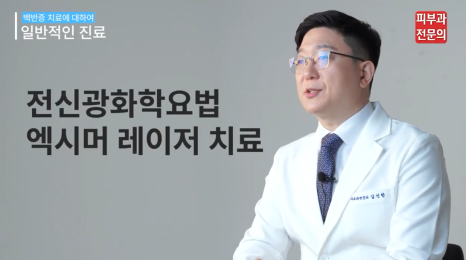
The treatment at the center of this approach is the 308nm excimer laser.
In the early stage of symptoms, the laser is focused on the depigmented area to stimulate melanocytes so they can function again.
This process forms the basis of the treatment direction, and the expected response can be confirmed only by continuing treatment at regular intervals.
In the middle stage, the laser intensity and treatment interval are adjusted according to the recovery speed of the lesions.
This is because some areas regain color quickly, while others show changes more slowly.
If necessary, using immunomodulating ointments or moisturizing care together can help improve the expected outcome.
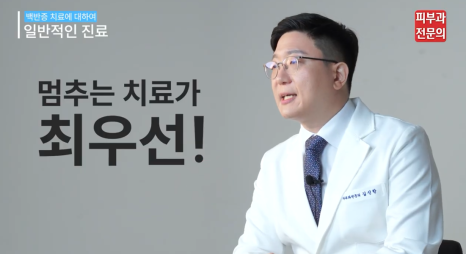
Once some skin color has recovered, treatment moves into the maintenance stage. If treatment is suddenly stopped at this point, the skin may lose color again within a short period of time.
In the maintenance stage, the treatment interval is extended while adjusting the plan so that melanocytes can settle in a stable way.
Vitiligo is not a condition that ends with short-term treatment, so stable results can be expected when the early, middle, and maintenance stages are connected smoothly.
Lifestyle and skin care points
to reduce recurrence
Along with treatment, daily care is important for vitiligo.
One way to manage it in daily life is to minimize skin irritation.
When washing your face or showering, it is best to avoid strong friction or hot water and keep the skin surface as gentle as possible.
After showering, you should apply moisturizer before the skin becomes dry to protect the skin barrier, which can help reduce worsening of the lesions.
Ultraviolet rays are also one of the most important management factors in vitiligo.
An appropriate amount of ultraviolet exposure can help treatment, but excessive exposure can spread the lesions further and make the color appear even more faded.
Therefore, using sunscreen before going out is essential, and it is especially best to avoid direct sunlight at midday.
Lifestyle management also has a direct effect on vitiligo.
Stress, lack of sleep, and dry environments can all worsen symptoms, and when the immune balance is disrupted, lesions often spread more quickly.
Basic habits such as regular sleep, 충분한 rest, and indoor humidity control are very helpful in maintaining the expected outcome.
Even after symptoms improve, it is necessary to regularly check the progress.

Because vitiligo is a condition involving a more complex immune response than simply a change in skin color, an accurate diagnosis and a systematic treatment plan from the early stage are important.
The laser treatment mentioned above is a treatment method that helps melanocytes recover, but along with that, reducing skin irritation and managing ultraviolet exposure, moisturizing, and lifestyle habits together can improve the expected outcome and lower the risk of recurrence.
If you are worried because spots have appeared on your skin, please visit a hospital, receive a diagnosis, and proceed with the appropriate treatment.
I hope the information about vitiligo shared today was helpful to you, and I will end the post here.
Thank you for reading to the end.
| This post was written for informational purposes in compliance with Article 56, Paragraphs 1 to 15 of the Medical Service Act. All treatments carry the risk of side effects and complications depending on the individual. Before treatment, please be sure to make a sufficient consultation with medical staff who have extensive experience before making your decision. |