Atopic dermatitis may seem like nothing more than dry, itchy skin, but in reality, it is a chronic condition in which the skin barrier weakens and the immune system reacts sensitively, causing symptoms to appear repeatedly.
In the beginning, it is easy to brush it off lightly, thinking, “Is my skin just feeling a bit tight?” or “Did I get scratched somewhere?”
However, if symptoms keep recurring or if redness continues to appear in a specific area, treatment may be needed before it gets worse.
Because atopic dermatitis quickly reacts even to everyday triggers such as dryness, temperature changes, and stress, it can be difficult to improve symptoms with moisturizing alone.
At Yeouido Station Dermatology, we take a step-by-step approach to atopic dermatitis based on these characteristics, from early symptoms to treatment and management methods, to help stabilize the skin.
Today, we will provide information on atopic dermatitis treatment, early symptoms, and treatment and management methods.
- Early symptoms of atopic dermatitis: what changes should you check first?
- Ointment treatment: an approach to relieving symptoms
- Moisturizing, lifestyle management, and how to maintain treatment effects
Early symptoms of atopic dermatitis,
what changes should you check first?
In the early stages of atopic dermatitis, several small changes appear on the skin surface.
They may be felt as simple dryness or irritation, but if they keep recurring, it could be the start of atopic dermatitis.
Common symptoms seen in the early stage include red patches, skin tightness, stinging, and dryness.
These symptoms may seem to improve temporarily with moisturizing, but because the skin barrier is already weakened, the condition can worsen again.
In particular, if the skin becomes rough and red repeatedly even without scratching, it may be suspected that atopic dermatitis is progressing.
It also has the characteristic of symptoms occurring frequently in delicate areas such as the inside of the elbows, behind the knees, around the neck, and around the eyes.

Ointment treatment: an approach to relieving symptoms
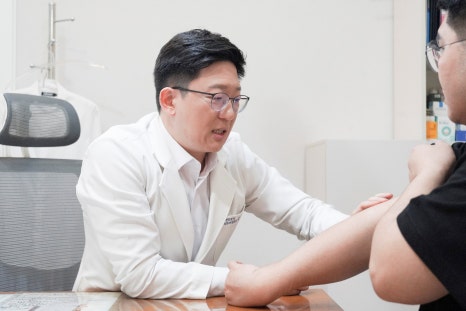
One of the important goals in treating atopic dermatitis is calming inflammation, and ointment treatment is at the center of that.
However, when it comes to ointments, using more is not better; it is important to adjust the amount, frequency, and type according to the skin condition.
When using ointment, it is best to apply an appropriate amount first so that the skin is not overly irritated.
If the amount is too small, the treatment effect decreases, and if it is too much, it may cause irritation instead.
It should also be applied to areas with redness and severe itching, while moisturizer should be applied to areas without symptoms rather than ointment.
In particular, when symptoms begin to improve during ointment treatment, the treatment should be maintained consistently.
If you suddenly stop using the ointment just because the symptoms seem to be easing, the condition often worsens again, so gradual adjustment is essential.
Ointment treatment is not a short-term management method; it should be carried out while gradually adjusting the amount used in line with changes in the skin’s condition.
Through this process, recurrence of inflammation can be reduced, and long-term skin stabilization can be expected.



Moisturizing, lifestyle management, and how to maintain treatment effects
Atopic dermatitis is not completely resolved through treatment alone, and the frequency of symptom flare-ups can vary greatly depending on how the living environment is managed.
First, to restore the skin barrier, enough moisturizer should be applied 2 to 3 times a day to prevent moisture from evaporating.
Applying moisturizer before the skin dries after showering is also effective, and it is best to avoid products with strong fragrance or irritating ingredients.
In addition, symptoms can easily worsen in environments with large temperature changes or dryness, so maintaining indoor humidity, managing stress, and getting enough sleep are also important.
These lifestyle improvements help maintain treatment effects for longer and also help reduce the amount of ointment needed.
In particular, because the aggravating factors differ from person to person, identifying which environments affect you plays a major role in reducing recurrence.

Atopic dermatitis is not a condition that can be solved by treatment alone; ointments, moisturizing, and lifestyle management all need to work together for symptoms to stabilize.
Simply identifying symptoms early and starting appropriate treatment can also help reduce the frequency of flare-ups later on.
If your skin is frequently turning red or itching repeatedly, do not try to manage it on your own; we recommend seeking an accurate treatment plan together with a specialist.
Please remember that the most important thing in atopic dermatitis treatment is consistency.
We hope the information shared today about atopic dermatitis treatment was helpful to you.
If you have any questions beyond the information above, please leave them in the comment box below.
We will answer kindly.
Thank you for reading to the end.
| This post was written for informational purposes in compliance with Article 56, Paragraph 1 to Paragraph 15 of the Medical Service Act. All treatments carry the risk of side effects and complications depending on the individual. Before treatment, please be sure to have a thorough consultation with experienced medical staff before making a decision. |