When red rashes and scaling repeatedly appear on the skin, people often initially think it is simply due to dry skin or a temporary skin problem.
Especially in winter, when the temperature difference between indoors and outdoors is large, dryness can feel more severe, and rashes or scaling can develop more easily on the skin.
"It’ll get better if I rest a little"
"It’ll improve if I just moisturize well"
People often think this way, but if these symptoms keep recurring in a specific area or the lesion gradually spreads, it may be necessary to suspect psoriasis, one of the skin diseases.
Psoriasis is not simply a skin disease that causes scaling; it is a chronic inflammatory skin disease in which the skin renewal cycle and immune response become abnormal.
Once symptoms begin, many people experience a repeated cycle of "improves, then worsens," and the condition can change significantly depending on the living environment and habits, so management in daily life is very important along with treatment.
So today, I will explain in detail about these psoriasis symptoms and lifestyle habits that can help reduce recurrence.
-Column order from Singil-dong Dermatology-
- Psoriasis symptoms: why do they keep recurring?
- Psoriasis treatment: inflammation must be stabilized first
- Lifestyle management points to help reduce recurrence

Psoriasis symptoms: why do they keep recurring?
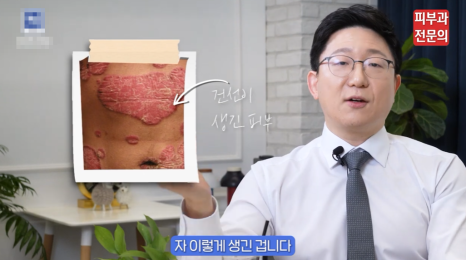
Psoriasis is a condition that occurs when skin cells are produced at a much faster rate than normal.
In normal skin, dead skin cells naturally shed through a regular cycle, but in psoriasis skin, this cycle becomes excessively fast, leading to a buildup of scales on the skin surface and inflammation underneath.
During this process, red, plaque-like rashes appear on the skin, and thick white scales often pile up in layers on top of them.
Symptoms such as itching, stinging, and cracked skin may also occur.
In particular, symptoms often recur in areas that receive a lot of irritation, such as the elbows, knees, scalp, lower back, and buttocks.
The reason psoriasis easily recurs is that the problem is not limited to the skin surface.
When immune responses within the skin are overly active, even a small amount of external irritation can easily trigger inflammation again.
Therefore, psoriasis is not a condition that should be treated only when symptoms appear; it is important to understand that management must continue even after the skin condition has stabilized.
In other words, if psoriasis symptoms keep recurring, it is necessary to review not only the current skin condition but also overall lifestyle habits.

Psoriasis treatment,
inflammation must be stabilized first.
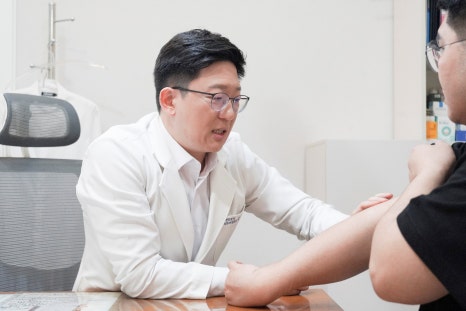
The first goal of psoriasis treatment is to stabilize the inflammatory response that continues deep within the skin.
At this stage, the focus should be on calming the inflammation itself rather than simply removing the scales on the skin surface.
In early treatment, steroid ointments or vitamin D derivative ointments are mainly used.
These topical treatments help reduce redness and thick scales and support the skin in regaining its normal renewal process.
What is important at this time is not to apply ointment indiscriminately in large amounts, but to use the appropriate amount and frequency according to the skin condition.
Moisturizing care should also be carried out along with ointment treatment.
Since psoriasis skin becomes more prone to worsening inflammation as it gets drier, applying enough moisturizer within 3 minutes after showering should become a basic part of care to protect the skin barrier.
Rather than once a day, maintaining moisturizing care 2 to 3 times a day depending on the skin condition can be helpful.
Once the inflammation has stabilized to some extent, phototherapy may be considered depending on the extent and condition of the lesions.
Phototherapy helps control excessive skin cell proliferation and reduce immune responses, and its effectiveness can be expected when it is carried out consistently at regular intervals.
However, treatment response varies from person to person, so it is necessary to continuously check the skin condition and adjust the treatment plan.
As such, it is important to understand that psoriasis treatment does not end in one step, but is a process that continues sequentially in line with changes in the skin condition.

Points of daily care to help reduce recurrence
Psoriasis is a condition in which daily care is just as important as treatment itself.
This is because, even with the same treatment, the frequency of recurrence and the severity of symptoms can vary greatly depending on lifestyle habits.
Therefore, it is necessary to consistently practice habits that reduce direct irritation to the skin and maintain immune balance.
First, it is important to minimize skin irritation.
Taking long showers with hot water, scrubbing away dead skin, or repeating habits that involve strong friction can worsen psoriasis symptoms.
When washing your face or showering, it is better to use lukewarm water and gently cleanse the skin rather than rubbing it.
For clothing, choosing soft cotton materials rather than rough fabrics can help reduce skin friction.
Moisturizing care is essential in psoriasis management.
As the skin becomes drier, scaling becomes thicker and inflammation can more easily flare up, so it is necessary to build the habit of using moisturizer consistently.
In particular, it is good to apply moisturizer immediately when the skin feels tight after going বাইরে or after showering.
Lifestyle habits are also related to psoriasis recurrence.
Lack of sleep, excessive stress, and frequent alcohol consumption can disrupt immune balance and worsen symptoms.
Maintaining a regular sleep pattern and finding ways to relieve stress appropriately can be helpful for long-term management.
Lastly, it is important not to stop caring for the condition just because symptoms have improved.
Even if visible symptoms disappear, the inflammatory response within the skin is often not completely stabilized in psoriasis, so checking the skin condition through regular medical visits and adjusting treatment when needed can help reduce recurrence.
Psoriasis is not a condition that can be cured in a short period of time; it is a chronic disease in which stable control can be maintained only by managing both the skin condition and lifestyle habits together.
It is difficult to prevent recurrence by treating it only when symptoms appear and stopping care when things improve.
Only when treatment to stabilize skin inflammation is combined with moisturizing, minimizing irritation, and managing lifestyle habits can the fluctuations in symptoms be reduced and long-term stability be expected.
In particular, it is important to identify which factors worsen your symptoms and to build care habits accordingly.
If psoriasis symptoms keep recurring or seem to be getting worse than before, rather than trying to manage it alone, it can be helpful to accurately check your current skin condition and readjust the treatment direction.
When consistent treatment and proper daily care continue together, the discomfort caused by psoriasis can be sufficiently reduced.
I hope the information shared today by Singil-dong Dermatology about psoriasis symptoms and lifestyle habits to help reduce recurrence was helpful to you.
Thank you for reading to the end.
| This post was written for informational purposes in compliance with Article 56, Paragraphs 1 to 15 of the Medical Service Act. All treatments carry a risk of side effects and complications depending on the individual. Before treatment, please be sure to have a thorough consultation with experienced medical staff before making a decision. |