Atopic dermatitis is not a condition that can be explained simply as dry or itchy skin.
Because it is a chronic skin disease in which inflammation repeatedly occurs as the skin barrier weakens and immune responses become more sensitive, many people go through a cycle in which symptoms temporarily subside and then worsen again.
At first, many people think, “Has my skin just become sensitive lately?” and try to manage or improve it with moisturizers, but if itching keeps recurring or a certain area stays red and develops flaking skin, it may be a condition that requires more systematic treatment and management.
In particular, because atopic dermatitis is sensitive even to everyday factors such as seasonal changes, living environment, and stress, simple care alone may make it difficult to expect symptom improvement.
-Column order from the Yeouido-dong dermatology clinic-
-
Atopic dermatitis: why does it worsen repeatedly?
-
Ointment treatment: why correct use is important
-
How are living environment and habits related to worsening symptoms?

Atopic dermatitis: why does it worsen repeatedly
Atopic dermatitis is a condition that appears not so much because of the skin itself, but because skin barrier damage and an imbalance in immune responses act together.
As the skin barrier weakens, external irritants can more easily penetrate into the skin.
In this process, itching and inflammatory reactions occur repeatedly.
The problem is that once this condition develops, it is difficult to recover naturally.
Itching leads to scratching, which worsens skin damage, and that in turn aggravates inflammation, creating a vicious cycle.
Symptoms often recur especially in areas where the skin is thin and folded, such as the inner elbows, behind the knees, the neck, and the face.
In addition, factors commonly encountered in daily life, such as stress, lack of sleep, temperature changes, and dry environments, also trigger atopic symptoms.
That is why atopic dermatitis is a condition that often leaves people wondering, “Why does it come back even after treatment?”

Ointment treatment: why correct use is important
In atopic dermatitis treatment, ointment is the most basic treatment method for directly controlling inflammation.
However, ointment is not simply a medicine to apply when itching occurs; it is a treatment tool that helps stabilize the skin’s inflammatory response and supports recovery, so the way it is used is very important.
As a rule, ointment should be used in an appropriate amount suited to the skin condition.
If too little is applied, inflammation may not be sufficiently suppressed and the effect may be reduced. On the other hand, excessive use may increase skin irritation or sensitivity.
Therefore, it is advisable to use an amount that can be thinly and evenly absorbed into the skin.
Also, ointment should be applied intensively to the affected areas where symptoms appear.
It is helpful to prioritize use on areas with clear redness or itching, and to focus on moisturizing care rather than ointment for areas without symptoms to reduce the burden on the skin.
One thing to be especially careful about is applying it over a wider area than necessary or stopping use on your own once symptoms improve a little.
This kind of approach can make the skin condition even more unstable and can also cause inflammation to return quickly.
Rather than ending ointment treatment in the short term, a more stable approach is to adjust the amount and frequency step by step while observing the skin’s response.


Living environment and habits,
How are they related to worsening symptoms
When looking at cases where atopic symptoms are not well controlled, living environment or habit-related factors often play a role along with the treatment itself.
In particular, the following factors are closely related to worsening atopic dermatitis.
When the skin is continuously left in a dry state, the skin barrier becomes weaker and inflammatory reactions occur more easily.
Frequent showers, using hot water, or repeated strong friction can damage the protective barrier and worsen symptoms.
Stress and lack of sleep are also major causes of worsening atopic symptoms.
As stress builds up, immune responses become more sensitive, and the skin’s ability to recover also declines.
If a low-humidity indoor environment is added on top of that, skin moisture loss speeds up, making itching and flaking worse.
For this reason, in atopic dermatitis management, moisturizing maintenance, minimizing irritation, and lifestyle habit management must be carried out together with ointment treatment.
Applying enough moisturizer within 3 minutes after showering and maintaining hydration 2 to 3 times a day according to the skin condition can also have a positive effect on skin barrier recovery.
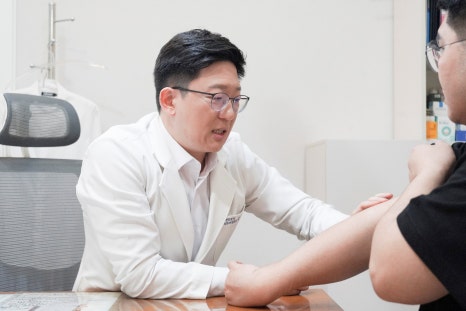

Atopic dermatitis is not a condition that can be resolved by just one method.
Symptom relief can be expected when the process of controlling inflammation through ointment treatment and the process of restoring the skin barrier through lifestyle management are carried out together.
Rather than giving up on treatment because symptoms recur, or conversely increasing the intensity of care excessively, it is important to establish a treatment and management direction suited to the current skin condition.
I hope the information about atopic dermatitis shared today was helpful for those preparing for treatment.
Thank you for reading to the end.
| This post was written for informational purposes in compliance with Article 56, Paragraphs 1 through 15 of the Medical Service Act. All treatments carry a risk of side effects and complications depending on the individual. Before treatment, be sure to have a thorough consultation with medical staff who have extensive experience before making a decision. |