Psoriasis has the characteristic of improving and then returning again, so many people end up thinking, “Why does it keep recurring?”
Especially when the scaling gradually becomes thicker or the rash keeps recurring, it is hard to attribute it simply to dryness or seasonal effects, and changes occurring within the skin also need to be considered.
Psoriasis is a condition that is difficult to judge accurately by looking only at the symptoms visible on the skin, so it is necessary to examine each person’s different constitution-related inflammatory response, lifestyle habits, and surrounding environment in a variety of ways.
So today, we will take the time to explain in detail why psoriasis recurs and how to manage it.
- A column by a Mullae-dong dermatology clinic -
- Reasons psoriasis recurs
- Why scaling and rash should be approached differently
- Management methods to prevent symptom recurrence

Reasons psoriasis recurs
Psoriasis is often thought of as a problem caused simply by dry skin, but in fact it develops from an inflammatory response that begins deep within the skin.
When the skin’s natural recovery speed becomes excessively fast, cells are produced much more quickly than normal, and in that process, scaling builds up thickly or a rash appears, leading to symptoms.
When common everyday triggers such as weather changes with large temperature differences, stress, and lack of sleep are added to this, the skin becomes more sensitive and symptoms can recur easily.
In the end, the reason psoriasis recurs is not the visible scaling itself, but the fact that the skin has become sensitive due to various triggers.
For this reason, when managing psoriasis, rather than trying only to resolve the symptoms you can see, it is better to identify the different causes for each individual and provide treatment accordingly.


Why scaling and rash
should be approached differently
Psoriasis treatment should be approached differently depending on whether scaling is more prominent or red rash is the main feature.
In the stage where the rash is severe, inflammation is active, so it is difficult to expect improvement with moisturizing alone, and it is essential to first stabilize the inflammation using topical agents such as steroids or vitamin D derivatives.
On the other hand, during periods when scaling appears to be excessively accumulated, the skin’s regeneration is progressing too quickly, so forcibly removing the scale can actually cause skin damage and expand the lesions.
In such cases, treatment should continue in a way that minimizes irritation and normalizes the skin’s recovery process.
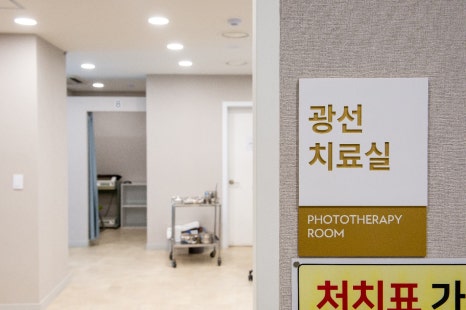
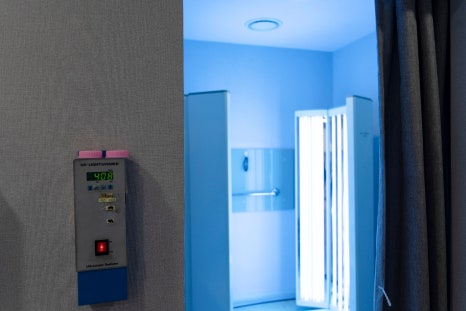
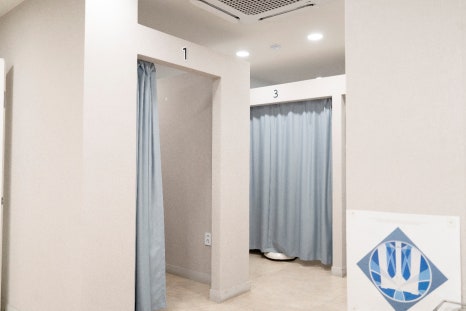
If the lesions have been present for a long time or appear over a wide area, treatments such as excimer laser or phototherapy may also be used together to help reduce recurrence.
In this way, psoriasis should not be managed simply by removing scaling or moisturizing, but by checking what stage your skin is currently in and taking a stage-by-stage approach to improve the expected effect.
Management methods to prevent symptom recurrence
Psoriasis should be managed together with lifestyle care alongside treatment.
In particular, if the skin is subjected to friction or exposed to specific environments, symptoms can quickly worsen, so it is a good idea to pay attention even to small everyday details such as clothing materials and face washing.
Because the skin is easily irritated, it is advisable to wear soft fabrics and keep showers short, and scrubs should be avoided because they can easily irritate the skin.
Also, because psoriasis-prone skin is more likely to develop inflammation as it becomes drier, it is important to use moisturizer several times a day to maintain a strong skin barrier.
Stress and lack of sleep are also major factors that worsen psoriasis, so establishing a regular daily rhythm has a significant impact on the treatment process as well.
Above all, if you stop treatment as soon as the skin looks better, psoriasis is highly likely to recur quickly, so it is necessary to have a specialist check the skin at regular intervals and adjust the intensity of treatment.
When this kind of lifestyle management is carried out together, the recurrence interval can gradually become longer, and the degree of symptom fluctuation can also be reduced.

Psoriasis may seem like a skin problem where redness or scaling appears and disappears, but in reality, it is a chronic condition that recurs as inflammation within the skin and the living environment work together in complex ways.
Therefore, even if the symptoms have calmed down, it does not mean the problem has been completely resolved; how stable the inflammation inside the skin has become is the key criterion in treatment.
A step-by-step approach, from initial inflammation stabilization to lesion reduction and then maintenance care, is needed to reduce recurrence, and if this process is followed consistently, the intervals between symptoms appearing can gradually become longer, and the intensity of worsening can be greatly reduced.
I hope the information about psoriasis shared today was helpful for those preparing to treat their symptoms.
Thank you for reading to the end.
| This post was written for informational purposes in compliance with Article 56, Paragraphs 1 to 15 of the Medical Service Act. All treatments carry the risk of side effects and complications depending on the individual. Before treatment, be sure to make a sufficient consultation with a medical professional with ample experience before making a decision. |