Itching is a symptom that is hard to endure.
Even when there are no visible wounds, when you keep experiencing discomfort that makes it hard to avoid scratching, your ability to focus in daily life can also decrease.
In particular, if you have experienced atopic dermatitis, one of the skin conditions, you may have wondered, “It doesn’t look that severe on the outside, so why does it keep itching so much?”
Even if there is not much redness or oozing, if the itching becomes especially worse at night or a certain area repeatedly reacts sensitively, it may be difficult to see it as only a problem on the surface of the skin.
This is because atopy is a condition in which not only visible lesions but also the state of the skin barrier and internal inflammatory responses work together.
Today, I will explain what skin conditions should be checked when itching continues.
- Column sequence from Dangsan-dong Dermatology -
- Why itching continues even when it does not look severe
- Signs that appear when the skin barrier breaks down
- Directions to consider together in atopy management

Why itching continues even when it does not look severe
Atopy does not always come with red rashes or oozing.
If the skin looks relatively calm on the outside but the itching continues, you may need to consider that the inflammatory response inside the skin has not fully stabilized.
In particular, when the skin has become thin, it reacts more sensitively to external stimuli.
Everyday environmental factors such as friction when putting on or taking off clothes, dry air, and sweat irritation can easily trigger itching.
At this time, rather than simply brushing it off as “maybe I’ve been scratching out of habit,” it is helpful to check whether the skin barrier is in the recovery stage and whether inflammation is still present.

Signs that appear when the skin barrier breaks down
The skin barrier acts as a protective shield that blocks external irritation.
When atopy recurs, this protective function weakens, moisture escapes more easily, and dryness becomes worse.
At this time, the skin may look rough on the surface or develop repeated flaking.
If tightness continues for a long time after washing your face, or if your skin quickly becomes dry even after applying moisturizer, the barrier may not be recovering sufficiently.
Itching also often gets worse at night.
This is because changes in body temperature and increased blood flow make skin sensations more sensitive.
In this way, even if noticeable rashes decrease, if dryness, sensitivity, and repeated scratching continue, it is difficult to say that the skin has reached a stable stage yet.

Directions to consider together in atopy management
Atopy management does not end with simply calming inflammation.
The process also needs to include creating an environment in which the skin can maintain balance on its own.
When ointment treatment is needed, it should be used for the proper period and with the appropriate strength, and care should be taken not to stop it arbitrarily or use it excessively.
Moisturizing is also not just a habit; it is an important part of care that helps the barrier recover.
Maintaining moisture right after showering and allowing the skin to absorb it by patting rather than rubbing can be helpful.
It is also necessary to check the living environment together.
Managing indoor humidity, choosing less irritating clothing, and avoiding excessive heat stimulation can all affect the relief of itching.
Atopy has the characteristic of improving once and then recurring again.
Therefore, rather than stopping care just because symptoms have decreased, maintenance tailored to the skin condition is needed.
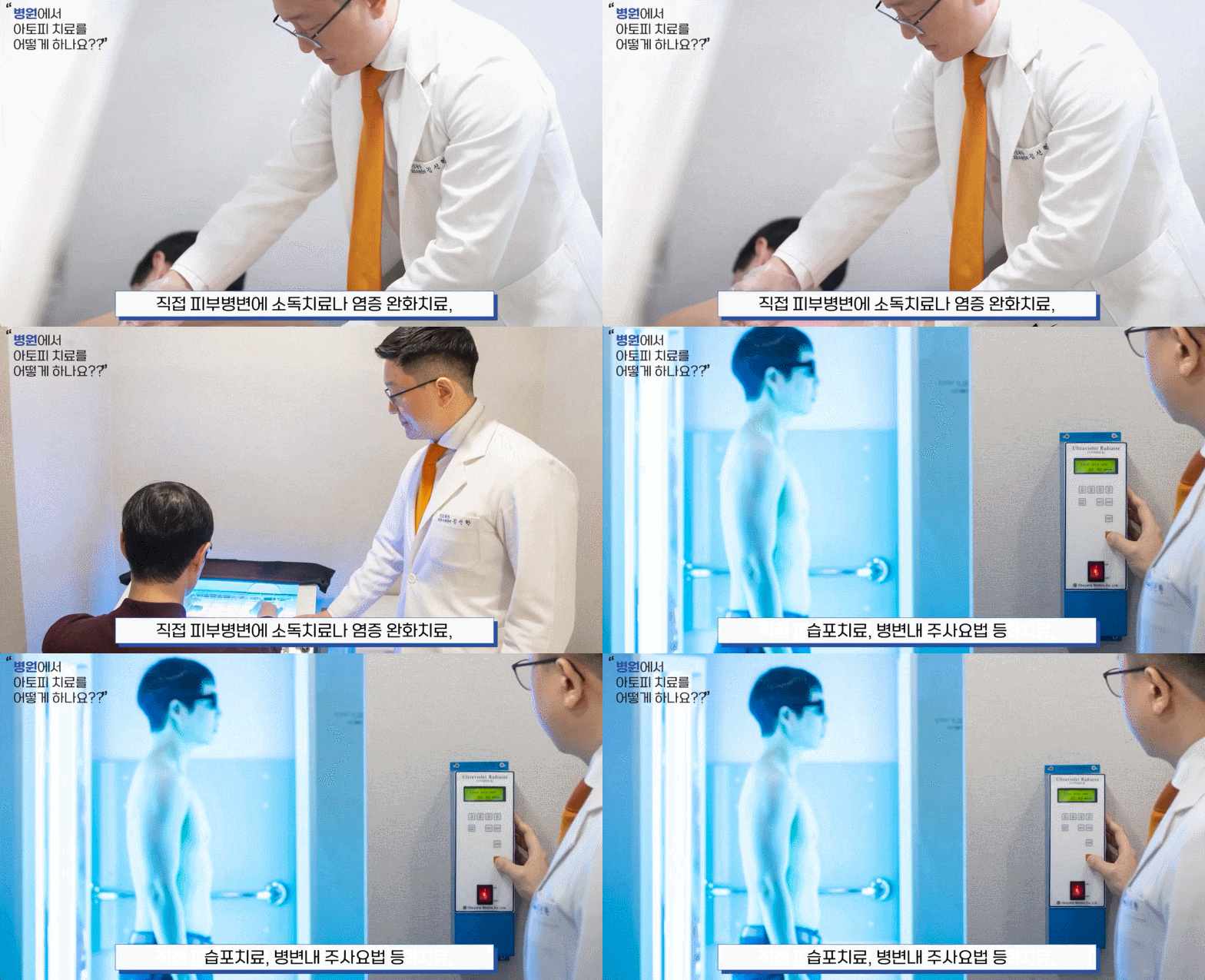
Persistent itching may be a sign that the skin has not yet fully recovered.
It is difficult to assume that the skin is in a stable condition just because it does not look severe on the outside.
Dryness, sensitivity, and repeated scratching can be clues that the skin barrier has not recovered sufficiently.
If you are considering atopy management, it may help to accurately check your current skin condition and consider both inflammation control and barrier recovery.
Understanding not only the visible symptoms but also the condition the skin is in can be the first step in care.
I hope today’s information was of some help to those who are struggling with atopy.
Thank you.
| This post was written for informational purposes in compliance with Article 56, Paragraphs 1 to 15 of the Medical Service Act. All treatments carry the risk of side effects and complications depending on the individual. Before treatment, be sure to have a thorough consultation with a medical professional who has extensive experience before making a decision. |