"If skin collagen decreases, will wrinkles form too?"
"Is a decrease in collagen also related to skin diseases?"
The term skin collagen is often mentioned in discussions about skin elasticity or aging.
For that reason, many people tend to associate reduced collagen simply with wrinkles or loss of skin elasticity.
However, collagen is actually known to play an important role not only in skin elasticity but also in maintaining skin structure.
As one of the main proteins that make up the dermis, it supports skin tissue and helps maintain a stable skin environment.
Regarding this, Dr. Kim Shin-han of Gye Dermatology appeared on JTBC’s Docu Plus Q and explained how reduced skin collagen may be related to changes in skin condition, and what should be considered together when understanding skin diseases.
Today, based on what was shared on the broadcast, we will talk about the relationship between reduced skin collagen and skin diseases.

Skin collagen is an important element
that maintains skin structure
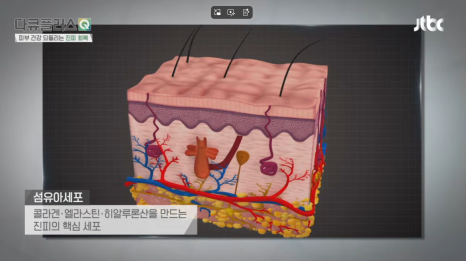
The skin is made up of the epidermis, dermis, and subcutaneous tissue, and among these, the dermis plays a role in supporting the skin’s structure.
The representative protein that makes up this dermal layer is collagen.
Collagen connects skin tissue and plays an important role in maintaining the skin’s shape and elasticity.
Simply put, it can be seen as a kind of support structure that helps sustain the skin’s framework.
However, collagen tends to gradually decrease as we age.
It is generally known that collagen production begins to slowly decline after the 20s, and over time this can lead to reduced skin elasticity and changes in skin structure.
These changes are not limited to simple skin aging, but can also affect the overall skin environment.


A decrease in collagen can also be linked to changes
in the skin barrier and skin environment
When skin collagen decreases, the skin structure weakens, which can also affect skin barrier function.
The skin barrier is an important element that protects the skin from external irritation and helps retain moisture.
When the skin structure weakens, its defensive ability against outside stimuli may decrease.
These changes can lead to an environment in which the skin reacts more sensitively.
In particular, in skin diseases where inflammatory reactions recur, changes in the structure of skin tissue may also appear.
In this way, reduced collagen can be understood as a factor connected not only to skin elasticity but also to changes in the skin environment.

When understanding skin diseases,
structural changes also need to be considered
Skin diseases are often difficult to explain solely by the symptoms that appear on the surface of the skin.
This is because the inner structure of the skin, immune responses, and the condition of the skin barrier can all influence symptoms together.
For example, in atopic dermatitis, skin barrier function may weaken, increasing the response to external irritants.
Psoriasis is also known as a disease in which changes in skin tissue structure appear along with inflammatory skin reactions.
In this process, collagen, which forms part of the dermal structure, may also be affected to a certain extent.
This is because when the skin structure changes, the skin environment itself also changes, creating conditions that can allow inflammatory reactions to continue.
So when understanding skin diseases, it may be necessary to consider not only the visible symptoms but also the skin structure and skin environment.

Skin collagen is not simply a factor that affects only skin elasticity and wrinkles; it is an ingredient that plays an important role in maintaining skin structure and keeping the skin environment stable.
Because the structural changes that occur as collagen decreases can also be linked to skin barrier function and inflammatory skin reactions to some extent, they may be considered as part of understanding skin condition.
Through the broadcast, Dr. Kim Shin-han of Gye Dermatology emphasized that when understanding skin diseases, it is important not to focus only on the symptoms visible on the outside, but to also look at changes in skin structure and the skin environment.
That said, because this was a broadcast format, there were limits to explaining all the detailed differences according to each person’s skin condition.
Even so, we hope this broadcast served as an opportunity to better understand the relationship between skin collagen and skin diseases.
Gye Dermatology will continue to provide accurate skin information that may be helpful for skin health.
Thank you.
| This post was written for informational purposes in compliance with Article 56, Paragraphs 1 to 15 of the Medical Service Act. All treatments carry a risk of side effects and complications depending on the individual. Before treatment, be sure to make a decision only after充分 consultation with experienced medical staff. |