Have you ever thought, each time acne breaks out, “This is probably fine if I just leave it alone, right?”
Or perhaps you received treatment, but as time passed it came back again, and you wondered why it keeps recurring.
In particular, adolescent acne often occurs when hormonal changes and increased sebum production overlap, so once it appears, it may not easily subside or may recur in the same area.
That is why, rather than trying to treat only the visible symptoms, it is important to first check what changes are happening inside the skin and how treatment should be approached.
If it has not been resolved with simple extraction or cosmetic care alone, it may also be necessary to review the treatment direction itself.
Today, I will explain antibiotic and vitamin A treatment methods at a dermatology clinic that prescribes acne medication.
-Yeouido Station Dermatology Column Order-
-
Why acne is difficult to resolve with simple care
-
Acne prescription medication: the roles of antibiotics and vitamin A
-
Post-treatment care direction
Why acne is difficult to resolve with simple care
Acne is not simply a problem that appears on the skin’s surface, but an inflammatory condition that begins inside the sebaceous glands and hair follicles.
When sebum is overproduced and dead skin cells do not shed normally, the pores become blocked and the internal environment changes.
If acne-causing bacteria multiply in this state, it can lead to inflammatory acne accompanied by redness or pain.
Because the changes begin inside the skin in this way, it is often difficult to achieve fundamental improvement with simple cleansing or cosmetics alone.
In particular, if acne repeatedly appears in the same area, a treatment approach that regulates the skin environment itself may be necessary.
One of the methods considered at this time is medication treatment.
Acne prescription medication,
The roles of antibiotics and vitamin A
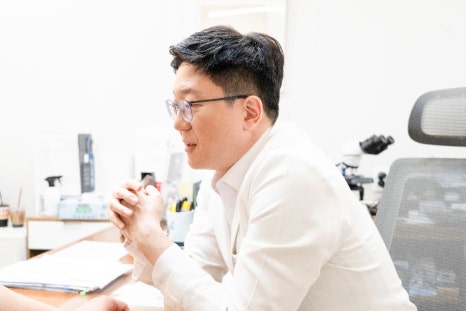
In acne treatment, prescription medication is a relatively basic treatment method.
Typical examples include antibiotics and vitamin A derivative medications.
Antibiotics can help suppress the growth of bacteria that cause acne inflammation.
In other words, this treatment focuses on reducing inflammatory reactions that have already progressed.
On the other hand, vitamin A–based medications help regulate sebum production and normalize the process of pore blockage.
You can understand this as an approach that eases the environment in which acne repeatedly develops.
These two treatments complement each other, so they may be used together depending on the patient’s condition, and the application method may vary depending on the severity of symptoms.
However, medication treatment does not produce immediate results in the short term; it requires a process of maintaining it steadily for a certain period and checking for changes.
Also, because the appropriate treatment plan can vary depending on skin condition, age, and lifestyle habits, it is important to approach it based on a professional diagnosis rather than making an individual judgment.
Treatment direction after treatment
Even after acne improves through treatment, the skin condition still carries the possibility of recurrence.
Therefore, post-treatment care can be said to determine the overall outcome.
First, excessive cleansing can actually weaken the skin barrier and further activate sebum production, so it is best to maintain gentle cleansing about twice a day.
Also, when the skin becomes dry, sebum may be secreted in greater amounts as a compensatory response, so it is important to maintain light moisturizing as well.
Rather than focusing only on removing oil because the skin is acne-prone, care should be aimed at restoring skin balance.
Along with this, it is helpful to reduce the use of oily cosmetics or products that may clog pores, and to control the habit of touching the skin frequently.
One especially important point is not to stop care simply because the skin has improved once, but to periodically check the skin condition and continue treatment if necessary.
When this process is carried out together, it can help lower the likelihood of acne recurrence.
Adolescent acne is a common skin problem, but if it recurs or inflammation becomes severe, it can lead to scars or pigmentation changes, which makes it a condition that should not be taken lightly.
In particular, prescription medication can be an appropriate treatment method, but because it is not applied in the same way in every case, it is important to approach it based on criteria suited to the current skin condition.
Also, treatment should not end with medication alone; follow-up care should continue as well in order to expect a more stable skin condition.
If acne keeps recurring and causing discomfort, rather than trying to solve it alone, I recommend checking your current condition accurately and setting an appropriate treatment direction.
I hope the information shared today was helpful for those who were looking for acne prescription treatment.
Thank you.
| This post was written for informational purposes in compliance with Article 56, Paragraphs 1–15 of the Medical Service Act. All treatments carry a risk of side effects and complications depending on the individual. Before treatment, please be sure to have 충분히 consult with medical staff who have extensive experience before making a decision. |