There are times when you happen to notice an area of skin with a different color while showering or changing clothes.
At first, many people think it is due to the lighting or regard it as a temporary change.
However, if the color does not return after a certain amount of time, it is a good idea to have your skin condition checked.
In particular, when there are no symptoms such as pain or itching, many people simply choose to observe it for the time being.
However, if the change in skin color persists or appears to be becoming increasingly well-defined, it is necessary to check the current condition of your skin.
Vitiligo is a condition associated with changes in the melanocytes that produce skin color. The treatment plan may differ depending on whether it is detected at an early stage or identified after some time has passed.
Today, we will explain the characteristics of early vitiligo symptoms and what should be checked before laser treatment.
-Omokgyo Station Dermatology Clinic Column Outline-
-
What does vitiligo look like in its early stages?
-
How is laser treatment for vitiligo performed?
-
What should be checked when experiencing early symptoms?
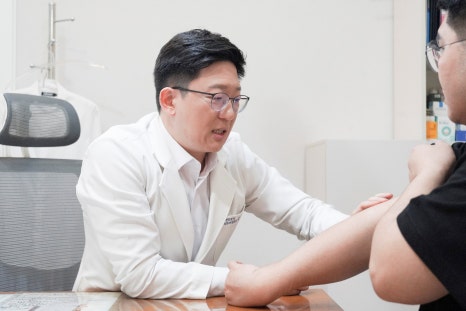

What does vitiligo look like in its early stages?
Vitiligo is a condition in which parts of the skin turn white as changes occur in the function of melanocytes, which produce skin color.
In its early stages, it often begins as a small spot or appears only slightly lighter than the surrounding skin.
It is also often painless and non-itchy, which can delay its discovery.
It may be found on areas that are frequently visible, such as the face, neck, or hands, but it may also be discovered by chance on the trunk, arms, or legs.
However, vitiligo does not appear in the same form in everyone.
In some cases, it remains largely unchanged for a long time, while in others, the affected area may expand.
Therefore, rather than looking only at the areas where the color has become lighter, it is important to assess the current condition of the skin as a whole.


How is laser treatment for vitiligo performed?
Treatment for vitiligo may vary depending on the current condition of the skin and the extent of the symptoms.
Excimer laser treatment is a representative method that uses light of a specific wavelength to selectively irradiate areas affected by vitiligo.
It may be used to stimulate melanocytes and help with pigment recovery, and is often used to treat vitiligo occurring in localized areas.
However, even with the same laser treatment, differences in response may occur depending on the location and extent of the lesions.
Some areas, such as the face, may respond relatively well, while areas such as the fingertips and toes may require more time.
Therefore, when planning laser treatment, it is important to first assess the current condition of the skin.

What should be checked when experiencing early symptoms?
In the early stages of vitiligo, it is important to determine whether the current symptoms are stable or whether the affected area is expanding.
We also examine whether any new lesions have appeared recently and whether there have been changes in existing areas.
The location of the lesions may also be taken into consideration when establishing a treatment plan.
In addition, family history, a history of previous skin conditions, and current health status are also assessed.
Most importantly, early symptoms should not be regarded as merely a change in skin tone.
Checking the current condition of the skin at an early stage and determining an appropriate time for treatment may be helpful.
This is because with vitiligo, the process of accurately assessing the current condition is important rather than simply starting treatment after time has passed.

Vitiligo may appear to be simply a change in skin color, but it is a condition associated with changes in melanocytes.
Because it often begins as a small spot, particularly in its early stages, many people do not consider it significant and overlook it.
However, if the change in skin color persists or there is concern that the affected area is changing, it is necessary to have the current condition of the skin examined in detail.
In addition, laser treatment for vitiligo is not applied in the same way to everyone; it may vary depending on the extent of the symptoms and the condition of the skin.
If you are concerned about changes in skin color, we recommend checking your current skin condition and then establishing an appropriate treatment plan rather than making a judgment on your own.
We hope today’s information was helpful.
Thank you.
| This post was written for informational purposes in compliance with Article 56, Paragraphs 1–15 of the Medical Service Act. All treatments carry a risk of side effects and complications that may vary from person to person. Before undergoing treatment, please consult thoroughly with a medical professional with extensive experience and make your decision afterward. |