When small white spots appear on the skin, the first thought many people have is, "It should be okay to watch them for a little longer, right?"
In fact, because there is often no pain or itching, many people assume they are simply experiencing a minor skin change and move on without further examination.
However, some people only visit a hospital later, after seeing the spots grow larger or increase in number over time, or noticing areas that had not been affected before becoming lighter in color.
Vitiligo is a chronic skin disease in which parts of the skin become white as melanocytes, the cells that produce skin color, decrease in number or lose their function.
Although symptoms do not always progress quickly, the speed and extent of change may vary from person to person.
Therefore, what is important is not simply whether spots have appeared, but whether the condition is currently progressing.
Today, for those considering vitiligo treatment at a Mullae-dong dermatology clinic, we will look at what it means for vitiligo to be progressing and what should be checked before beginning treatment.
-Order of the Mullae-dong Dermatology Clinic Column-
-
What kind of disease is vitiligo?
-
What should be checked in the early stages of symptoms?
-
What should be checked before proceeding with treatment?

Mullae-dong Dermatology Clinic Vitiligo Treatment: What Should You Check Before Symptoms Progress?
What kind of disease is vitiligo?
Mullae-dong Dermatology Clinic Vitiligo
Whether vitiligo is progressing can be an important criterion when establishing a treatment plan.
Vitiligo does not appear in the same way in every patient.
In some cases, small spots remain largely unchanged for a long time, while in others, new lesions may develop over a short period or existing spots may gradually expand.
At this time, it is important not only to look at the size of the spots, but also to check whether there have been any changes over the past several months.
If any of the following changes are present, it is necessary to examine whether the condition is progressing.
-
The white spots have become larger than before
-
White spots have appeared in new areas
-
Multiple spots have gradually joined together
-
The color of body hair or scalp hair has changed as well
-
New lesions have appeared repeatedly
As described above, the treatment approach for vitiligo may differ depending on whether the condition is currently stable or progressing, making it important to examine the pattern of change.

What should be checked in the early stages of symptoms?
Mullae-dong Dermatology Clinic Vitiligo
Not every white spot suspected to be vitiligo is caused by the same disease.
Changes in skin color may also occur with various skin diseases other than vitiligo.
Therefore, rather than relying only on visual judgment, it is necessary to comprehensively examine the shape and distribution of the lesions, as well as changes in color.
In particular, the course of vitiligo may also differ depending on where it develops.
Some areas, such as the face, may show a relatively favorable treatment response, while other areas, such as the hands and feet, may require a longer treatment period.
In addition, checking for a family history, the presence or absence of autoimmune disease, and any recent skin damage or repeated irritation may help in understanding the current condition.
Most importantly, the process should not end with determining simply whether it is vitiligo. It is necessary to accurately understand the current condition of the lesions.
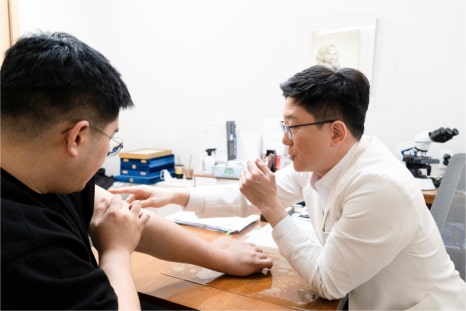

Before proceeding with treatment
What should be checked?
Mullae-dong Dermatology Clinic Vitiligo
For vitiligo, it is important to determine how much the condition is currently changing rather than focusing only on the size of the lesions.
Vitiligo treatment does not aim merely to restore the white spots to the surrounding skin color.
This is because the treatment plan and the way the course is monitored may vary depending on whether the current lesions are stable or new lesions continue to appear.
For example, the approach may not be the same when there has been little change over the past several months and when lesions have rapidly increased within a short period.
Therefore, even during the initial consultation, it is important to check not only the current extent of the lesions, but also when they first appeared and whether there have been any recent changes.
In addition, the treatment response and course of vitiligo may vary depending on the affected area, such as the face, trunk, hands, or feet.
If treatment is started without considering these characteristics, the expected changes and the actual course may differ.
Above all, what matters is accurately determining not merely the presence of white spots, but "what stage the vitiligo is currently in."
This evaluation can help establish a treatment plan suited to the current condition.
Vitiligo often causes no pain or itching, so in the early stages, some people may overlook it as merely a change in skin color.
However, even if the change is small, it is necessary to check the current condition if the lesions are expanding or repeatedly appearing in new areas.
In particular, because the speed and pattern of progression vary from person to person, it is important to observe how your own skin is changing rather than judging your condition based on someone else’s experience.
Rather than focusing treatment solely on improving the white spots, it may be more appropriate to first comprehensively evaluate whether the lesions are progressing and the condition of the skin, then establish a treatment plan. This can help determine a more suitable treatment approach.


Vitiligo Q&A
Q. Does vitiligo always progress quickly?
A. No. In some cases, it remains largely unchanged for a long time, while in others, new lesions may appear or existing lesions may gradually expand. The pattern of progression varies from person to person.
Q. Does everyone who develops white spots have vitiligo?
A. No. Changes in skin color may also occur with various skin diseases. A differential evaluation based on the shape, distribution, and course of the lesions is necessary.
Q. Should treatment for vitiligo be started in the early stages?
A. Whether treatment is needed and which method to use may vary depending on the current condition and pattern of progression of the lesions. Therefore, if vitiligo is suspected, it is important to first determine whether it is progressing and then establish an appropriate treatment plan.
Q. Once vitiligo improves, does it not come back?
A. The course of vitiligo may vary from person to person, and new lesions or changes in pigmentation may occur even after treatment. Therefore, it is important to continue monitoring the condition of the skin after treatment.
Mullae-dong Dermatology Clinic Vitiligo Treatment: What Should You Check Before Symptoms Progress?
| This post was written for informational purposes in compliance with Article 56, Paragraphs 1–15 of the Medical Service Act. All treatments carry the risk of side effects and complications, which may vary from person to person. Before receiving treatment, please make your decision only after having a thorough consultation with medical professionals who have extensive experience. |